From Johnson’s index to Mecklenburg subplot in Anniversaries
Notes (and quotes) on and by Mieke
Unlike Ingeborg Bachmann, who died in Rome, but is not buried in Rome, Uwe Johnson died and is buried in Sheerness.
She took this photograph of his grave – a pink granite slab, with only his name carved onto its face – and it sits over Solonga’s desk. It has become her talisman.
One of the Caspian languages an object cut or engraved with a sign or character under various superstitious observances something that produces extraordinary or apparently magical or miraculous effects truth is a talisman of which the charm never fails her pride as the sort of talisman that would save her from every kind of ill
On 25 October 1973 Ingeborg Bachmann, who died in Rome on 17 October, was buried in Klagenfurt, the city where she was born on 25 June 1926. On October 29, 1973, Uwe Johnson flew to Klagenfurt, and visited her tomb.
Viewing the site of her grave from a nearby bench, Johnson remembers Bachmann again:
‘above all one cannot have grown up here and be me and then come back.’
He composed A Trip to Klagenfurt by drawing from her letters, local papers, and his notes.
His little revenge for what they did to her after her death.
He is looking for traces of the dead poet and novelist, rummaging through newspaper articles, old letters, stories, poems that are ripe for abstraction, rife for quotation, constructing a collage of statistics, schedules, cadastral extracts – a patched together requiem for a friend who has been lost . . . not only lost, she’s been displaced.
It is so hard to slow down to the pace where it is possible to explore one’s own mind.
One absolutely must be a stranger to be able to stand a place like Klagenfurt for more than an hour.
After spending some time in New York, Johnson moved to the seaside town of Sheerness, on the Isle of Sheppey, Kent, in 1974. He was 40. It was a decision that astonished his admirers.
Characteristically describing himself in the third person as writing things down in his notebook. People still remember him. That old German writer. Something Johnson.
One absolutely must be a stranger to be able to stand a place like Klagenfurt for more than an hour, or one must live here always.
The inside page of a pamphlet distributed by the Carinthia State Tourism Office even has a sketch showing the lay of the city in a valley between mountains and next to a lake, but it just so happens that a mountaintop blocks precisely what you’re looking for.
‘Klagenfurt – The Garden City on Lake Worthersee’ is to be recommended, since the back page has a street map and the front has a list of hotels, as well as a depiction of the landscape by E. Kucher. You behold Mt. Maria Saal to the north, but again what lies at its base is obscured by crosshatches, and the instructive street map likewise suppresses any hint that there might be a cemetery here.
I wait not for time to finish my work, but for time to indicate something one would not have expected to occur.
Process is paramount.
Someone came up with the idea of putting the airport next to the cemetery, and the people of Klagenfurt always said that this made it easy to bury the pilots who flew training flights there for a while. The pilots were never considerate enough to crash.
One absolutely must be a stranger to stand a place like Klagenfurt for more than an hour, or one must live here always, but above all, one cannot come back.
When she was three years old she taught herself to read.
When she was six, her family moved to Wognun.
Mieke was a brilliant student, one, according to a classmate, who sucked up vast amounts of knowledge.
On her eighth birthday, she announced to her family that God did not exist.
She spent some time in South Africa where she got married and where she got divorced. She also went to India, and, according to the friend with whom she went, she fell in love with the works of Nasreen Mohamedi.
She admired the severity of the drawings, but she could also see the poetry behind the lines in every piece, especially the photographs, which Mohamedi kept private all her life; she never intended for people to see them, probably because, despite their formal qualities, and however abstract they may appear, they are in some way ‘about’ the world.
I once told a South African friend about the relationship I had had with my South African husband. I told him why we broke up and that I couldn’t deal with his disillusionment and that being disillusioned had broken him down and that I was another contribution to the collection of disillusions. He replied that it was the stupidest thing in life to be disillusioned because one shouldn’t have illusions in the first place. I felt upset.
Mieke’s death was not a tragedy. Her life was not meaningless. It was good.
She made the choice she thought she had to.
She was intrigued to read about Mohamedi’s experiments with sound.
Silence oasis in acoustic parks.
The way she liked to capture the noise of banal activities, such as the screwing up of a piece of paper or a knife being dropped on a stone floor.
Recently Mieke came across a passage from Nasreen’s diaries. A friend recalls that she was very moved. According to this friend, she said Nasreen’s death at the age of forty-five was not at all surprising, that if you added up the numbers it made sense.
These little human markings done in pencil, barely even present.
In late 1994, Mieke returned to the Netherlands. She had decided to study photography at the art academy at The Hague.
Wednesday she was wrapped in a shroud from her own clothes made by the friend with whom she traveled to India.
She spends her time mostly alone, and after high school takes up drawing, then photography. She is interested in all those people who we see around us every day who live and die alone. She observes them when she goes outside, sitting in parks on benches, eating at a restaurant, carrying a grungy tote bag filled with food and papers as they cross the street, a rucksack on their backs as they enter a museum or a gallery, sitting in the very last row of a cinema watching a movie, wearing clothes that is slightly worn out but somehow nice as they sit beside her at a theatre or a concert, sit and read the paper at the library or a bookstore, sit beside her on a plane, their eyes are sometimes closed and they will never talk.
With this series of photographs made between 1998 and 2001, Mieke Van de Voort allows us into the private lives of the recently deceased. Carried out in collaboration with Amsterdam social services, the project shows the interiors of apartments just as they were found by social workers who were researching the identity of people who had died without any known friends or relations. Within the context of a wider examination of the isolation and anonymity that affect city-dwellers, Van de Voort tries to preserve both a physical and a spiritual trace of people forgotten by the world, people who died in complete solitude.
When one looks at these images it is easy to think that they have resigned from society and given up on order and structure in their own lives as well. The rooms certainly don’t look like the inhabitants were expecting any visitors.
She’d been reading quite a lot of Uwe Johnson, even visiting his grave in Sheerness, taking photographs. She thought she would explore his work, get a feel for his life when he was living in New York, and maybe write an essay.
In early 2002 she moved to New York City, having managed, with the assistance of her close friend Geert, to sublet an artist’s loft on Mary Street.
She needed a break from her life in Amsterdam. She needed something else. A new start.
She was helping her friend curate a show in the Village.
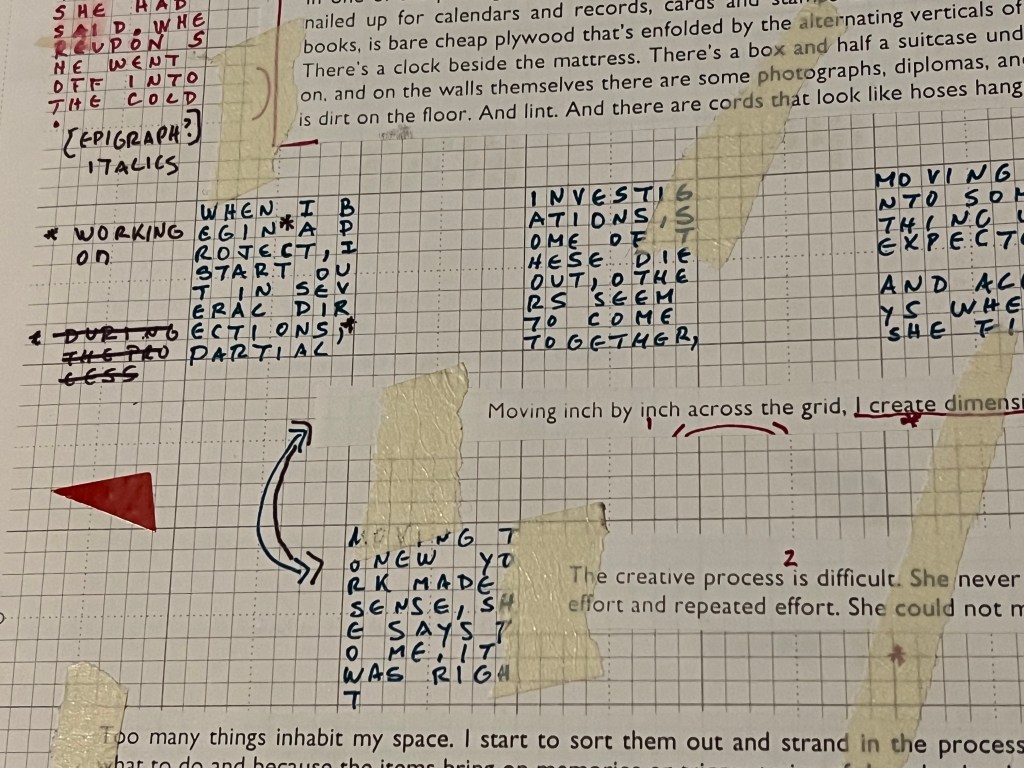
I create dimensions out of solitude.
No more than two on every wall. At least four and a half feet apart.
Out of these concentrated difficulties, drawings, calculations, frustrations and despair, one arrives at something very simple.
Her clothes, her beauty, her tightly braided hair.
None of the photographs sold, but I was told that they were very well received, that people would come back and they would sit or stand before them quietly and they would look.
Moving inch by inch across the grid.
This being so. And after nine and thirty years. Because I must.
Mieke ended her life a few days ago. Her father and her mother accept her decision.
But the panic attacks. She was already depressed. And what can one do? Psychiatrists give a pill and all creativity is slain.
I have a specific relationship with newspapers. I am never able to read them for more than a few days in a row. But I don’t throw them away because I think I might still read the bits that I didn’t cover and the ones I didn’t read at all because I am sure there are lots of interesting things inside. By the time the pile grows larger than myself and falls over, I start negotiating to get rid of it because I get tired of restoring the pile each time a tram comes by and not having read the papers and adding more to it. The passing of time is manifested in the pile and I don’t find reconciliation.
Most of the houses were quite messy, but the messes differed in quality. For example, many ‘pretty’ things such as tiny sculptures and paintings and furniture, nicely displayed but too many to be able to appreciate, gathering thick layers of dust.
After a long period, despair, but a kind of despair which is slowly reflected and finally, after long delays into the night, understood.
In one of the photographs, there is a wall, and hanging askew, between two large unshaded windows, the light caught streaming in, there is a cross, and on the table, there is a pair of unlaced boots.
Nine days earlier she ended her life. I read about the cremation in the newspaper. I was traveling by train. There were two other people in the car, a man and a woman, traveling by themselves, the man reading a book and every few minutes delivering himself of an enormous sigh. I began to think of it as something that was required of him, of a breath, something like a breath, much the way that pauses in a piece of music help enact its rhythm, while the woman sat stock-still throughout the trip and gazed outside. Occasionally she would move to smoke a cigarette or use the toilet, nothing else.
Some of the houses I photographed were almost empty. On the wall only a cut out newspaper photograph of the previous queen, nothing more personal than that.
She is already depressed. They fight each time that they go out. Things are not too good for them. He says he thought her smile was real. And there are the panic attacks, he doesn’t know what to do, not anymore, not like this, they are becoming much more frequent, how he should attempt to handle them. Usually he just leaves and sees his friends until she’s calm, back on the drugs the doctor says she needs. He adds, she has her camera. She can look at things. This must be a help, being an artist must be a help, I think it must be a help. It must be grounding, though I wouldn’t know myself, of course, he says, that’s not my thing. But we both care about the world. We have that.
She is staying in Solonga’s loft. Solonga’s table all in white – white painted wood (it might be larch). I sit here and I try to write. Her work, from what I see: Black Mountainesque constructions made of wood and paper and of trash. But clean, austere and white (she paints them white).
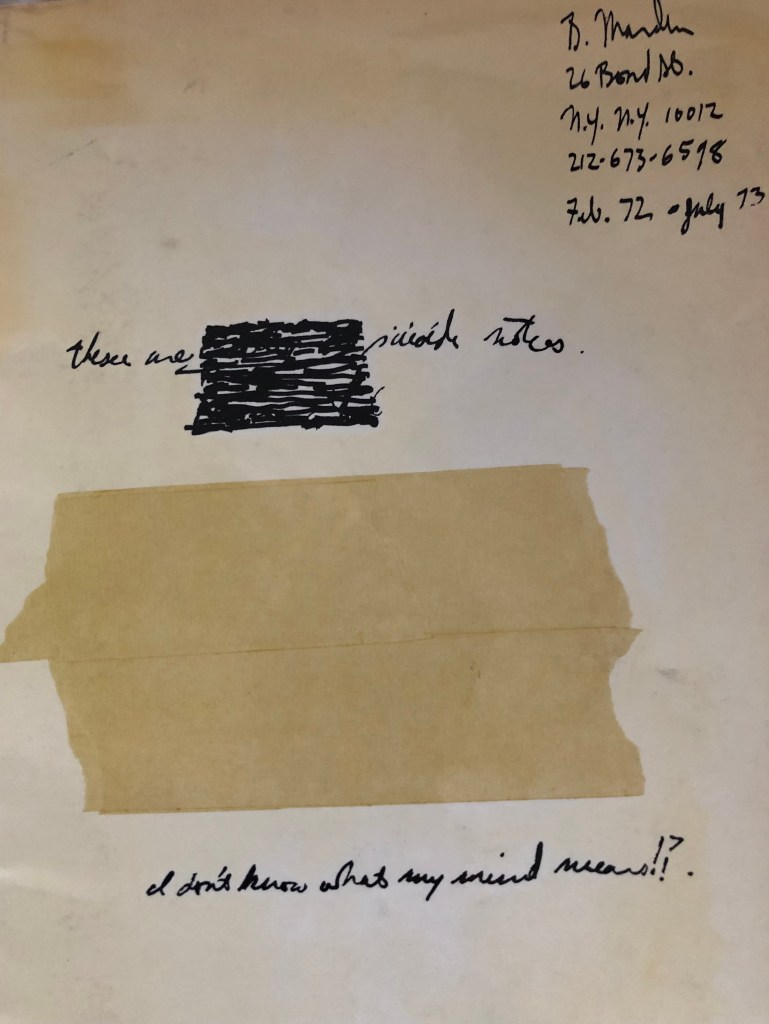
This is to be a sort of diary or book of notes (a window molded out of blood) from my time, when I was living in New York.
A small table is covered with beads – small brown ovoids, spotty against the black – over by the window, a translucent curtain blown, hovering as light in gentle slants, it breaks over the floor piled high with stacks, mostly newspapers, either collapsing or collapsed beside a small metallic bed frame with a mattress pushed haphazardly against the wall and several books. The sheets are crumpled and dirty. A camera can be seen to peer among the folds. The ceiling has been painted white.
Too many things inhabit my space. I start to sort them out and strand in the process because I can’t decide on what to do and because the items bring on memories and trigger trains of thought that I can’t stop.
But I forget what I was doing. So many unfinished stories, where is the beginning, where are my plans? The mess inside me multiplies the mess inside my head. I forget who I am. How did these things enter my house? Who was I when I brought them in? How did I become so fragmented?
In the bedroom, I found a walkie-talkie on a blackened pillow, half-finished paintings and a half-empty bottle of milk.
I used to have a friend long ago who only possessed as many things as she could carry by herself.
I once read an excerpt of a novel, I think it was by Paul Auster, where the protagonist creates structure in daily life by organizing things in terms of color. For example: Monday’s dinner: only green foods. Tuesdays dinner: only orange, etc. Limiting choice by color.
And there are the colors in my photographs. The blue carpet with the subtle patterns. The beige curtain. The white of the radiator darkened by a shadow that’s been cast. And the light. There is always the light. Except for all those rooms where the books are kept in cases and the blinds are always shut.
In one of the photographs there is a mattress pushed against the wall and some of it below the warping board nailed up for calendars and records, cards and stamps and boxes, little folders, cut out squares of newsprint, books, is bare cheap plywood that’s enfolded by the alternating verticals of beige and white that paper all the walls. There’s a clock beside the mattress. There’s a box and half a suitcase underneath the metal slab the mattress sits on, and on the walls themselves there are some photographs, diplomas, and some hooks. The bed is a mess. There is dirt on the floor. And lint. And there are cords that look like hoses hanging from some pipes.
The creative process is difficult. She never thought it was good enough. She complained about the blocks. It is also effort and repeated effort. She could not make something and then enjoy the whole process of its creation.
In one of the houses I found a note on the wall, saying:
and when I am dead
don’t be sad
for I am not really dead
you should know
it is only my body
that I left behind
dead I am only
when you have forgotten me.
I wondered if anyone else but him had ever read that note and if there was anyone to make sure that he wasn’t really dead.
She spends her time mostly alone, and after high school takes up drawing, then photography. She is interested in all those people who we see around us every day who live and die alone. She observes them when she goes outside, sitting in parks on benches, eating at a restaurant, carrying a grungy tote bag filled with food and papers as they cross the street, a rucksack on their backs as they enter a museum or a gallery, sitting in the very last row of a cinema watching a movie, wearing clothes that is slightly worn out but somehow nice as they sit beside her at a theatre or a concert, sit and read the paper at the library or a bookstore, sit beside her on a plane, their eyes are sometimes closed and they will never talk.
Notes by Mieke.
The photographs are not staged. They are what they are. And yet they are composed. A chosen angle, slant of light, a juxtaposition of textures, colors, objects given somehow leave to make, even if it isn’t speech, a kind of noise. I am responsible for how their lives will look, with how they’ll be preserved, perhaps remembered if there is anyone around who will recall that thing they took such pains to make in private, what we often label ‘lives.’ I try to draw an index here.
A woman found in an apartment down the street, dead she’d been for thirteen days. It was a waft beneath the door that moved a neighbor to get quickly to the phone, a waft that let the landlord in, and the police to find that she had ‘died in the bath’ and no one earlier to wonder where she was, to make a call, drop by, or knock. She lived there thirty years, so quoted in the Times, and no one even knew her name.
I have a specific relationship to newspapers. I am never able to read them for more than a few days in a row. But I don’t throw them away because I think I might still read the bits that I didn’t cover and the ones I didn’t read at all because I am sure there are lots of interesting things inside. By the time the pile grows larger than myself and falls over, I start negotiating to get rid of it because I get tired of restoring the pile each time a tram comes by and not having read the papers and adding more to it. The passing of time is manifested in the pile and I don’t find reconciliation.
Notes (some quotes) by Mieke
‘I like it that art is anonymous.’
‘Our dreams in the one life given to us
Have no boundaries, unlike this sky
We sought a heaven first,
And now discover heaven is empty,
Empty and yet crowded
Our offspring by our death will find new life there
We shall not see the purpose
We fulfill it
Outside the stars
And at the speed of light we arch across the void
Yet we seem motionless on a world, a grain of sand
Where time, a human construct,
Has stopped and died’
‘I think that all art could be anonymous so that you just look at the art, there’s no story.’
A Note by Lee Lozano
‘Finally I must say something about why I write in such small books. It is to encourage myself to maintain terseness.’
A (quoted) Note on a Statement by Ray Johnson
‘Taken from Johnson’s “work table” box. Johnson mentions this Yiddish-English dictionary several times in “Should an Eyelash Last Forever?” For example: “So I’m cutting these things out block by block and doing Yiddish dictionary information the way I did the American dictionary, which was long before Kosuth. I methodically went from A to Z and simply cut out these blocks of information and endlessly glued them down or attached them with Scotch tape.”’
A (quoted) Note about Ray Johnson.
‘Johnson at times used his Correspondence art to air what appeared to be very private messages.’
A Note on Magda by Mieke
That’s what she said as she cut and pasted notes and pictures (and there were also several drawings) onto the newest version of her guide to the city of New York and its life. Always reworking the pages, studying their surfaces with the fingers of her hands, looking straight into the chasms and then smiling, though this smile was but an automatic response, a reaction to the sweep of unspoiled air that breezed across her face and then flew by. It wasn’t like this anymore, she said, and this was good. Or at least it was fine. She accepted it. And shouldn’t that be enough? And it was enough. And she was right. It was the paintings and the rhythms of the words that really counted, as they fell backward, opened, and provided a place for us to sleepwalk into. This was, indeed, true, she felt. It was right. And she’d been noting things that linked them all together, both in marginal notations and her notes, for some time, tying their lives together like a string, stringing their deaths up on a line that you can walk along and post things, add things over, write on.
A picture held us captive. And we could not get outside it, because it lay in our language and language seemed to repeat it to us inexorably. – Wittgenstein
A Note on Ernst
The writing about writing about art becoming art itself, in itself as art, as writing, as notation, as the noting of notes as notes and nothing more than notes, nothing notes, notes about nothing, the nothing that is noted and again as rhythm as movement as writing as notes on notes as notes as noted down but not transcribed but expressed, as something made and nothing referred to and as yet it is that something that nothing is as noted as written as seen and maybe heard in how it moves and doesn’t move, in how it’s here. This is how he drew it, what he drew, the way he wrote when he was here.
A Tape Recording of Ernst
from an interview discussing his work habits and procedures my almost fanatical obsession regarding pens fountain, felt, fine tip I like to vary and make to mark an almost calligraphic glide and swoosh over the surface of the page I move my hand and something else appears, something happens only later do these somethings begin to take on the images of letters and of words a movement often indiscernible
A Note by Ernst
askew slanted and lopsided, almost falling down
but not like this a hissing informality of gesture. It is like that picture I have framed over my desk a brick wall it’s conspicuously hanging off its nail trying to fix the gestures into words that don’t just garble themselves in the mouth of sense but spit themselves out into a line that doesn’t contour but invents. This might very well be what I mean if I were to mean or if I meant or if I wanted anything besides the frisson of seeing the line invent as I hang by, passenger-like, merely following along agog at what is or might be happening or not as I glide and float and stop after a flop and quite a stutter and begin to paint over the line itself, to let the Liquid Paper cross it out, enfold it into an opacity, an all-too-narrow space that isn’t space at all but only surface and surprise and letting color, or the lack of color, hang its head and rest, if only barely, as my own hung on last night, my ears and mind and chest taking in the sounds of these Nordic fellows playing B’s quartet as the movement, the almost of it, quiet, moved around it in itself in shades and almost stopped.
A Note on Ernst
Gray white beside black plane which hovers over thick and ropy streak of bleeding red into the yellow echoed in the ghost-like play of scratched off letters, almost words, a syllable, an almost “well” without the “e”
His way into the paintings, Webster’s Third. Patiently, he fills the surface, every tiny canvas little script, meditating copy path and valley of each word, read the map of its contortions smooth as color sounding muddled sense of sense, trying never trying he could fill his “little etymologies” of paint.
internal illustration from J. H. Prynne’s Into the Day, 1972
‘He drew a distinction between “the voice of the poem” and “the voice of the poet … an accident of biography … which does not interest me”’
in order ‘to establish relations not personally with the reader, but with the world and its layers of shifted but recognisable usage.’
‘Although the neurochemistry of the brain, medical operations, the inner structure of the ear, wounds, sutures, and corporeal forms of opening and purchase are all mentioned, the presence of actual human beings is largely absent.’
‘Subjectivity is radically dislocated, with the “I” becoming a largely impersonal pronoun.’
‘For Prynne, poetry only becomes real work when it has exhausted all the possibilities of the common idiom in which life has so far been lived.’
‘According to Keston Sutherland (another ex-student), “poetic thought” in Prynne’s sense of the phrase is located “at what he has called ‘the borders and edges’ of language, that is the vastest and most nearly untraversible distance from the material corruptions of workaday language, which Prynne in 1986 called ‘the false & corrupted idiom of residual, vernacular commonalty as almost pure cant‘.” ‘
Opposing this with something else
‘which he described in a letter to Andrew Crozier as the “retrospective formalism of the occasion.”’
“By opening onto an elsewhere, an excess, a beyond, Prynne’s work, in spite of itself, has explored the conditions for the language that speaks always too early, or too late.”’
“In Prynne’s poetry, obscurity is combined with excess: there is always more language, more reference, more signification in an expenditure which may or may not be concerned to recuperate some core of meaning from its riot of utterances.”’
‘His is the first poetry to exercise the full potential of the written language. … [It] excises completely the role of the poetic “voice,” whether as a personal or as a synthetic medium of expression, and so it moves beyond the range of purely aesthetic effects. His poetic form offers a writing that calls into question our conventional response to what we think of as “poetic” and what we think of as “non-poetic.”‘
‘Forrest-Thomson offered a similarly salient explication in terms of “the minute attention to technical detail which, together with tendentious thematic obscurity, gives the poet a way of recapturing the levels of Artifice, of restoring language to its primary beauty as a craft by refusing to allow its social comprehension.”’
‘I have found the most productive approach to Prynne’s poetry is simply to keep a copy of the Oxford English Dictionary nearby and to pay close attention to each word as it is laid out on the page, especially the calculated deployment of italics, indentations, line breaks, and punctuation.’
‘Difficult ways of speaking about a complicated world
refracting any easy access to intelligibility with an exasperating beauty.’
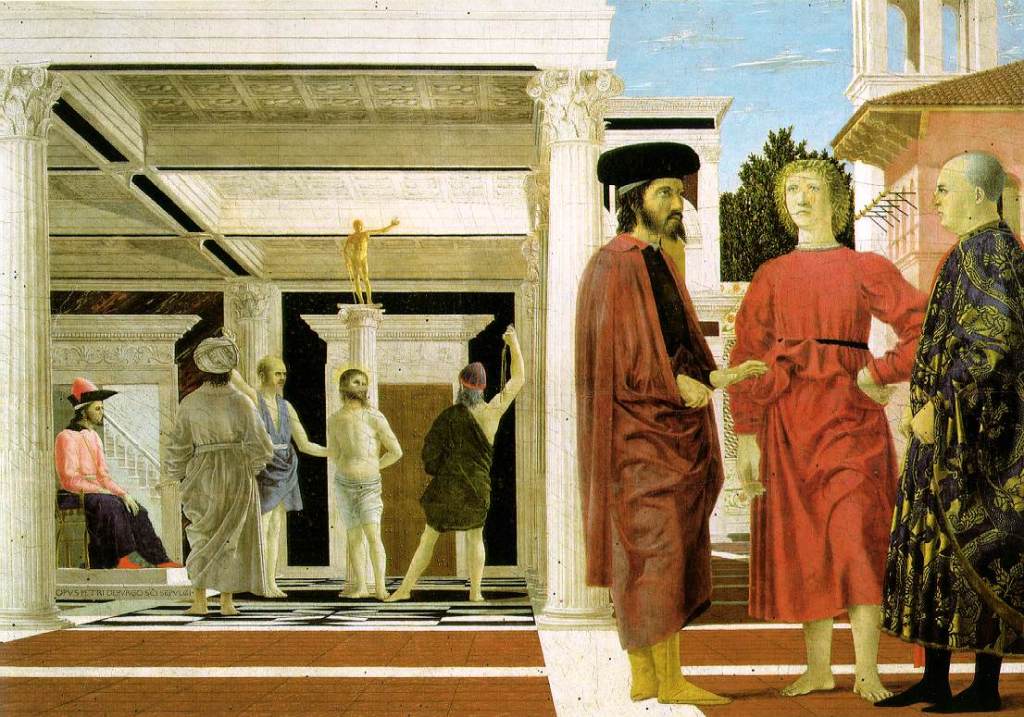
If art is self-effacement to begin with, no one who has not experienced something of this will understand, the word that comes closest is perhaps touch, the ephemeral feel of the pencil in my hand as I write. Now you are writing things down that you read, making “arrangements,” drawing from a notebook, drawing from a notebook, composing, trying not to think “composing,” what in the end (and trying not to think this too) it may be junk. So be it. Rule: Go to extremes. Keep doing these kinds of things (kinds of things), going forward by going back, shifting things but just a little. Choosing not to write in ink. I chose some months ago not to write in ink. I prefer [It prefers] pencil. Ink is good because it forces you to make decisions, to decide, to “stick” to things, but the provisionality of pencil (“to erase”) allowing you to layer [allowing it to layer], palimpsestic spaces – flat – on the surface. Ghosted words held down and spread. I have a pretty palette. It isn’t my vocabulary. I never steal. I write. Sometimes he can’t read his own . . . hand. The notebook entries going every other way – intersecting at the oddest angles – quoted passage fading into something just arrived at, “fresh.” He convinced himself he was Piero. You’ve been following his voice and he convinced himself. He leaped, or so it appeared, from coal black, blocky, head-like masses on wintry gray grounds to . . . There were no bridge paintings in the show. His past – hoods and pink cities – emphatically over, a switch installed on his telephone so he could turn it off. Now, blocky shapes, open brushwork, blocks had become people and things, boxy cars, Krazy Kat mesas, heavy black outlines, “Hoods.” And, of course, they do evoke the comics. Clunkiness stands as a blunt reminder. Free hand drawings. He had been led by the cockeyed landscapes of Surrealism, not the flatness of Cubism. His abstract paintings, with their “hierarchical attitude toward form,” preserved the distinction between foreground and background that belonged to the history of figuration where the picture plane is not essentially flat, called up the visually distinctive, thematically quirky older strips of the teens, twenties, and thirties. And, evidently, the opening night of the Marlborough show was unpleasant. “Well, let me just look at it another minute.” He wanted to tell a story. Not just “diddle around” with placement, color, formally imperative determinations. Discriminations were emerging, the making of the surface in itself a palette, “getting close,” not pulling back from what he’d done till it was “finished.” [It was finished.] And he brought this new immediacy to tell his stories, which in time became more personal, increasingly isolated – a large yellow wheel against a flat red surface. He was dead. And she was still alive, though barely. Muse. Entering the city once again at times, collecting knick knacks for the barn, and making coffee. I can see her sitting in the kitchen drinking coffee in her cup and looking out the window at the snow, the birds pecking ground. The way he used to sit there late at night. Drink. All I can do honestly is give you my questions. I hope you will find some use for them. That’s all I can do. You take the greatest thing and turn it into a banality. By repeating. Right now I’m passionate about what I’m going to do. But after some years, I’m under no illusion. I don’t even want to talk about it – where I’m going, might be going, where I’ve been. It snowed today. I was just outside. The birds were almost quiet. If I could stay with what I’m doing. If I could stay. I don’t want to be unhappy – stuck or stopped – but you have to be more explanatory. You can – if only you could know this, understand what I’ve been saying – help me. But you can’t. I want to be more specific. Really I do. I’d like to give you details – how the heads began to happen – but I can’t. I want to answer all your questions. But I was only working towards an image. And it bothers me. It does. The head. That bothered me. This area, this world, the rectangle. Afterwards I got real critical. A rough period. I drew. I had to draw. For a couple years. But then you already knew that. Things. And I was worried, instinctively I mean. I was worried. I felt eaten alive by all this. Something was bothering me. Like this finger . . . here. A picture of me, a self-portrait – a head, a hand, a brush. But what I want to know. How do I know? To see what happens, what will hold. There’s no such thing, you know that, painting now. Not anymore. I mean, who’s a painter? I don’t know anymore, Chuck. I really couldn’t tell you. Try and torture me. I really couldn’t say. You put your finger . . . Right, I know what that picture is. I didn’t paint it. It moved right through me. And then, like a dope, for six months I tried to do more. Then I got the black, I got into the mud, the muck, once again. Chaos. I had a kind of breakdown, had to stop. You have to be more alone to paint. I feel more alone now. It is a joy to be with (near) you. It is important that the act of preservation (writing is continuing) as a type of obscuration (Auskratzen) is presented. To originate is carefully, patiently, lovingly, to combine. Invention, and we must remember this, means finding. What am I looking for? It’s like the zoo after hours. The facts talk to one another. Begin the story of arrangements. Portraits inseparable from prayers. We have all, of course, had childhoods. Composed in ink on uniform sheets (on a grid), stab bound, tied with string. Something in the way the elements of the music are chosen, something unrecognizable, a signature, a voice. Notes. Poems hung on walls like windows. Not that I had ever thought of painting. I think that you will like it. A word, precisely placed, describing itself. And people said of me one night . . . The cathedral is across the street. Solitary lead marks. Pages now appearing empty frames. “Distance lingers in her hand.” A hand like his remembering over her breast that afternoon on Mary Street, the old Mary Street, not even on a map back then, unfolds to almost speak (foreignly, familiarly) their own. And instead of turning the page when it is done, and looking over at the desk, she places the card on the chair, through the window: cobbles catching fire (glass). And though the glass is mentioned, it is not present, but abstract. Something abstract. Not exactly here. There. Perhaps this will be a big book of very little definition. Perhaps. An improvised paper on hermetic poetry. In spite of all my talk about the way the page looks, and particularly in regard to these pages being constructed as if they were a sort of drawing – strangely, the strongest element I feel when I am writing something is acoustic, something hopelessly mixed (naturally), and at the same time, hardened. I feel I’m losing control to gain a surface. The boards along the wall like glass. But the feeling for seeing in a poem, where the plane of color changes (childhood) the second word on top of the first, an allusion to leaves, conjuring a space. Among the gaffes and bungles, I think there is the occasional apercu of disintrication, thinking always of the fringes, cold walks, lines leading nowhere. So things are, perhaps, a little less wretched, but I feel now (what have I discarded) that something large, which was squatting on me, has stood up and waddled away – margins, notes, ineptitudes. Nothing was completed but a lot of sketches, doodlings on a grid to pass the time – sloppy clit-like drawings, pulse-like strokes and stem-like patterns, edges left in raw, letters verging loops done slowly fainting pencil, cocks. Skewed, dynamic, meter shift, transcribing flattest ink and scoring cardboard (scribbling notational images), thickly marking margins, surfaces in horizontal loops across a chalk-white glaze pressing, rhythmic, smeared, irrelevant to private space, exuding and compressed – a long private conversation. Modesty, care, a kind of helplessness. You can see the prose stepping off. Forgetfulness. I make these drawings when I write. Collage. Intense selection. A collection of torn sheets, fragments, moving things around this floating world.


 marginalamericannotes.com