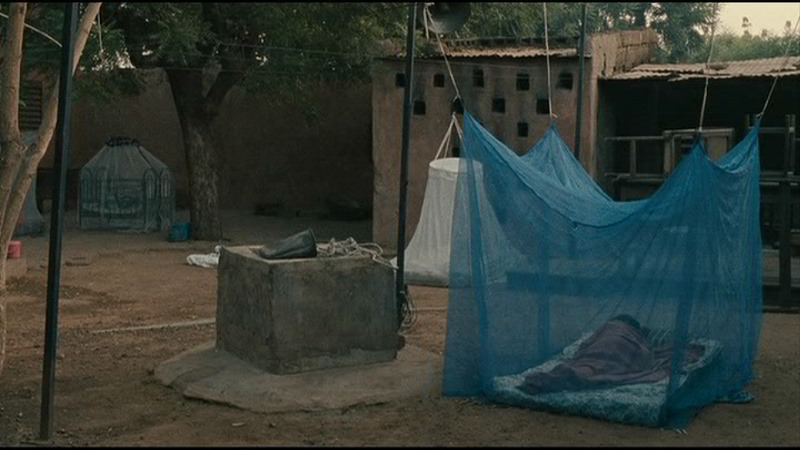
BAMAKO (notes on place)

still from Bamako

‘And to help someone hear, you have to give them space.’ 

Something that exists around, something that creates a distance, let’s one see.

‘lady, my things

 water leaden

 my maps, my compass

 after all, what is the political position of stars?’

‘She was praised for the way she analyzed Aristotle’s definition of place in the Physics. Each thing exists in place. Each thing is described by place.’

‘In spite of this, there are many important technical advances in The Threepenny Opera. The curtain appeared to be nothing but a dirty sheet drawn across the stage. A fair-ground organ stood at the back of the stage, with a jazz band on the steps in front of it. Coloured lights lit up when the music played. Free use was made of titles and drawings projected onto screens in red satin frames on either side of the organ, and mock-religious signs were pinned on Peachum’s walls, such as, “It is more blessed to give than to receive” and “Give and it shall be given unto you.” By these means, the audience was persuaded to practise Brecht’s notion of “complex seeing.”‘

The newscaster, having just announced what is to come (the slated ‘feature presentation’), clearly troubled—eyes widening discomfort—as the camera does not cut away as scheduled, is forced to resume her pleasant smiling for the audience (the villagers are gathered here; they’re getting comfortable as nighttime comes, gathering before the glow of it—the set); clearly, her patience has been worn, she’s overtaxed beyond endurance by these awful awful (how absurd this is, how absolutely . . . unforgivable, how unprofessional, how backward) “technical difficulties” soon resolved with PRESENTS superimposed on a sub-Saharan landscape—a single picture-postcard—trunk and canopy—a tree rising (just above) the pleasant, calmly flowing waters (following a wide panning shot of the ‘set’, a medium shot of the man and his horse), underneath which (we can see him sitting: a tight shot, yes) Danny Glover (freeze the frame to show his name), every bit the movie cowboy, loading up his rifle, looking serious, a little troubled, deadly if the need for this should ever come (a black John Wayne, a black Clint Eastwood, Cary Cooper, Jimmy Stewart), every bit the star (the film within the film intends for us to notice this; we do).

And yet.

‘The next step we must take is to see in how many ways one thing is said to be in another.’ 

‘It is important to remember that Aristotle is not offering a theory of space. He hardly ever uses the Greek word for space, and his view of space is to be found in his discussion of spatial magnitudes. He is here offering a different notion of place.’ 

‘I have lived in the States, in New York, and in Europe—London and elsewhere.

You stress place, it seems.

‘Drawing equally from declamatory African traditions and European modernist procedures, Bamako stages a kind of Third World Epic Theater.’ 

I thought you wanted to know my history.’ 

‘That is why these have contact: it is organic union when both become actually one.’ 

‘Brecht’s stage was to be stripped of its theatrical magic, and the audience refused the state of emotional, empathetic trance, a degrading condition he associated with what he called “Aristotelian” theatre.’ 

‘It’s worth knowing that I called upon judges and professional lawyers and also real witnesses. I worked a long time with them. I decided what the framework of the proceedings was going to be like and then I let them put it to life.’

‘[A] young man testifies to how he and a group of fellow migrants barely survived crossing the Saharan desert, leaving one young woman [masquerading as a boy] behind. His testimony is sullen and flat and frankly rather dull by conventional movie standards.’ 

Heavy, red, streaming dye into the gutters, a lengthy piece of fabric curtaining the screen, hangs.

‘Sissako textures these dense, splendidly performed monologues with lyrical interludes and harmonizing mini-narratives,

‘He also fleshes out the film with a few scripted story lines, which he called “attempts to maintain the viewer’s attention.”‘    

‘Mele is a bar singer, her husband Chaka is out

of work

and the couple is on the verge of breaking up

In the courtyard of the house they share with other families, a trial

court has been set up. African civil society spokesmen

have taken proceedings against the World Bank and the IMF whom

they blame for Africa’s woes   Amidst the pleas and 

the        testimonies, life goes on in the courtyard.

Chaka does not seem to be concerned by this Africa’s desire to fight

for its rights’ 

‘This narrative is advanced only intermittently and ends in a death as unexplained as it is shocking.’

snatches of daily life that supplement and underscore the meta-legal procedural.’

‘But then Sissako cuts elliptically to a re-enactment of the young woman left lying among the blinding sands, surrounded by scavenger beetles’—a shadowy white screen, spotty, tinted, irregularly black.

‘This film is linked to my desire to film in my father’s house, who has passed away . . .

‘Where the grandmother grafted the citrus [and] the graft remained staunch.’

It’s a plain house, made of earth.”’

‘Afterwards, I understood that I could perhaps go further if I gave up the idea of a single space, one theatrical setting.’ 

‘So the role of the western in this film is to create space.’ 

‘I wanted the lives of the people living in the courtyard to echo or interfere with the speeches delivered at the bar.’

‘It was impossible for me to imagine this trial anywhere but within a real living space.’

‘I fired at one and I got two!’ the black cowboy laughs.

And the children (laughing) watch.

‘So, I saw this western sequence as a metaphor of the World Bank’s or the IMF’s mission carried out jointly by the Europeans and the Africans.’

The cowboys, like the jurists who exist at the bar inside the courtyard, are superimposed, are simply placed there—grafted onto the land.

‘Even within our imaginations we are raped.’

‘Nightclub singer Mele and her unemployed husband Chaka are quietly drifting apart and pondering the future of their young daughter Ina.’

‘We used four video cameras and a sound recordist, deliberately letting them be visible on the screen . . . in the same film, we had professional actors and actual lawyers, judges and witnesses, people from the neighborhood, and members of my family.’

The film fiction, like the documentary fiction, unfolds side by side with village life.

‘Artworks that negate meaning must also necessarily be disrupted in their unity; this is the function of montage, which disavows unity through the emerging disparateness of the parts at the same time that, as a principle of form, it affirms unity.’ 

“At first these vignettes seem disjunctive, but Sissako returns to some of them, creating a visual rhythm, and from that a sense of space and place: a community constructed entirely by cinema.’

‘So the role of the western in this film is to create space.’

‘Why should the fate of a people depend on their ability to buy and sell abroad?’

‘Sissako’s primary skill as an artist is his ability to convey total worlds while maintaining a formal porosity that accommodates the displaced, the traveler, and ultimately the impact of the West.’  

‘Negation of synthesis becomes a principle of form.’ 

‘Another mass product of Western industrialism, it has gone on a triumphal tour of the world, crowding out and defacing native cultures in one colonial country after another, so that it is now by way of becoming a universal culture, the first universal culture ever beheld.’ 

‘I’m stirred by the bluntness of Bamako’s address as a formal strategy and emotional effect, yet I’m nagged by the question of how it speaks to Africans.’ 

‘At one point, a couple of guys sitting outside a building reach up and turn the radio off, as the trial “is getting boring.”‘

‘I wanted to disappear into shiny, unreal objects.’ 

‘Speaking in a straightforward way is extremely difficult these days’ 

‘An elderly Malian man delivers his testimony as a mournful folk song.’

‘For me, we had to film the trial as one would a documentary: a scene couldn’t be interrupted, a witness wouldn’t have been asked to repeat a sentence and we let the court president and the lawyers listen to the testimonies and intervene as they saw fit . . . outside the trial, we chose a fictional scenario, with a shooting script, reverse angle shots, master shots . . .’ 

‘The hope is that by listening and failing to understand—by taking that profound ignorance on as our own wound—Western ears might at last take in something radically new.’

‘Sissako doesn’t bother with subtitles.’ 

Even the way the titles come up at the end of the western sequence (‘Directed by . . .’) after ‘something’ has ‘happened,’ after the audience has been absorbed into the scene, reeks of Brecht. 

‘So the role of the western in this film is to create space.’ 
NIGHT : Notes from Notes

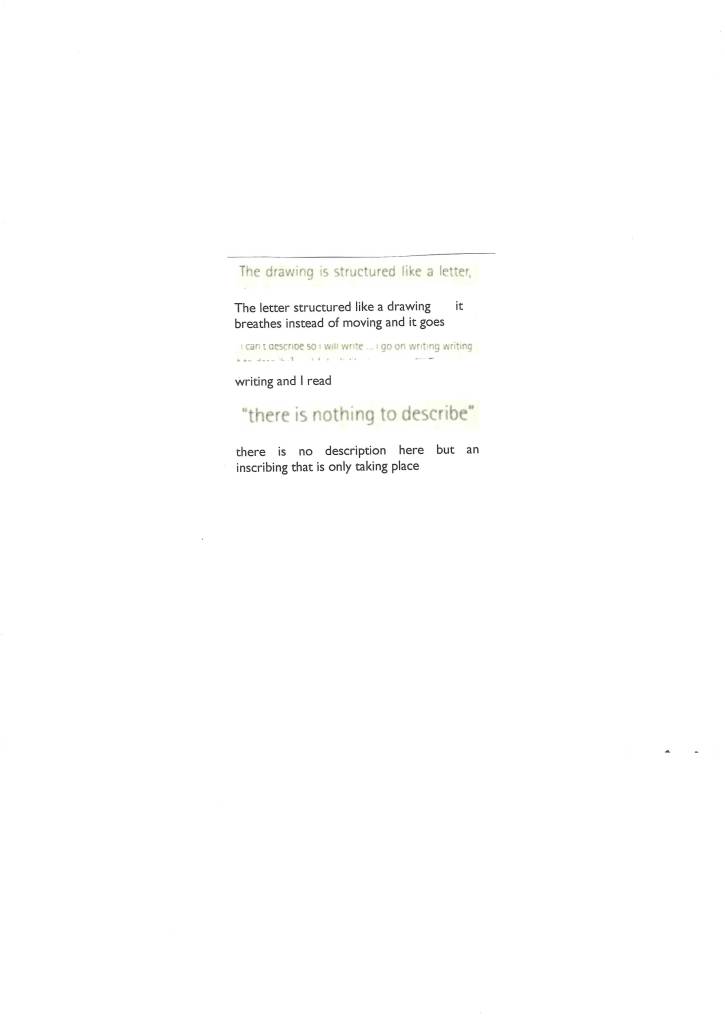
Collage by V. H. Wildman

01.09.21 (Drawn from 10/5/15;10/6/15;10/13/15;10/17/15)

What Western music

al forms have be

come is a para

phrase of memory.

But memory could operate otherwise as well.

— desolate, dystopian and highly erotic.

Monks and heretics shift ‘into delirium and

curse softly when bodies are set into motion’

‘slices of time’ that are not incongruous

providing an aperture

on to multiple temporalities,

past and present

‘ruin lust’

The first concern of all music in one way or another is to shatter the indifference of hearing, the callousness of sensibility, to create that moment of solution we call poetry, our rigidity dissolved when we occur reborn

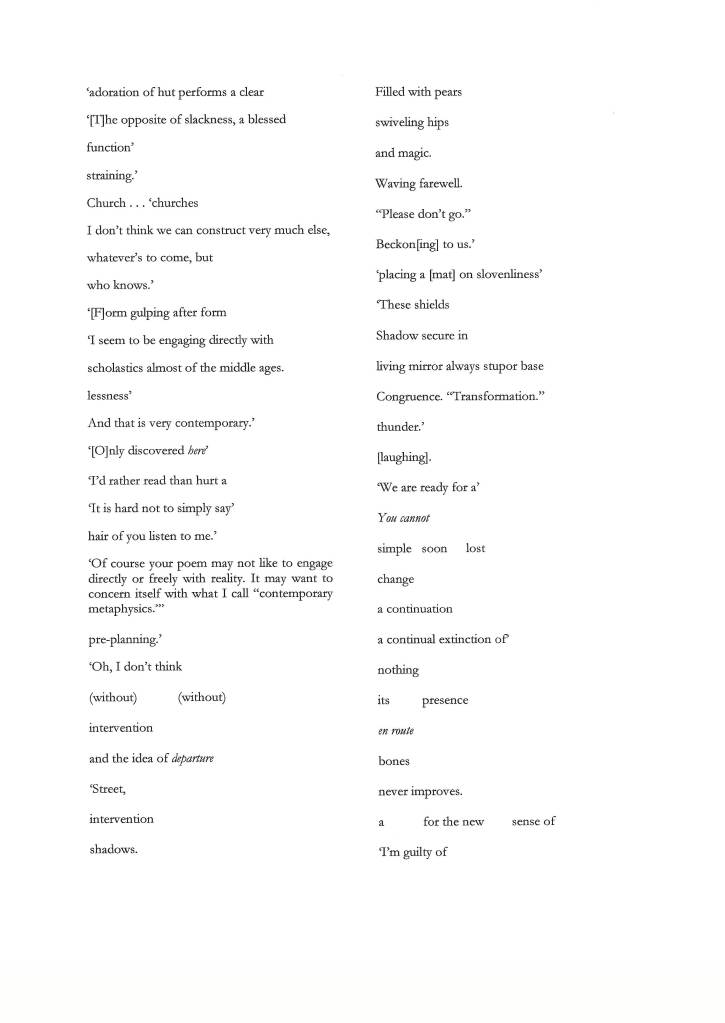
a use of parataxis, and a mixing of genres; a responding “to the m om ent”; a recording

of the experience of writing; and a resistance to closure.

I feel every piece I write has a new form.

On a Page from Mieke’s Notebook

Collage by V. H. Wildman

The words ANGST MACHT are found inside a drawn heart shape, written out in pencil, lines protruding outward from the heart: (on one side) RITUAL (on the other) ABSTRACT, words contained in boxes that connect through other lines: DISEASE, MEDIEVAL, SHAME, PERFORMANCE, PLAGUE, STAIN, LEPRA, FILM, and above and on the right (surrounded by other ramifying villages of words, COMMUNITY and POWER, set apart) in a box all by itself floats DISTANCE. So distance, she writes, must be something that floats.

WOODMAN, HOWE (and briefly)

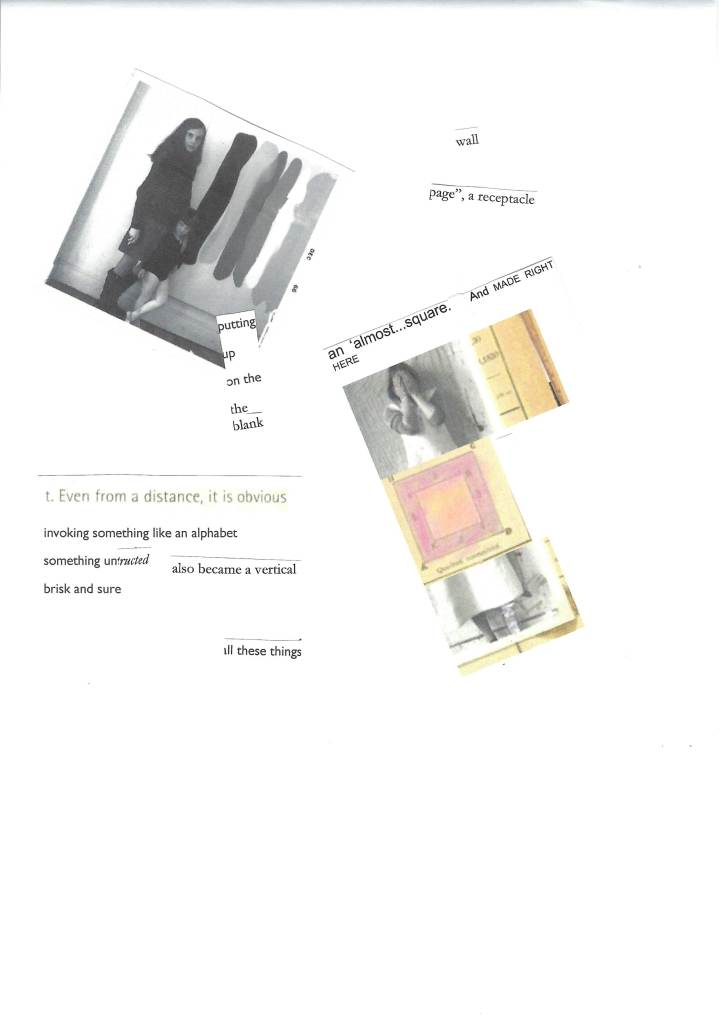
Collage by V. H. Wildman

Howe started writing by transcribing walls. A poet friend of hers advised her to collapse the walls around her into print. And she did.

And it became a hinge. A picture balanced on a precipice of sound, invoking something like an alphabet in space.

Woodman slept inside her schoolgirl closet, using, for a time, her dorm room not to live, but to ossify, by photographic means, herself.

And later in New York, after failing after fashion, she succeeds.

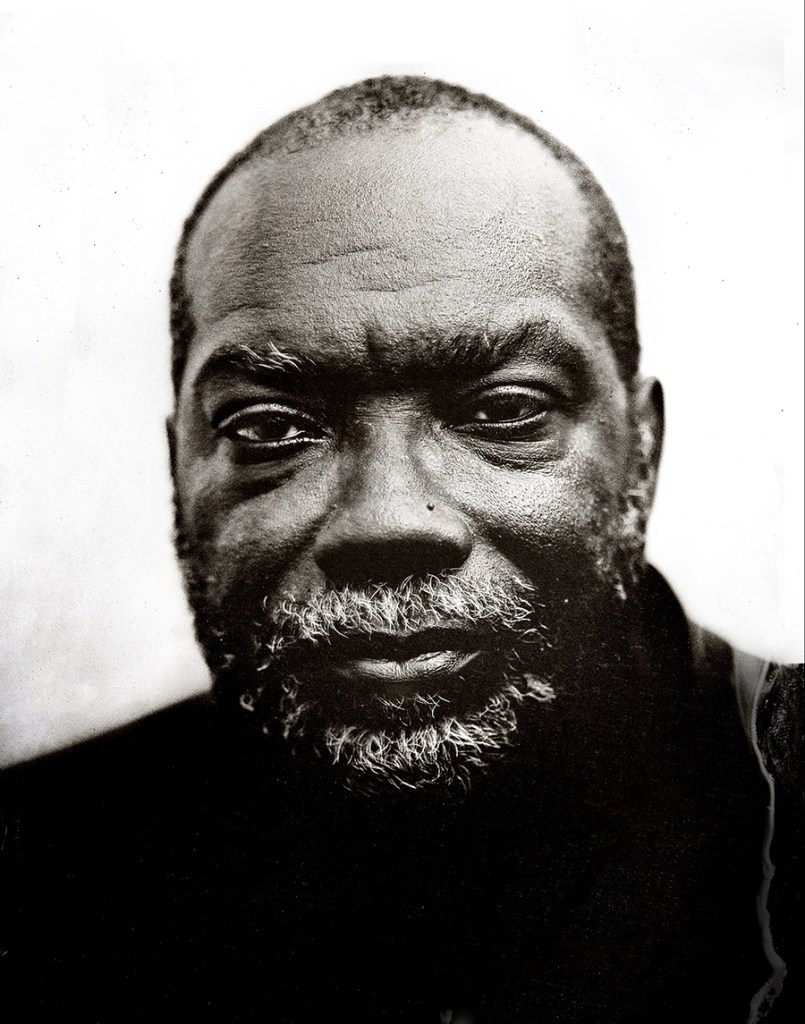
FRED MOTEN ANSWERS A QUESTION

Fred Moten. Courtesy: Letter Machine Editions; photograph: Kari Orvik

The poem is a recording        

an experiment in improvised choreography

The material of the poem is               performances

the necessarily fragmented               notes  

cut up

memories        scrambled      

to transcribe

the trace of those      performances

the juxtaposition of words

‘motion’ and ‘capture’

Other Dimensions of Music   

movements relation to confinement

the production of sound

bending and twisting              after

notes

his own firmly planted

to cross           over

quickening

of hands and breath

however weigh[t]ed down

wires, relays

his movement

writing

This phonochoreography

is concerned with a lot of the same

things

of a different order

autobiographies

all kinds of associations

of which I tried

to make room

for in the poem

however obliquely

back and forth

through music

I imagined a train        moving

the sound of a horn

how my mother told me what she thought it was

I thought about

I lived              called

fugitive

nocturnal

corresponded to

I wanted to imagine   

stolen collectivities

a poem

trying to work             this

tries to sound

move

old and new

constructs

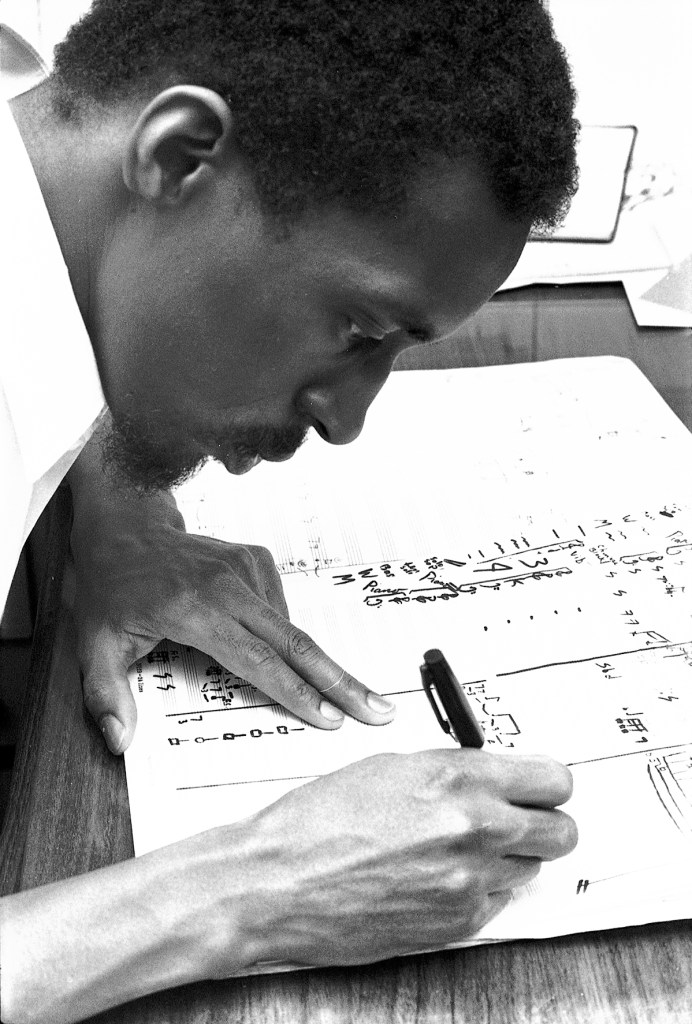
NOTE: JULIUS EASTMAN

Photograph by Donald W. Burkhardt

THE HOLY PRESENCE OF JOAN D’ARC

The composer in his lonely room

constantly birthing music

This must be opposed

Discovering what is fundamental

Discarding what is superficial

Buddha for unspecified instrument

Our God for piano and for voice

Our Father for two male voices

The Holy Presence of Joan d’Arc

Joan was taken to the stake

and she was tied to it

Also recorded was a spoken introduction

The pyre was lit

Find presented here

a work of art,

full of honor

integrity

boundless courage

Joan could feel the pain,

but she could also see beyond it

too

I shall emancipate myself from the materialistic dreams of my parents

I shall emancipate myself from the bind of the past and the present

I shall emancipate myself from myself

And please accept this work of art

Joan sees God

and God is there

and Julius dies alone in Buffalo

at Millard Fillmore Hospital

It is a sincere act of love and devotion

Joan

speaks boldly

He was evicted, homeless, still composing

He is encouraging her to speak

I knew that Julius would die before me. I always knew that.

to her oppressors

Probably not from AIDS

Boldly

at the age of forty nine

Depending on who you talked to,

it was brought on

when they question you

by insomnia and possible tuberculosis,

dehydration, starvation, exhaustion,

or depression

According to his brother, his body was cremated, and there was a family memorial in Annapolis, Maryland.

NOTE: TWO ACCIDENTAL POEMS

Peter Hujar, “David Wojnarowicz With Hand Touching Eye,” 1981.

READING WOJNAROWICZ (after Carr)

It would take a separation from the normal levels of existence

Sagging docks and railroad cars rusting in the oily rain

He wanted to explain his feelings on the voice within the body

To put together a collection of voices

Like a passage coming to an end

I give my life up to it

Out and in the night

Sometime soon

I’m with my notebooks

Both before my eyes and behind them

Scribbling

Writing a letter on the back of an envelope

Taking place in that bird within the chest

Writing on a poster for the fuck to lie me down in bed

Underlining the following in red

One long breathless sentence

He could hear the music in the trees

My hands, my arms, my thoughts and all I do is write 

Going back to the apartment 

That is all that he can do

I just never mailed it

And he took a bath

The descending into night    

The horse that gallops into russet dusk of seas

Vision is less elastic now

And its sounds

A tiny room is formed

Finding a way to remove my self from all internal strictures, rules, constraints

It’s like a bolt 

The vision behind the eyes

The stuff of paint

He was having many dreams of the American west and wanted to make another cross country trip

He missed the wildness of New York

The distances of a forest in the eye of a fish

And down dank hallways dripping pipes

The skylight with one broken pane     He slept

Writing with no cross outs    no words added   

I felt such a harsh love

Rising in the throat

Thick fists

And the subtleties of weather shading green

His lips tracing lines along the belly

Lent a drawing    lent a poem       a collage

The silence of the floorboards

Something from the street

The maze of hallways wandered as in films

And on a small paper bag he made some notes

Only a faint smell of jism

Something directed toward the lens

Blistering   blazing   bones        Honesty

And he could go inside

He’s in some really private space

Going out in the world alone at the age of nine

Light coming through the holes made perfect circles on the floor

He always said that he was nine

He was in the midst of compiling some two thousand pages of notes

He says that he was nine or ten

Not to be flirtatious but to maintain distance

Except that home was unstable

Broken asphalt and a few ailanthus trees

Broken down seating scrounged from the streets

To celebrate the squalor and the poverty

The dirt road that leads to the lake

The place behind the barn

The linden trees, the room, the bed, the heat

The pipes running down the wall

The cheap curtains

A very strong and low intake of breath

Stillness   the body of a friend

on the bed       

All I want is a sort of grace

He’s in the wind, he’s in the air, he’s all around me

Speaking into the tape recorder

The rain roaring through the trees

The body of a friend

on a bed    in a box    under feet

He moved into his loft on Mary Street

But he did not go back to making work that he could sell

Climbing a tree without branches

Pounding out the pages for these words

Sitting on a chair   the light from the window upstairs     a working mouth

He’d become interested in diagrams

The image of an elephant

He seemed obsessed with garbage         

Something he discovered at a zoo

He sketched (in black felt tip)

He worked on the mock up of a square

Finding out how light will act on paper

The thirty seven pages of a book

They are journals. They are diaries. No, they’re notes.

But the harmony   suspended hell    the invisible or variously

divisible flow

Lantskips now or showre

On what he called the self

on rhythm and music

portrait, film, or note

This is more than a song about myself

A series of fragmented views might take you as a cloud

slowly covers the page        and it goes

The photos held in place

The carvings

Fragments

Rough notes

He had made for himself a kind of shrine

Better something quiet that cannot be touched

The yeti on a trike     The yeti on a trike

Or something else

CHINESE TREES (after Hujar)

Trees must be well-proportioned and possess force. They should not be too tall, or else they will lose their vitality and their strength. They should not be too short, for then they will become vulgar and confused.

In painting tree roots, those trees which lean and rise at river banks have roots which seem to rise and fall as they push the earth away.

In painting withered trees and branches, one must simply pay attention to their sunken cavities and hollows.

I see white light, fix my eyes to the plowed earth. He’s in the wind and the air behind me. He covers fields like a fine mist. He’s in his home in New York City. He’s behind me and it’s cold and wet, the way it numbs my fingers, makes the knuckles red and white. The trees are uprooted and the grave is fresh and it is time to leave.

I see candles on a table and I sit down and I read. The wind and the rain and the words. This is a storm they announced on the radio and it is confusing me.

Erect in bearing, tall, pine trees, and superior, aloft they coil into the sky. Their branches spread and hanging down. They will not bend to shade me after the storm.

Reading I am mumbling the companionship of mists and vapors. The window is bespattered by the rain. The light is on the table. It is spring.

The form of a mountain and I see his face. Water as blood, foliage as hair, haze and clouds as spirit. The arteries run low and the base is solid and wide. I feel comfort.

Thick and pointed like a needle, I will write this using ink, burnt ink, ink that has been keeping overnight, receding ink as fine as dust. Ink is sufficient, very like a porcelain bowl, a piece of earthenware, a brush.

Strokes, staccato strokes and I will fill the page, leave in gaps. Layers have been soaked. Texture stroke and scrubbing they will dot the page and scrape the layers down until it’s just a pattern of indenting lines, nothing of use, only the imagining of color where the ink had made the trees and then the words. Colored snow.

To delineate. Spacious and secluded. Waterfalls.

Painting stream after stream. Going to bed.

Animals and their wishes. Rearing and they cannot be suppressed. Follow the landscapes then the dogs. Mentioning birds. A portrait from inside the head.

Cool gusts when I awake. I record my voice beside my tea. It is overindulging. I would rather eat. This is not haste.

Making such a longing scroll with both my eyes. The bowl it swells. I can appreciate the way it thins. I am delighted by the pale and the hue. It is sitting on the table. I will trace it.

Brush and spirit and bamboo. I suggested and the floors are soft. Noiseless walking. Only my breathing and my breath. Leaving a mist on the glass. Wiping with this cloth both moons, and then adjusting. I can see. 

The park outside. The kids.

Chinese trees.

NOTE: PETER HUJAR

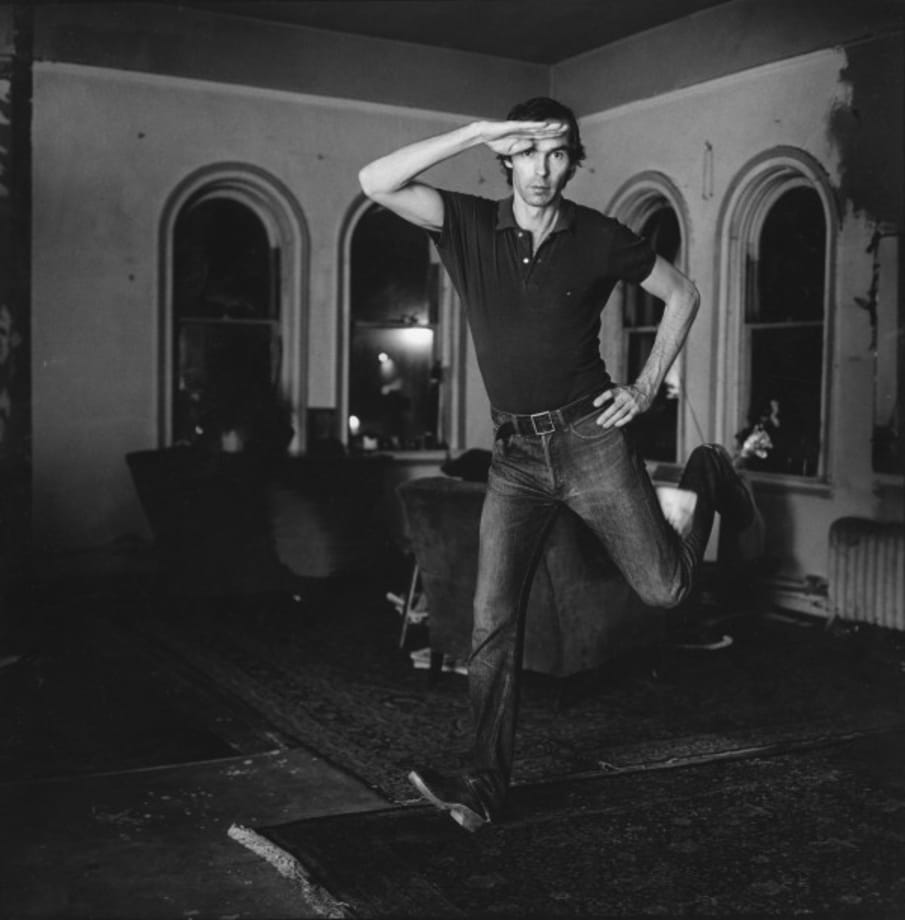
Self-Portrait Jumping (I) 1974 Peter Hujar

He sits behind the blue kitchen table smoking. One thing I won’t answer is anything about why I do what I do. I make uncomplicated, direct photographs of complicated and difficult subjects. My work comes out of my life.  I like people who dare, people who push themselves to some extreme.  What I do is something old, something that has, however dead now, a tradition behind it, people like Julia Margaret Cameron, or Mathew Brady. I compose the picture in the camera. I make the print.  And it has to be beautiful, or else I throw it out.  I can express myself in truth only through my art. I finished high school in Manhattan in 1953. I worked for fifteen years as an assistant to commercial photographers. They let me use their studios, they let me use their darkrooms after hours. After 1963 I never left New York. I tried to make it as a freelancer in the worlds of advertising, fashion, music, but it didn’t really work, the hustle wasn’t right for me, and in 1973 I moved to Twelfth and Second Avenue, into this loft above the old Eden Theatre, where I’ve been working ever since.

Into the silence of the space

Riverside Park Fog by Lynn Saville

NOTE: A SENTENCE ON MIEKE WRITING ABOUT UWE, KATARINA AND PHOTOGRAPHY

He has taken Katarina out into the evening black, into the fog and wetness of the snow in Riverside Park, their rubber boots plashing down the part-lit paths, in hopes that they will work up a bit of hunger, and later on return to the apartment tired, famished really, almost spent, and find Elisabeth has set up on the table in the kitchen Tuesday’s meal where they will all sit down and eat in silence as they do each night, for the apartment has no dining room, but a kitchen and a bathroom and a space for Uwe’s work, and there’s a room for Katarina, as Elisabeth and Uwe go to bed now on the foldout in the living room, and there’s a window, you can see the park, though the curtains have been drawn, for it has been long, a very long day, and while the editing at Houghton Mifflin might be easy, it is plentiful, too plentiful these days, and goddamned tedious as well, and though this evening Uwe is feeling unusually tired, he still gets out of bed and goes into the kitchen where he reaches up into the highest cabinet and finds a bit of scotch to serve himself a drink before he crosses over to the other side where he unlocks a door with a key he keeps attached to a little black string around his wrist before he enters closes locks the door behind him and sits down over what now, that he has snapped the little lamp into its light, appears to be a mass of papers, open notebooks, typed up sheets and maps, that he adjusts his glasses and he looks at as he writes, a heavy mechanical pencil in his right hand which he is now replacing with a red felt tip, the glass of scotch hovering beside him in his left, annotations into the margins of his notes, the way I’m doing now, rehearsing what I did last night into this grid, after having spent the morning out of the apartment in the city here with Geert who will be staying in New York for several months to curate what she says is an enormously exciting show of photographs she’s busy setting up at Milchan’s Gallery on Twenty-third, I mean, she said at morning tea, that many of these artists, these photographers are new to me and how to deal with what they’re doing or they’ve done, to hang their work, and make them speak to one another, is a problem that I haven’t really figured out in any way, at least not yet, and she took me to the gallery to walk around the space so I could have a look at what she means, and then she suddenly was called away and I was left there in this straight-backed wooden chair with a view of all these framed up pictures lined up on the floor in rows and snaking round the space against each wall, I have been taking photographs myself, of course, as I’ve been taking notes on all the things I read each day, my empty park bench series and the photographic archive I’m constructing of Solonga’s things, annotating oftentimes with comments or quotations, and I wonder if these practices are somehow similar, and is there an effect, and which way does it go, are these photographs the seeds of what I’ll work out later in my words, are my words anticipations of my photographs, or are they unrelated, disconnected and absurd, while it is dark now and I look outside my window at a post which hangs a bluish light and a number (I have seen it) you should call if you should find yourself involved in some emergency, in something that emerges, an ‘emerge,’ or is it, now that I zoom in a little closer with my camera, absolutely nothing but an image with a bluish glow and words that make you wonder why it’s dark, why is it, despite it’s being quite so early, quite so dark, with Uwe walking through the park with Katarina, lost perhaps out there tonight, and when will they be heading back to sit and have their dinner as, however strained, a family, to sit down the way that I was sitting in that straight-backed chair with Geert before she had to leave, looking at the photographs that were on the floor and propped against the walls, one of them, in color, showed a page of someone’s notebook or a diary, the handwriting neat and quite severe across the unlined space, leaving no room at all between the entries, not on either side the slightest margins, neither on the bottom nor the top, and on the edge one gets a glimpse of what might be a table or a floor, what seems to be a dark brown surface, that the notebook or the diary is propped on,  above which there’s a sliver of blue (perhaps an indication of a view from someone’s window), and if you do not get too close and try to read the words themselves it is an abstract composition, something taken from the world as it exists in space, that sheet, those words, the color of that table or perhaps that floor or maybe even window sill, the blue from what appears to be outside but might just be a poster or a shade of wall, how all of this is taken through a camera’s lens and turned into a photograph, which makes me think of something Susan Sontag said or maybe wrote, about the way a photograph can be described as a quotation, how a book of photographs’ a book of quotes, the way that Benjamin would write about photography and dedicate the last years of his life to the compiling of exactly that, a book of quotes, the way a text is something larger that we take from and compile to build another kind of place, create a world all of its own, to take a photograph, writing by light, to take from the world,  isolate, sequester it, and print it on a piece of paper, maybe later bringing it into the company of others, other pictures, ‘takings,’ quotes, in just the way that Geert is doing now by curating this show, cumulatively building something else, a selection or a group of pictures, art, and I can see the image of Uwe and Katarina now quite vividly, they are coming into focus, frozen in that pathway in the park, the faintest light so vaguely now defining them as figures in an abstract landscape so like a pair of Beckett’s tramps forever and precariously placed before a storm, maybe they are in the middle of a conversation, how was Katarina’s day at school, or maybe they are not, for the photograph is silent, the acoustics supernumerary, brought inside by us into the silence of the space.