I have written to the French artist Pierre Leguillon. I have written about writing. I have written about writing this essay. I have written about writing this essay as a kind of homage to his work, to his curatorial approach to making art. I have written about making this essay a sort of tribute to the ways in which he focuses on aspects of an artist’s output that everybody else has overlooked.
Artist’s calling cards. Ad Reinhardt’s slides. Photographic reproductions of Carl Andre’s floor pieces. Debuffet’s typography. Diane Arbus’s commercial work.
I wrote him, ‘I am in the process of composing an essay. It involves a meditation on your most recent book project, Oracles.’
‘I would love to know more about the development over the years of your art-making practice, the ways in which you moved from a scholarly interest in art history to the making of art through exhibitions and through books.’
‘Oracles, your book about artist calling cards, is a sort of exhibition in the form of a book. The way facsimile reproductions of these cards are displayed between its pages. The ways the short essays that compose every chapter, chapters which you label ‘Deals’ (the cards are dealt and played?), indirectly interact, respond to one another. Speak. It is this constellational approach to the aesthetic and the biographical material that I find particularly compelling.
‘But there is one artist who I am especially drawn to in the book, someone who is commanding my attention more or less completely.’ And I asked him about his relationship with the French-Israeli artist Absalon, ‘I understand that you and he were friends?,’ attempted to convey to him how the Absalon material was continuing to grow, how it was branching out, beginning to distort the process of my work, and making rampant and oblique connections, often with the lives and works of other artists, most of whom are figures who are not themselves contained inside his book, but who have now become a part of this essay, despite my impotent objections, half-hearted protestations, my self-deceptive listing of objectives, I am trying now to write.
Though shortly after beginning writing I got stuck. I had to stop and start again.
Like Moby Dick, Oracles opens with a series of quotations, one brief quotation taken from every one of its eighteen ‘Deals.’ These serve, perhaps, as headnotes, cornerstones dividing its thematic space.
‘I will first make a series of preliminary statements,’ it is the beginning of one of Pierre Leguillon’s Non-Happenings after Ad Reinhardt, ‘what we call in French preambules, which you can see as curtains opening onto curtains.’
The word ‘preamble’ comes from Middle English. It derives from the Middle French word, preambule, which in turn derives from the Middle Latin praeambulum, which comes from the Late Latin neuter praeambulus, or walking in front.
Preamble, preambling, to amble before. Before walking, or moving in a leisurely manner.
To proceed without haste.
A ‘preamble’ is an introductory part, as to an essay or a book, or to a document, or a performance, or even to a lecture. It can also be read, more broadly, as an introduction or a preface to something larger.
A kind of pre-walk, or rehearsal for the event itself, whatever this event might, in the end, turn out to be.
A preface also points before it, somewhere else. It is something forward because it comes before.
It is the first curtain opening.
‘Forwards,’ writes Fred Moten, the theorist and poet, ‘are cardings that ought to be, but can’t quite be, discarded.’
The way that calling cards, that nineteenth century staple of polite society, once presented people to one another. These were cardings that were not supposed to be discarded, it would not have been polite, for they came before the person to whom they once belonged, standing in for them, one might even say, representing them. They mark an introduction, passageway, they introduce (traduce? betray?) through their own materiality, their choice of color, through their font.
The recipient may use this card to go forward, gain entrance underneath, to undo, at least partially, the first curtain before the name, by paying, and there is, inevitably, always a price, a visit to the person to whose name this card belongs.
Though each time the recipient of this card pays a visit to this same person, assuming they will pay this visit more than once, the person being visited is someone else.
The same holds true of Leguillon’s Non-Happenings, these lectures, followed by slides taken from the estate of Ad Reinhardt, for each one ‘is always both a repetition of the last one and a rehearsal for the next.’
‘So let’s just say that I’m doing some preparatory studies, some sketches, that happen live and that cannot be reproduced.’
These introductory texts, these forwards or cardings, Moten goes on to write, are ‘terraced airings of tangle, smoothing out refusals of smoothing, defibering with dried fibers in bright Farben, preparing spinning with caressive compact.’
To fold and then unfold. To caress.
And fold again.
This compact caressiveness that calling cards possess. They announce themselves in fewer words. Their concision can appear to make them cryptic, even oracular in what they won’t announce.
An oracle is a means, or a place, or an instrument of revelation.
And Oracles, a book of written constellations, composed around the calling cards of artists, cards that have been sequenced, grouped, dealt out as ‘Deals’ (the names its chapters have been given; one thinks of them as ‘dealings’ – forged and then arranged – with material) and edited by Leguillon, is precisely such a book.
Perhaps the quotations at the beginning of Oracles also constitute its preface. The preliminary aspect may simply reside in their having come first. It is the book’s forward part. The Forward as – in,medias res. We are already in it when we start. Much the way that Henry James’ prefaces simply come before. They do not purport to explain or simplify our way. They do not pre-figure. The Forward is already inside. It is that which faces the reader upon entering. It is the pre-face or Forward taking us further inside the book.
untitled , 2012, Wood and painting, 50 x 85 x 5 cm,, photo: Aurélien Mole, Private collection, New York, USA
All of the items here are unnamed; I need an environment where I can breathe, and think, and move about more freely.
They are without dates or chronological order; I have to find a landscape to protect me from the brutality of the world.
This exhibition, which also doesn’t have a title, is a regrouping, a reimagining of sorts; I like to start by casting everything in doubt.
It is a restaging of Fernanda Gomes’s oeuvre; I love that moment of going into an empty space and starting to move around and around, letting my imagination go.
Like Robert Ryman, she prefers to work in white; the panes have cracks and scratches, the unworked side is black and blank and as opaque, the other a consortium of whites.
She incorporates these imperfections into her work; these sides are joined together by a hinge.
Like Carl Andre and Blinky Palermo, she picks up objects from the street and she composes them; I like to mix abstract forms with common objects: chairs and tables, books, a box of matches, strands of hair, a number of other unclassifiable composites.
She creates an atmosphere, a surreal domestic space; it is a space cluttered with stuff.
I have a mind for the essential objects; when I really started doing, what I consider is a language, it was white.
Method is a discipline of life; it means steering clear of the coarser side of things, doing less with the stupid and the bureaucratic.
I compose without any method or effort; pleasure is my guide.
A pedestal can become a sculpture; a painting can become an object.
If I don’t feel like doing something, I don’t do it; I prefer working to going out.
The word ‘work’ is inappropriate; words are never, and always they are falling short, enough.
The idea of repetition is a part of this; the most basic kind of everyday activities have inspired what I’ve done from the beginning.
I carry on as if it is the same, always it’s the same; it is always different and unfinished.
I open up different directions without closing any of them; I keep everything at my disposal, different things all at the same time.
I keep a lot of stuff, looking at it over years; I like using everything.
Distance in time also creates a critical distance; I live a continuity of times.
I let go as much as I can; I imagine a whole load of ramifications, but I do not carry on.
The main cycle is the day: morning, afternoon, evening, night; one day follows another and repetition heightens nuance.
I like to let things happen and carry on without trying to control them too much; I often think of doing one thing and end up doing something else.
Things catch my attention when I’m out or I’m at home; apparently meaningless things kindle completely unexpected sparks.
I always have different notebooks: one inside my bag, bigger ones at home, specific ones for an exhibition; I’ve always, since I was a child, been in movement.
I like doing things little by little; I like doing things gradually, letting them add up, creating more organic structures.
A constant in my work is looking at things; I respect the things I see and let them guide me.
I like to have lots of work around me; it’s like a materialized thought process.
I start imagining different possibilities and I work them out; I take note of what I’m doing, some of which I follow, some of which I then forget.
I find myself in a state of total awareness; it’s about balance.
It’s the unexpected plus imagination, that’s what it is; it’s the idea of using what I can immediately access, putting discarded items back to work, recovering, preserving them.
And it all evades our verbal language, our descriptions, in favor of a different kind of poetry; it’s free.
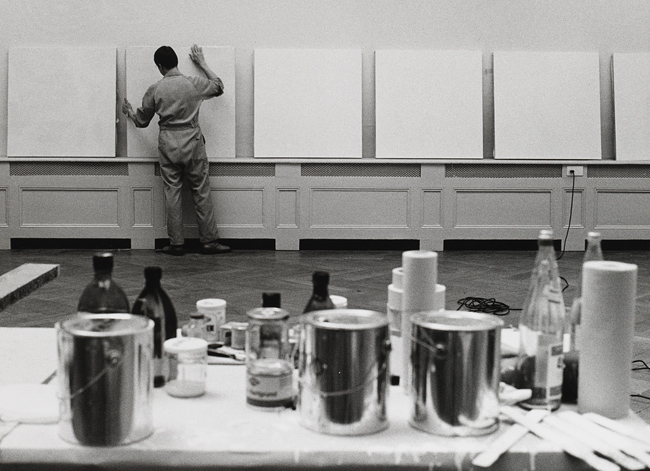
Robert Ryman during the installation of his solo show at Kunsthalle Basel, 1975
‘It’s Something Else’
Dull and watery to start, and blindly in this way, Enamelac on corrugated board, quite fuzzy, VI and VII (1969), it feels quite different from the choppy horizontal rhythm, the thick oil paint of the Winsor (1965) series on coarse linen, different from the swathes of matte enamel of the Standard (1967) polyptych pulled across reflective steel, clear how they feel, import, avoided isolating auditory sense, but Lennie used to practice on a silent keyboard, which means you really have to know what notes you’re playing because you can’t hear anything—directness, mark, effect, his one-time stroke, predicated subtle—visually, to play and think is impossible. I do all my work slowly, very slowly, and never think that when you paint, and he would now just go ahead, connect it, play it, hear, record, and do it, learn to sing one’s breath, every note, every phrase, every beat—he had me sing the solos bird half speed and it maintained the full effect of the melodic continuity of line, slowing down the records 33 to 16 RPM requiring, well I did them three at a time and I had them next to the wall and I cleaned them and they were coated with lacquer and they would all be ready and I had a kind of assembly line situation, and it was, and it was going, so when I began to paint them I had to have the paint ready, and I had to have the brush ready, and the consistency of the paint and when I painted them it had to be done quickly and it was just a one-time stroke, and then again, and right across, and sometimes if my, I don’t know if there was a certain twitch or something, the stroke might miss a little bit as to how it went across or maybe it’d be too much, too much of a drip, or something would happen where it just didn’t come out, but I would do the three and I could look at the three and I could do them very quickly, it only took me maybe fifteen minutes, and then I could look at them and then I could see that one was not quite right as the other two and maybe all three would be okay but there might be one that would not be and I would put that one aside and do three more so it was really just a matter, how it looked to me and how it felt, I mean I’m very aware of what the paint is going to do, I know how the paint is going to react on the surface, I know it, I’ve done it, it’s difficult to explain, but it has to be direct, and very sure, there can’t be any dawdling, it has to come out right away and it was just one time, the reed and so the note starts out then and the fingers once put forward, not retractable—never retractable, and sometimes we’d be asked to play at Chumley’s, play at Chumley’s, sometimes, on an off night, just for fun, but actually Lennie wasn’t, he was not, I don’t really consider him, he was . . . he wasn’t very good as a teacher, I mean I might have gone on with the music, I might have gone on to do, but he was very cold, kind of frigid, you know he had a certain approach, he wasn’t able to teach in that way of opening someone up, up to themselves, to their own personality, I think maybe the reason that I went, chose painting over music was because of my, my personality, it was a thing about my personality, it’s because of who I was and who I am and what I could do, because painting was something I could do alone, and I was by myself, and this was, this was, good. Though I do like other people—Bartok, Charlie Parker, line recitative strokes, I never got tired, a little buggy at times maybe, a little bit on the edge, but with color, I’m not at all involved with color, I use it more as a, as a contrast, and I usually prefer, it’s not a matter of deciding I don’t think, but well you know it’s strange, you’d think collectors, you’d think that with collectors, well I, I know better now, but you would think that they would know what it is that they have, what it is that they’ve got, but they don’t, but they don’t, they don’t seem to know what the painting is, I’ve seen paintings hung, someone had two small paintings of mine and they were hanging in a hallway, maybe they were a foot apart, maybe two, along with other paintings, other pictures kept in frames, and it was totally misunderstood as to what they were, there are of course situations where they are proper, where the person understands what it is they are, what it is they have, but, a lot of times, not. I’ve seen strange situations, even covered in plastic, and of course there’s nothing you can do, there’s nothing I can do, it’s just nuts, it’s in a private situation, it’s impossible, though in a public, when it’s public, you can take the plastic off, do what it needs, remove the frame if that’s the problem, do something else, although it’s odd, I still do find it odd, so really, really odd that they could seem to, think they like it, even love it, yet refuse to understand the way it is and what it is and how it works, the thing they’ve got, but I was just, I guess now, was naïve, I was very naïve, and in fact I have one if you want to see it’s over there, it’s in a drawer, and there’s another one I found, I don’t know it quite exactly, I was doing then these solid, solid white, these paintings with the color underneath, a little pencil line just off, and if it wasn’t for the music maybe not, I would have tried it just the same, but it was important now to try, to see it what might happen, what could happen if I tried some other, other way, and so I did, and I still do, I mean look at this wall, look at these pictures, it’s exact, and yet it’s not, it is, no matter how I try it or how long, it’s something else, it’s always something else, and that’s the way I do, I do it, what I like I guess, it’s something else.
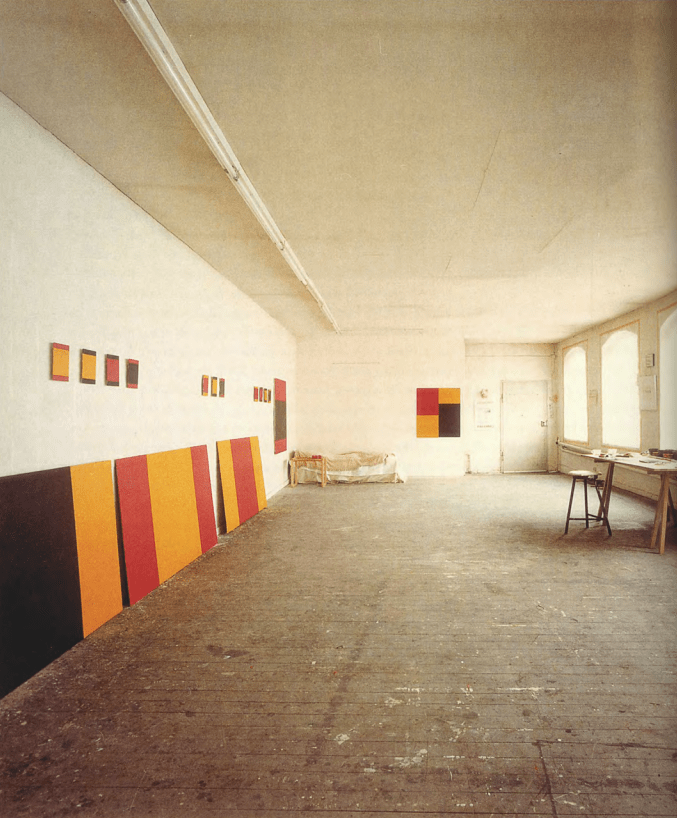
Palermo’s studio shortly after his death, Dusseldorf, 1977
to the people of new york city
(a sketch in pieces)
Oak leaf never plane leaf
There’s a filling of the page
out from non-consecutive arrays
gathered feldspar phylotaxis
It was just an enormous amount
I think it covered everything
Words, spoken words, turning into sounds
Something to be gathered
Something to be arranged
Begin the story of arrangements
It was a matter of using his hands correctly
Altogether tactile, sensuous
An aggregate of unposed
image barest fact
The emphasis is on the stage
the connection between images on a page
page to page
self-portrait
spread Lay, as he lay there
on the floor strand and wide
wither
The rhetoric of interior spaces
She turned to me and said, “I feel
the air from other planets,” and was quiet
Taking his place behind the tape recorder,
he then began to speak
He began to record what he would write
to transcribe orally the accumulations of a life
A novel as “accumulations of a life”
in the form of notes
Blocks of copied text
Reflections evocations image
Sitting before the recorder he begins to speak
reading into it his notes
He’d be sitting by that little table with the shadeless lamp.
I was seeing him at the time, writing stories of my own, a poem published in Horizons, a sonnet published in Mist, a haiku in Channels, a sequential little thing that I’d been working on for years.
And he was living then on Mary Street.
Patterns on the floor brown and yellow
patched The wood is warped and the planks
A pattern of pipes behind the sink outlets switches lights
A tall glass pitcher filled with water
He would use the term “composition,” a word he revered, for work built up, layer after layer, over time, drawn in long procession from his notes.
“These contrapuntal unravelings, loomings,” he would say.
And all his life he preferred the vitally impure.
But experience cannot be thought or painted, only noted and composed.
He had these pieces lying all over the floor and he would pick them up.
It’s a movement into something more. Not really a poem, such is life.
As if without interference, without a teller someone to tell
The more you work, the less you exist. I am nobody.
My childhood bends beside me.
I feel the heaviness of this chair, the weight of that door, the play of light upon this sheet.
The uniform matteroffactness of a meandering male fist
But the blindness of the process “what might be” is not a ground
A tender red
Color laid indefined like stains
Bent on absorbing unfamiliar items into chalk
The black and white of printed words
Something turned something spread used to cover surface
A long dull poem and a bare one
Skirting reference extra words
A stool she likes to step on and a knife
“I caught a bird which made a ball.”
“I caught a ball which made a bird.”
It alters.
An encaustic line. Relief.
And why should I be so concerned with “sense” when there’s a window here. Rabid fellow tokens and a chest.
“Because the latest thing in art is just the latest thing in art.”
Slowly squatting.
I’m interested in grids. In typological structures. Juxtaposing things. And for this a book, a handmade book, is what makes sense. It’s what I need. Spending a lot of time with Benn and Hilde, I learned a lot from what they did, how they’d be putting things together, side by side or so to speak, although they worked primarily with sound, it’s much the same. A matter of structural relationships and chance.
His writing developed essentially as a way of sculpting. It is a patchwork, a weaving together, a convoluted account, hollowing out of sound, drawn mostly, a bewildering and bloody list, from life.
He wasn’t at all conceptual. He was poetic. He was literary. He was musical. And yes, he could be quiet. He loved to talk about music. He was very enthusiastic about music. Highly unusual music. The extreme innovations, which mostly come from America.
But one can talk him easily to bits. Instead, one should perceive his work all at once like a breath.
But I do in a sense mourn.
He loved black hookers. He loved Times Square. He loved Canal Street, Coney Island, people selling candy, wacky ethnic places, rides.
Notations in felt pen and pencil on blue paper used for mailing letters.
The particular characteristics of a given space.
Notes arranged on cardboard sheets.
Documentations, “conceptual instructions,” the impossible task of rescuing centered on an experience that can no longer be had, interview fragments.
I think he once referred to it as an unfolding.
A wall drawing with music.
A dark blue line following the contours of a door, a radiator, several windows.
“Unexpectedly complex,” he said. Aluminum panels. Chords of color. And lots of empty space.
A murmur in the wind.
I could have waited.
And the cycles of the day, the night. The cycles of the seasons, flying into town, the simultaneity of things, every time, in an immediate way, without preparation, between departure and return.
His first wife Ingrid and her daughter, Iris-Jasmin.
Thin strips of wood. Stretcher sides. A ballpoint pen on whitewashed reverse, following the arrows where they point.
Water scales, plum and trees, the changes in the light from cool to warm, red bricks and plants; all of this, of course, without transition, intimation.
I think he was a new person in New York. It absolutely woke him up to what he was. He was a little drunk. He was holding on to the table. His fingernails were dirty and I liked the way he looked. He asked me who I was, I said Babette. And I told him I could paint them. I said gold, and he said fine. He amused me, how he acted, like a child. He kept quite still throughout.
But he might as well be dead. It was a most unexpected illness. And his compositions by that time had been extending. A pencil pressed on paper, a red clothbound book. And against the pale blue rule, a scattering.
Smudges and tears bewildering leaves.
A simple statement of fact in a certain form. You sweat like a dog for that.
But what I required was an uninflected surface, something to resist my piddling hopes and burdens, something harsh.
Twenty-Four Short Pieces. It was a way of drawing out without extending time. A burst, you might say. It took me seven years.
To write, to scratch, to carve.
A constant series of events. The aim and acquisition of a non-descriptive line.
That which is already altered.
These assume their own reality.
But something always seems left out, somehow blurred, made invisible.
It is just here, but without revealing.
It is virulent and it breaks.
And something always happens.
A coming to life. A stroke. A line. Intervals.
An inconspicuous economy.
It is the moment of the snow itself.
A new beginning every time.
Moderating whiteness. Adding dirt.
Spreading the gray paint with our fingers. Brudie taught me that. We were learning to paint with our hands. Enjoying all the things that we could touch.
The shade and the light and the dark and the back.
Having to redeem.
Insolvent image. Break.
Pleading somehow for weight.
He decorated his studio with American adornments and collected ragtime music. He Anglicized his first name and cultivated an American persona, persuading not a few of his friends that he was half-American or at least had been to New York.
Shrink-wrapped, and obscure. Made intact somehow.
I think that color, the use of color . . . I didn’t particularly want to use or add. And every now and then I have a feeling. Sometimes it is a red, sometimes it is a yellow, sometimes it is . . . or a blue. But I did develop it in color . . . or a black perhaps, because of the color, quite particularly.
Color is collected in his drawings. Color is collected in his notes.
An unmarried woman Schwarze her name The father Stolle probably dead Adopted nearly at birth, a month coming on Peter a little bit taller, thinner than Michael never really recovered told at 18 from the shock Heisterkamp Wilhelm and Erika Leipzigians A year later quite unexpectedly a sister named Renate After marrying Kristin Kristin after Ingrid (both and with Babette a former child) living on the fourth floor of a school a former school in Dusseldorf But music remained at the core of his concerns.
He was obsessed with color, musical color.
He was all consumed with timbre.
He preferred doors, open doors. They always suited him. His paintings were like doors. Open doors sealed shut. He had a knack for closing down the possibilities, cancelling the options, one by one. I was one of those doors he liked to shut. But he arranged it so I wouldn’t close, not all the way, not tight. I stayed open for him. I remain open, even now. I’m like the groupings in his final panels, senseless when viewed in isolation, but seen together, as I move from wall to wall, somehow forming something, something that was always missing, a unity. A redacted composition. He has found a way to spread me out, to make me occupy a half a dozen rooms, left me hovering in front of the walls, barely casting any shadow. I refract the light, and yet I’m porous, open. And the colors he has chosen, he has made me German. And yet I remain, he remains, New York.
He wasn’t interested in conventional painting, easel painting.
He seems to have wanted to test how far he could go in eliminating variations from his hand.
They seemed to me like things he found in the street that he would cover over with some cloth, and then color.
The notations in his notebook show that this was done on purpose. It was the source, the first step.
cadmium yellow deep creamy white fields degreased rather than colder bluish loose and vivid bleeds pronounced dividing lines interspersed
Above the bed he hung a disc, slate gray, made of stone.
I could always respect that, that he could make something so quiet.
A blue triangle, a small black square.
It’s always the interval between two things that can’t be measured.
It was a much more severe aesthetic.
The writing fills the page as drawing would.
It was very New York.
It was at a party at the Lampersbergs, the night I first saw him, that I knew. He would do this to me. It was inevitable. It was bound to happen. Taking me home that evening I knew he’d fuck me. I knew that it was crude. That it would not be making love. I was a subject. I was like a subject. He would poke and finger me, he would feel me inside out till I was raw, and I would let him. Afterwards we went to Pat’s. And how he loved that New York coffee, that American coffee you could only find at 2am in the Village, in the East Village, with a scone. And the jazz. He loved the jazz. The jazz that Bob had put him up to, along with metal, learning to paint on metal, how to use aluminum, to make it hold the paint together, do the things you want to and behave.
He bought most of his aluminum panels cut to size in metal-wholesale stores on Canal Street.
U-channel bars permit the panels to be suspended.
Soldered aluminum U-channels that he then glued to the reverse with epoxy adhesive or contact cement.
He was a quiet man. He barely spoke, but when he looked at you . . . Isa introduced us by the piano, beside her little “Japanese” who’d only then just “finished,” done “a darling job.” It’s true, the way she played the Schonberg pieces—Six Little Pieces for the piano. I’ll never forget it. Porcelain faced—dressed in satin—she couldn’t have been more than twenty—Isadora’s “latest find”—her little prodigy from Julliard—those tiny little hands. And she was bearing down aggressively on all those keys. Mother always told me it was all in the fingers. It was all in the fingers. And it was. All the time she played, he sat across from me, the second row, eyes closed. It didn’t look like he was even breathing. On Kurumba, they would say, they say it happened on Kurumba, on the island of Kurumba, that he suffocated there. Heiner Friedrich used that word, it was a kind of animal that chokes, it was “a suffocation.” He could no longer breathe. They said he stopped breathing. So it was possible for him to really stop. I know now that it was possible. Yet it doesn’t make him go away. So what if he’s not breathing, he’s around me. He is spreading me around, from room to room. I’m in pieces. And I will not be put together. I cannot be put together. He’s designed it so that this could never happen. He has screwed me to the wall and left directions—piece after piece, proportionally spaced. This is how it has to happen. How it will always happen. And so I visit myself and I move on. Out into the cold and rain. I don’t even have an umbrella in my purse. I never thought to bring one. I could see it falling—lightning—through the panes. I’m not going anywhere. I’ll remain here till it stops, or the museum closes, or someone kicks me out. I come here everyday. I like to look at myself, like this. And he knew that I would. I’m sure of that. He knew that I would. I’m Osiris. And Blinky was an orphan. He told me that after the second year. We were in my loft on Mary Street. He had the window down—the frosted rectangle at the top of the frame, it was down. Open. And there were pigeons on the roof across the way, a blackened water tower Bernd and Hilla came to take a picture of one time. They’d had to climb the fire escape, plant the tripod on my roof and there’d been lots of scuffling shoes, puddles from the rain the night before. And the ceiling had been leaking since that night. Bernd and Hilla must have damaged it that time, I can see it from the bed. But Blinky only grinned. I laughed and said I’d been invaded by the Germans. Not by me, he said, I might be something else. Not by me. All I know is Joseph is my father, you’re my wife. But we’re not even married. You’re my wife. You’re my country. He took hold of both my hands, wrapping my fingers round the post, and without using his own he began to rub against me, pushing me against the frame, almost folding me into it bodily. The night I found out he was no one he could come inside. And he did. I am feeling him against my breast as I begin to write this down. It was a little kick but it was high. Already it’s demanding. I will give it what it wants. When the time comes I will give it what it wants. I will let it take what it wants, and I will not complain. He is close to me. He is closer now than when he breathed on my skin. That night after the Lampersbergs he breathed on me. And I remember, I could feel his breath. I feel it now.
Etel Adnan, Mont Tamalpais II, 1997, watercolor and ink on paper
I am after that sense of America (the way that Uwe was), and I am reading Walden now
and ‘time is but the stream I go a-fishing in. I drink at it; but while I drink I see the sandy bottom and detect how shallow it is. Its thin current slides away, but eternity remains. I would drink deeper; fish in the sky, whose bottom is pebbly with stars. I cannot count one. I know not the first letter of the alphabet. I have always been regretting that I was not as wise as the day I was born. The intellect is a cleaver; it discerns and rifts its way into the secret of things. I do not wish to be more busy with my hands than is necessary. My head is hands and feet. I feel my best faculties concentrated in it. My instinct tells me that my head is an organ for burrowing, as some creatures use their snout and fore-paws, and with it I would mine and burrow my way through these hills. I think that the richest vein is somewhere hereabouts; so by the divining rod and thin rising vapors I judge; and here I will begin to mine.’
But what will I find among these newly shaken urban canyons made of glass and steel and (way downtown after the coming of collapse and then of death) dust?
‘Wherever I sat, there I might live [I am trying to work, I am trying to make, I am trying to write], and the landscape radiated from me accordingly.’
To live along that grid the way that Bernadette Mayer once did. Back in 1971, and it’s July. The way she lives in (and constructs it) Memory.
‘wow/you know what street that is? you wont believe it/i’ll figure it out. yes i do/what?/canal street/oh shit/right?/yeah ahhah/doesnt look anything like it though, i know, someplace outside nebraska or something, that’s what it looks like/that’s a dream a dream i had/is it? you took a picture in it?/yeah/ i took a nap the afternoon of july 4th….’
‘When I first took up my abode in the woods . . . which, by accident, was on Independence day, or the fourth of July 1845’
‘[M]y house was not finished for winter, but was merely a defense against the rain’
A list of impressions perhaps, and perhaps what these might be, as missiles into time and space and rock.
‘This frame, so slightly clad, was a sort of crystallization around me’
‘intransigent prose…communicating in great waves like an apparition’
‘And sometimes, in writing [or in attempting to write] a full American paragraph as it speaks and thinks itself,’
Am I writing down in paragraphs? or are these ‘pieces’? or are these ‘blocks’? Discomforting, it is, that word, unless one is a child. ‘Blocks.’ That thing torn down and yet contained. A feeling (even before Solonga’s monumental window) that’s totally walled up
in side.
Stone slab. Square concrete. Something ‘tomblike.’
‘Booklike.’
‘A book like this is like a dream, or perhaps like one word: in a month, or even, I am certain, in one day, there are enough references, enough proposals, enough innuendo, simply there’s enough stuff!— the usual weekly load—which, if put into language, encompasses, if not everything in the universe, which is what I believe, at least everything in one’s own life, everything “autobiographical.”’
She was sitting with her paintings in the dark. She could not see them but she knew. The sun had burned so miserably so earlier this morning and right as now as it was finally getting dark. So here exactly here where she was, and even though they were no longer visible she knew she saw them, she could see them, feeling their outlines over her flesh stampeding and cutting away brilliantly over her, like the movements of some darker sun that crossed her and embraced her and convulsed.
A book allowing children to commune with words. Die Flucht, or an escape. Montieren, to assemble and to write. Kleben, to adhere, and not forget.
TO DO: A BOOK OF ALPHABETS AND BIRTHDAYS by Gertrude Stein
An alphabet book, a naming book, a book of maximalist rhyming, anniversaries, and sound. A strange little object with some scribbles faintly fonted on the inside. An integer in green will place it in your tiny hand and you can hardly guess.
So there they were, no home, no nothing but each one of them had a birthday, and pretty soon each one knew that rather than anything better than nothing, better than nothing anything, even something, something better than even nothing, than nothing of grammar, of playing, of washing, of working, that rather that anything tender and true and all for you this is to very many always each time astonishing.
Tacita Dean in her Berlin studio by Mustafah Abdulaziz for The New York Times
I keep my files from New York City all around me.
“It is strange”
Warps –
Grooves – in
Passing
“that the
most intangible [page break]
thing is the
most adhesive.
I can almost remember his thumb, see it making a shape along the wall.
I tell you Clark. The things I like to paint. I don’t really know. ‘[And] Then, he would make these drawings; he was always making drawings. He would take out a line of my poetry that he liked.’ He would work from that. I can’t really tell you much more. I mean what is there to “say.” I don’t really know how it happens, how it comes. I mostly have to work it through the night. It’s something like being blind. ‘[D]rawings [he loves] WHOBODY (he loves)’ ‘[W]hat Malone would write’ ‘[W]rite on this’ ‘do this to this’ now. This is how it happens after all. Am I right?






 marginalamericannotes.com