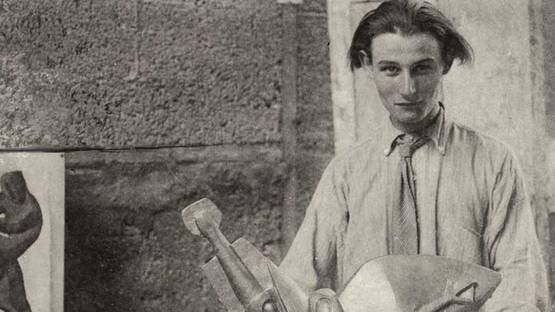
Ahead lay Cubism and collages, and H. D. cutting bits of Greekness full force into vers-libre poems; and Gaudier about 1913 cut (did not cast) a brass figure that embodies in its four inches several hundred formal decisions: that two triangles, one fish-tailed, shall have open centers and bevelled edges, that four finger-like rectangularities shall prolong but displace the downward thrust of a straight vertebral gesture, that next to that descent in high relief shall lie a concavity, its far side curved . . . T. E. Hulme used it for a pocket toy to occupy his restless fingers. It is a sacred object, elusively anthropo- and ichthymorphic, with no god but its own vigor.
David Wojnarowicz, from the series Rimbaud in New York, 1978-79
He drew a crude attempt of Rimbaud’s face across a windowpane. I wear a mask over my face of his own face, a mask of my own face. And while he was still working at the agency, he made a Photostat of the cover of Illuminations, a life-sized mask of Arthur Rimbaud’s face, soft in Ray Johnson’s design, and hard and grainy and pure.
They live lives without any architecture, without structure, lives without form; it is all of it a constant seeping of oneself.
The ‘I’ of my self had crawled through the thickness of memory and consciousness to some other place in the structure of the brain and emerged within a new gray coil.
He stole the camera from his friend after being treated unfairly by him, rather shabbily in fact, and accused of stealing.
A camera in some hands can preserve an alternate history.
And this is but a tiny draft, trying out how to write, how an artist like myself attempting now to art my words, to make my research, using Gladman’s word, simultanate itself, conjoin, on the page where one appears to always be moving forward (though I am always moving back), a transformation of a melody into a harmony, something that unhinges – verticality – so that the prose (so like a poem) goes together all at once.
Later as she continued her piece, she wrote over the lines the way a painter paints over her lines, both erasing and retaining all at once. The paint may cover over but it also glues below what came before, it ghosts the momentary past into the present and it fixes it in place.
How to make a music out of Kobro and Strzeminski’s shattered lives.
She literally writes one passage over the other.
Boustrophedon writing, where alternate lines are written in opposite directions, as oxen, reversing their movement, pull a plow back and forth, the origin of this form being in the turning from one side of the orchestra to the other of the classical Greek chorus.
Portraits and prayers.
Oracion.
And sentences.
All loose manuscripts make portraits and prayers, according to Gertrude Stein.
Stein stands there, Ulla Dydo writes, before the Picasso portrait that represents her, before herself, speaking of herself and of the portrait as is her work.
Crossing over from painting into writing, making writing into painting, painting into writing, an arranging of oneself across a space. Call it a page.
Weaving myself into these notes.
Notes and prayers.
A meditation upon looking, writing, thinking, making, understanding.
Prayers and notes.
To understand that to undertake to overthrow your undertaking.
She demands, Dydo writes, total concentration on the naked text
before the eye and ear
She is tapping ‘rivers’
words
across the street
I see the park and the river
runs along behind it
A word beside another
and it moves
by a path I must discover
moving from the auditory to the visual
sense
‘these’ joined words
‘rambling about the ordinary’
is meditating or writing
She meditates about composition
Name or describe
Nothing
Share, bestow, meditate
Create a stark verbal space
Give nothing away
Sudden shifts
She is in and out
I am here
placed in a plane
Order and placement, writes Dydo, refer not only to writing but also to painting.
Explain wording and painting and sealing and closing
opening
as if doodling or arranging
flowers opening up
A checkerboard. A grid.
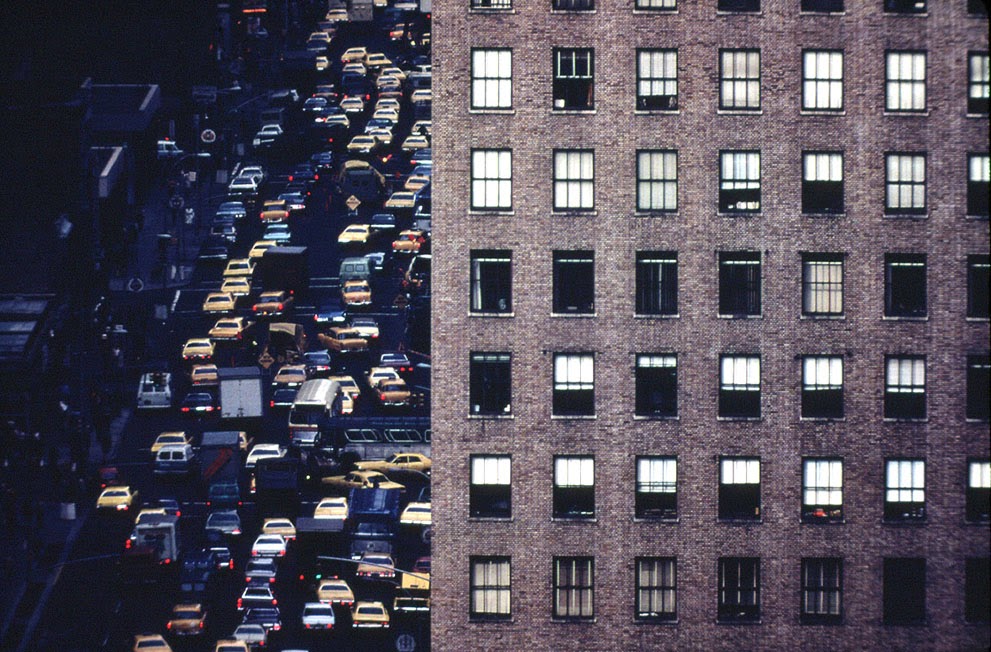
The city is a grid.
And Uwe Johnson had it all laid out on a map that he could see above his desk. A series of maps he memorized, incorporating them, like prayers, into himself.
Regular geometric patterns he could study
Muted colors
‘Stall’ opens words of spatial order –
‘tall,’ ‘all’
–
boxes, loose boxes,
cubes
buildings, windows, walls and doors
Throughout 1921, Gris used the motif of the open window.
And look at the order of time
lodges
in the mind
A sad procession
not a description of private life
They come together as a construction requiring no explanation
an arrangement of words in compositional space
landscapes which make everything visible at once
images after Strzeminski
and Katarzyna opens forms
They met during the first world war, and later had a child.
I am always grappling with the precise arrangement of my words, the words I’m laying out like paint over a blanked out surface – should I move this preposition over there or keep it here? should I shift this clause or phrase to the middle of the sentence or should I keep it at the start in its immediacy and force – with questions of repetition as not only a semantic but a sonic virtue, questions of line and breakage, accidental fragmentation and opposing movements wanting to enfold – fold in – disparate places times and people, thoughts and oppositions merged into a polyphonic fabric weaving in and of itself around a series of events, removing linearity in movement, performing time as a species of space, threatening sinkage into something that cannot be placed but only listened to though hardly sensed, something I’m unpacking with every word as it repacks itself with all the others into something I am almost – often wishing – I’m aware of, somehow glimpsing, even if only partially, even if only accidentally, even if only – what if I’m imagining all this? – close-up or abstractly, something removing and replacing and unhinged I know I’ll never reach or access in some other way, something that may be something, or something, or something, or something, or something altogether different from that something or that something or that something or that something, something else, beyond all logic and all sense, beyond the recognitions of my body or my conscious or subconscious inklings, intuitions, or my hopes, a blankness that is always there.
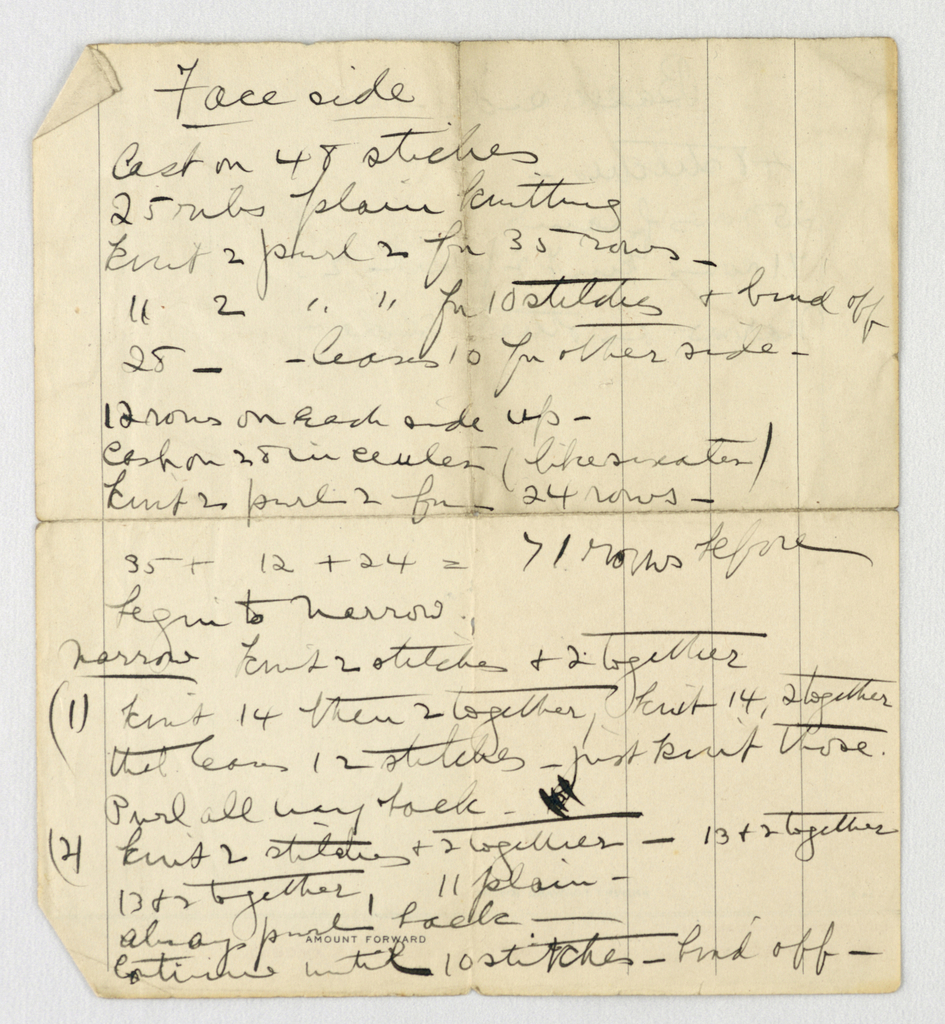
HANDWRITTEN NOTE, MANUSCRIPT PAGE OF KNITTING INSTRUCTIONS, 1900–05
Aurora and aurora and aurora. It may lie on top of the page as the rising light of the morning, or the dawn of the day, or the redness of the sky only just before the rising of our star. The first connecting lines, making something new appear. A word related to another. Joins, to lier (to join, connect) and the homophony. A blank space colored in and made to sound itself imploy. And moment to moment, it is like this. Only something partial. Movement, motion, influence. A minute portion of time. A part of something. Moist. Naturally or constitutionally wet. As when. Turned on. Moved. Saturated. Marked by a discharge. Fucked. Low colloquial. Potently amorous. Fuckster. Addict. Fud. Lying in the region. Pubes, pube, pubescent, as on the surfaces of leaves and stems, or else the bodies of books. The pages saturated, dense. A design of sorts of mind and heart and mood. That indomitable conquering in quivers. Tremor, a sudden, a case for carrying arrows, radiance.
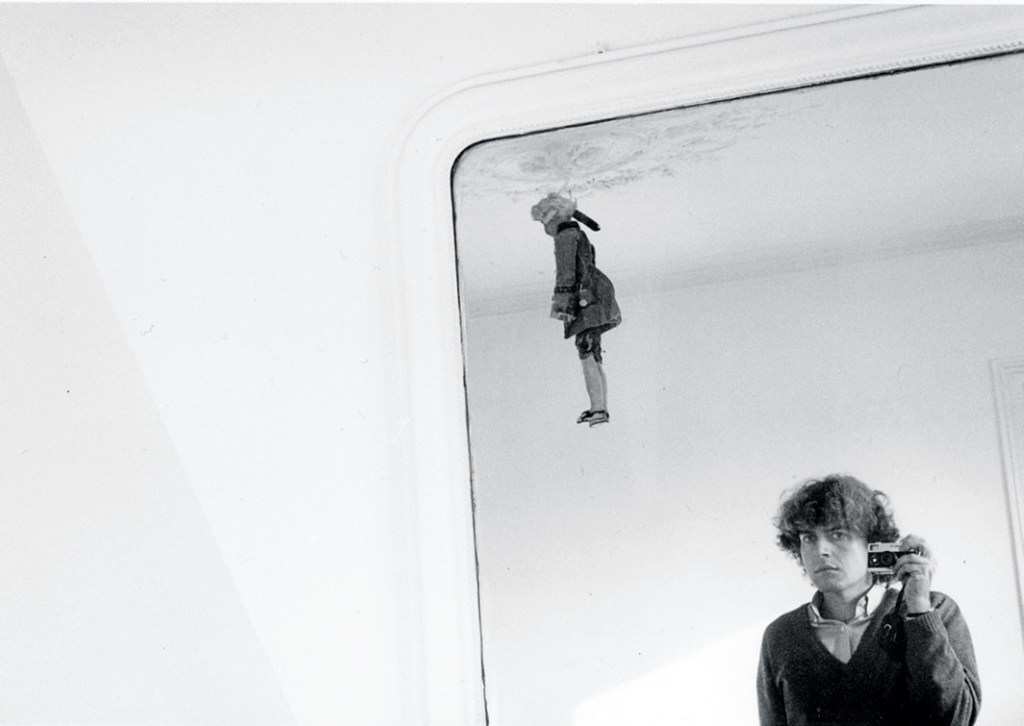
Untitled, 1977/78 by Francesca Woodman. Courtesy Betty and George Woodman
She had become her own puppet – something to be posed and played with, something hanging from a doorway – life-sized, almost crucified.
Hervé Guibert, Autoportrait et pantin (Self-portrait and puppet), ca. 1981
While all the while Guibert arranged – in both photography and words – himself, making from himself a puppet for his sex and for his life, ventriloquizing Thomas Bernhard in what might have been his final book. He didn’t have too long to live, and he could no longer have sex, but he could write. He could always write. It was a way of moving himself about (and later, animating his corpse across a stage) across the page. A recurrent staging of one’s death, played out in the form of graphomania.
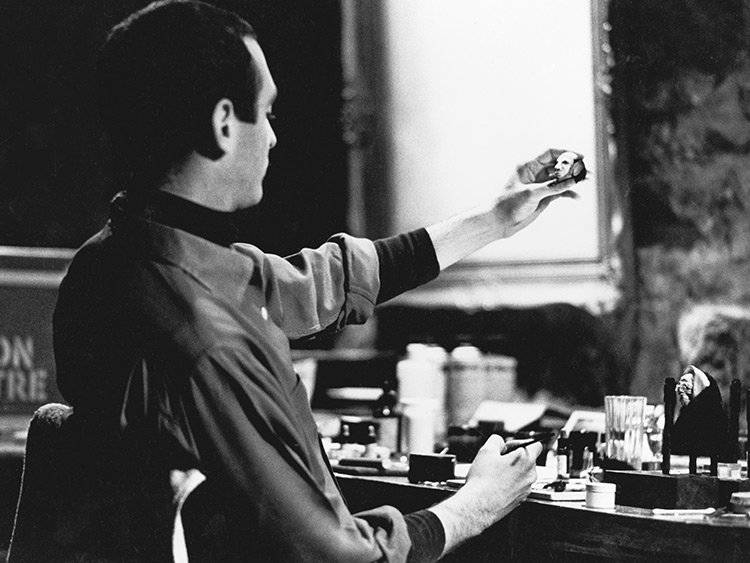
Robert Anton working on one of his puppets
The way that Robert Anton would stage his tiny puppets for his friends. It was a little world that could always exist, even if one was already dead. A concentration of one’s life into one’s hands. His hands, animating at the end, what he could only dream might once have been his life.
There are times I suffer isolation. Trying to write I do anything to avoid beginning, yet I am always beginning. Starting again I want and need to be interrupted, and yet it’s only when I am not that I can work. Sitting here in this café, in loud music, alone, at a low table in the back corner, people, kids, dogs, no one I know, by a window overlooking an old brick wall, I am happy. Just to see the others, just to look outside, is enough. Not needing to be close. And anyway, it’s already begun to rain and I didn’t bring a raincoat and I don’t have an umbrella. And the stained brick wall I see outside the window, and the ivy climbing up and up and up, is a calming in this gentle rain.
When I finish up a project — learn through doing something, ‘master’ something — I move on to something else — photography to film to writing and composing ‘something else.’ And whatever that might be.
But the creative process is difficult. She never thought it was good enough. She complained about the blocks. It is also effort and repeated effort. She could not make something and then enjoy the whole process of its creation.
Today I gained access to Magda’s diary. It was behind a pile of her treated New York City guidebooks. She said that I could have it for a while if I enjoyed, she said, to read it, even use it for my work. Do a treatment of my life, she said, and then, why not?
I found this in her diary, it reads I chose to dance with an abstraction. An abstraction of a city. An abstraction of a life. It is preferable to, as they say here in the U.S.A., ‘fleshing things out.’
That’s what she said as she cut and pasted notes and pictures (and there were also several drawings) onto the newest version of her Guide to the City of New York and its Life. Always reworking the pages, worrying their surfaces with her fingers, looking straight into the chasms and then smiling, though this smile was but an automatic response, a reaction to the sweep of unspoiled air that breezed across her face and then flew by. It wasn’t like this anymore, she said, and this was good. Or at least it was fine. She accepted it. And shouldn’t that be enough? And it was enough. And she was right. It was the paintings over and the rhythms of the words that really counted, as they fell backward, opened, and provided a place for us to sleepwalk into. This was, indeed, true, she felt. It was right. And she’d been noting things that linked them all together, both in marginal notations and her notes, for some time, tying their lives together like a string, stringing their deaths up on a line that you can walk along and post things, add things over, write on.
Difficulty of speech. Feeling at home but not at home. Speaking how I used to speak when I was in South Africa some years before. When I was a Mrs. When I had a husband. But I am not in South Africa. And my name has always been my own. I am not with the same people. I am living in Solonga’s flat (thank you, Geert, for making this possible) and I am mostly on my own, except for Magda and her sometimes visits, except for you when you’re in town. I encounter what I am now calling misunderstanding but which is something else that needs to be defined in a more apt way. It makes me very self-conscious and, I am afraid, sometimes, even paranoid.
I also found a much older note with the same handwriting, on an inserted piece of paper dating from 1993.
So many people were present that she really cared for, people she admired, secretly loved. A strong sensation of time passing, flying by overcame her. This odd sensation she usually felt when she smelled the Wattle Tree; a gentle tree with tiny yellow soft bubbles that reeked of time. She could not describe it any other way; this scent of time.
A Wattle tree, also known as an Acacia, most commonly known as the golden wattle, is a tree native to southeastern South Australia. It has now become naturalized, the way that I almost became naturalized (and it was also at this time, I now learn from looking at the dates, that she was writing this in Eastern Europe), in South Africa. You will not find it in New York.
There was a strong sensation of time overpassing her, moving along somehow, without her consent. But this is not unusual. We surely all feel shortchanged by what is designated ‘time’ by other people.
It struck me that she had used fiction in her diary. I mean that she had been writing in the third person rather than the first. Why did she do that then, and, not now?
I want to be the owner of new memories without having to go through a new experience.
I want to absorb my subjects’ memories for myself, but without living their lives.
And if one cannot genuinely call that a memory, then all she wants is the representation of it; to hold in her hands the aesthetics of a memory embodied in something like a photograph.
To become someone like Francesca Woodman for whom photographs become my memories.
I spend more time reading in her diary and drinking from my tea at the café, and it is no longer raining, and it is no longer overcast, and the light is changing, as the sun, or so we say it in this way because we see it in this way, is setting, and its presence will be noted. The white marble table top near the window is covered in bright sunlight, so that I am for a moment blinded, cannot see other people in the room. Now one-fifth of the marble is in shadow and the little rectangle on the woodwork that I could actually see change before is gone. And the heat and the light of the sun has moved off of me toward the empty chair and wall opposite, and the table itself is now more than half in shadow.
There is an Irish rock band, based mainly out of Dublin, called The Frames. The Frames were once a ‘cult’ band, today they’re widely popular, known through all of Ireland, performing in the U.S. and in Europe. Glen Hansard, their lead singer, worked in a bicycle shop for a little while, but the name came . . . my back garden was so full of frames, my house became known as The Frames house, much to my mother’s distaste, she hated it. But my garden was full of frames, old bikes, I would make up bikes for my friends out of all the old bikes. So it sort of became known if anybody found a bike up on the hill on the way home they would throw it in my garden, a graveyard for old bikes.
Thomas Bernhard’s A Child was the last installment of his autobiography to be published, although chronologically the period it covers should be first. The narrator is Thomas Bernhard at the age of eight, and Thomas Bernhard recollecting (one might say re-imagining) his experiences— when he was a boy, one morning setting off illicitly on his guardian’s bicycle. As in the other volumes, there are two narrators (maybe three), two Thomas Bernhards, though in truth there’s only one; the second (maybe third) is constructed out of pronouns—out of verbs, implications, shifts in tense.
Virginia Woolf once defined a frame as a rule designed to bring order to our perceptions. She seemed to find in music such an order, particularly in the late Beethoven compositions she preferred, his string quartets. She listened to them quite often, especially the Op. 130 in B major with its original final movement, the Grosse Fuge Op. 133, in 1939 and 1940, on an old Algraphone she and Leonard purchased some time in 1925. She was writing The Waves. The number of characters or voices in the novel, like the number of movements in the quartet, is six.
In his unfinished book on Beethoven, Theodor Adorno sets out to reconstruct how I heard Beethoven as a child. I can clearly remember the magic emanating from a score which named the instruments, showing exactly what was played by each. Flute, clarinet, oboe—they promised no less than colourful railway tickets or names of places. If I am entirely honest, it was this magic far more than the wish to know music as such that induced me to learn how to transpose and read scores while still a child, and which really made a musician of me. So strong was this magic that I can still feel it today when I read the Pastoral, in which, probably, it first manifested itself to me. Not, however, when it is played—and that is no doubt an argument against musical performance as such.
The organ was a great influence, confides Glenn Gould, not only on my later taste in repertoire, but I think also on the physical manner in which I tried to play the piano. Early in his teens certain aspects of organ playing—the physical aspects—had made a great impression on me. I learned that when you played Bach, the only way to establish a phrase, a subject, a motive of any kind, was not to do as one would with Chopin—you know, try to make a crescendo in the middle of the thing—but to establish it by rhythmic gasps, breaths. One had to have an entirely different approach, something that was based, really, on the tips of the fingers being responsible for the whole action, something that could almost produce the wonderful whistling gasp of the old organs. So that expression, consequently, was accomplished with practically none of the slurrings and over-fadings, not to speak of pedalings, with which Bach is so often played on the piano. And I really feel that this is entirely due to the fact that, at an early age, I was playing the organ.
The caesuras, the sudden discontinuities that more than anything characterize the very late Beethoven, are those moments of breaking away; the work is silent at the instant when it is left behind, and turns its emptiness outward. Not until then does the next fragment attach itself, transfixed by the spell of subjectivity breaking loose and conjoined for better or worse with whatever preceded it; for the mystery is between them, and it cannot be invoked otherwise than in the figure they create together. This sheds light on the nonsensical fact that the very late Beethoven is called both subjective and objective. Objective is the fractured landscape, subjective the light in which—alone—it glows into life.
Thomas Bernhard never wanted to write an autobiographical work, being averse to anything autobiographical. The fact is that at a certain moment in my life I conceived a curiosity about my childhood. I said to myself I haven’t much longer to live, so why not record my life down to the age of nineteen? Not as it really was—there’s no such thing as objectivity—but as I see it today.
Four paces long by two paces wide; the window opening onto the Seine and onto the forest through foliage rent apart by light.
Red and purple flowers on a black ground—my mother’s dress; and she was sitting either in a train or in an omnibus, and I was on her lap.
I must have been two: according to family records, we stayed at Majorenhof in the summers of 1900 and 1901.
Once when I was very small he lifted me onto this, and I sat there and he began to explore my body. I can remember the feel of his hand going under my clothes; going firmly and steadily lower and lower. I remember how I hoped that he would stop; how I stiffened and wriggled as his hand approached my private parts.
I was forced into examining his leavings and middens like an archeologist sifting for ostracizing potshards.
I can remember toys of some kind lying on the floor and highlights made by the sun at the bottom of the nursery wall.
At two or three or four he claims to have been molested by nannies.
Peasant women, pigeon English, stir the pot to bring the rabbit up to a nice steady boil, sit around the kitchen peeling scraps, letting them drop between their meaty—blue, like spidery ropes, webs—legs, splayed, their raw-encumbered ankles roped—looped with veins, into a bucket, laughing, stooped.
He began to repeat with one hand on the piano certain combinations of sound that made an impression on him.
Alone, sitting in a room—a small room, no longer streaming—in: the light—failing, he will not stir, he will not—move. The words he reads in simple repetition, and the images—the rabbit has a birthday, it’s arranged, it’s a surprise, the silly carrot candles—blow them out! extinguished—one more time.
He is five when his brother takes him to an anatomical museum in Liverpool (on Paradise Street, inevitably) where he sees bleach-pale plaster casts depicting the ravages of venereal disease.
While six he suffers a fall down a single flight of stairs—he tumbles, sits, looks out—behind the alter, pleasantly arranged; there’s soon to be a wedding child—move, go on, get over here—quickly . . . quickly, out of the way boy: pretty flowers, two small bells behind a pew, the lengths of pale blue ribbon bird-emblazoned (yellow-green), the aisles arranged without discrimination: either side it seems will do exactly—just the same: the groom or bride’s—leaving him with a jagged scar on his knee, a wound he will later say he received when his ship was caught in a Tong war along the Chinese coast.
At seven, he complains of being bullied by the other Cub Scouts.
But cold baths made men—made Englishmen—stiffened the sinews, restrung the nerves. As did tennis, rugger, swimming, shooting, golf, church, long strenuous walks.
And he became good at them.
Whereas, before Karrer went mad, I used to go walking with Oehler only on Wednesday, now I go walking—now that Karrer has gone mad—with Oehler on Monday as well.
Away at the Caldicote School, he is struck in the eye playing ball.
Because Karrer used to go walking with me on Monday, you go walking with me on Monday as well, now that Karrer no longer goes walking with me on Monday, says Oehler, after Karrer had gone mad and had immediately gone into Steinhof.
The injury is neglected and an infection sets in which leaves him partially blind for four years. Or so he chooses to believe.
And without hesitation I said to Oehler, good, let’s go walking on Monday as well.
Still he is teased about the size of his member.
He also imagines that his mother, unable to bear the sight of her half-sighted boy, refuses to let him come home on vacations, and that everyone has left him alone.
But still, he would sit down at the piano and perform.
And his mother watched him smiling, improved his chords, and showed him how certain tones would be necessary to carry one chord over into another.
Certainly I have a vision of her now, as she came up the path by the lawn at St. Ives; slight, shapely—she held herself very straight.
A density not normally forthcoming, so it seemed, an interweaving of abstract and concrete, symbol and object, fact, plain fact, and dream, each nourishing on each, each, in turn, nourished; if not yet passion, what might lead to passion, if not yet fluency, at least the flow.
And his ear confirmed what she told him.
The Art of the Fugue was not to be performed, according to Bach’s own notations, on any instrument in particular.
Bridges over rivers made of glass and sky-blue paper.
Years ago I made a little film about my mother’s face.
Signals. Glowing lights.
This matter was considered—reconsidered—left open.
Galloping along the track to catch the train.
I made it with an 8mm camera and a special lens.
Many bright colours; many distinct sounds; multiple voices, woven, unwoven; human beings, caricatures; comic; several violent moments; always including a circle of the scene which they cut out: and all surrounded by a vast space.
In my mind I cross the Sunday-quiet Storgatan and go into the parsonage.
It smells of scouring powder and holiness, just as it did fifty years before.
Smiling minutes after—only taunt.
Even had Bach been in fact satisfied with the organs and harpsichords of the epoch, with its thin choruses and orchestras, this would in no way prove their adequacy for the intrinsic value of his music.
Light as my loves’ thought, the sounds of light stay in.
And if someone were to ask me once again of the circumstances of my birth, I think I should answer finally that I was born somewhere in the middle of my first book.
Her usual smile.
A branch of lilac or bird-cherry.
She asked me to keep them for her.
Today, as I lean over photographs of my childhood to study my mother’s face through a magnifying glass—her soft oval face, gentle sensual mouth, her warm unaffected gaze below dark shapely eyebrows, thick center-parted hair, her strong small hands.
My first memory is of her lap; the scratch of some beads on her dress comes back to me as I pressed my cheek against it.
But it’s the branch that I can remember clearly.
And let us not forget that the absence of idiomatic keyboard writing (the fugue mimics choral style) is a direct result of structural density.
Sitting on the bus the other boys would not abide—the seams of every sentence had to show, the stitchings green—by how my tongue would wrap itself around the words—syllable by syllable, stress by heavy stress—with ease, as if they came that way, bound like beads through luted dimpled wires straight as air—sifting, lit, obscure—to then reveal themselves if only just to me—draped like silk, the worms about to finish, to surround me on my seat—protecting, isolating, warding off.
With great narrative prose, interpretation easily takes on the coloration of a foreign word.
It is interesting, though, that in working there obtrudes from the material, out of the material, various implications for the form that I long expected, but that now indeed astonish me.
The syntax sounding foreign as the words familiar.
I have had this kind of experience since my childhood, when old Dreibus, a neighbor who lived on my street, attacked me in a rage as I was conversing harmlessly with a comrade in a streetcar on my way to school.
And he looked around the spacious room.
Tendrils at the foot of all the pictures.
Gaslight burning as I left.
‘I could not teach myself to see,’ he quotes, a kind of scratch mock-stutter on the page, ‘without, at the same time, teaching myself how to write, for the words, and the observations they comprise, coalesce.’
Maybe because he wasn’t trying to cater to an instrument in any way, there’s a sense that there isn’t a wasted note, there isn’t an artificial or superficial note.
And everything I’ve written since—this intensely structural, intensely hinged and jointed preliminary frame—is an exploration of an image.
Everything is material to the material, everything grows out of the original subject, out of the original six notes which started it all.
At the age of eight I rode my first few yards on a bicycle in the street below our apartment in the Taubenmarkt in Traunstein.
Katarzyna Kobro, Spatial Composition (5), 1929, paint on steel, 9 7/8 × 25 1/4 × 15 3/4
In 1932, Jan Brzekowski, born in Wisnicz Nowy on the 18th of December 1903, who studied in Cracow and in Paris, and in 1924, together with Tadeusz Peiper, Julian Przybos and Jalo Kurek, formed the so-called ‘Cracow avant-garde’ group of poets, publishes a reproduction of Katarzyna Kobro’s Spatial Composition(5) as an example of Unism in his book on modern art published in Budapest in Esperanto.
Esperanto is a non-native language, without any connection to any special territory, or any native speakers. It has a sing song quality. And more than most other languages, it relies on sound in making sense.
Almost all of Kobro’s oeuvre was destroyed in 1939, when the Nazis ransacked her studio. Ten works have survived, including one oil painting on glass. Six others have been reconstructed from photographs, in one case using a recovered fragment. The surviving works are in the collection of the Muzeum Sztuki in Lodz, and circulated in an exhibition, Constructivism in Poland, during the 1970s.
I read in a book recently loaned to me by Geert that the vowels of the Esperanto alphabet are pronounced as follows: the a as in ‘far’; the e as in ‘fiance,’ or like the a in ‘fate’; the i as in ‘machine,’ as in ‘I am a machine’; the o as in ‘toll,’ ‘it tolls for thee,’ or like in ‘for’; the u as in ‘rude’ or ‘rudimentary.’
It is, she thinks sometimes, and now she writes, the gesture that is the primary thing. Feeling my body, the weight of my body, my hand on this sheet, the way I cover it over with a tangle of words, my far too often illegible scrawl, though later I may read it into the recorder, though later I may type it up, looping versus angular strokes, my letters coiled and linked and sometimes torn in the downstroke or the upstroke as I begin to veer, I don’t know where I’m going, somewhere else, or even if I am, or what I am constructing. Something. She thinks of it as her constructivism in New York.
Katarzyna Kobro believed that the task of spatial composition is the shaping of forms that can be translated into life.
Kobro discarded the idea of isolated form. Her sculptures merge with the surrounding space, rather than dividing themselves against it. She wishes that she could do this with her life, determining its rhythms and divisions. It seems to her a way of absolving the world. It seems, she writes, benevolent and open, though, especially given how Katarzyna will wind up, it is also probably naïve.
The articulated structure of the tractate is invisible from the outside.
Consciously composed, his texts make meaning inextricable from the text’s dense interweaving of semantic and formal linguistic elements.
This is prose that immediately announces itself as diction.
Spellbound by what is fixed and acknowledged to be derivative.
The walls stand speechless and cold.
It has a highly accented gait and strong rhythmic accents.
In the wind weathercocks clatter.
It actually scans.
The essay erects no scaffolding and no structure.
All its concepts are presented in such a way that they support one another, that each becomes articulated through its configuration with the others.
This order is not linear but planar.
Elements crystallize as a configuration through their motion.
The moments are interwoven as in a carpet.
Indeed, the experience of reading Aesthetic Theory is of a field
(paratactic parts of equal weight)
in which a recurrent, small scale pattern
(the dialectical movement from assertion to negation)
plays over an endless surface without depth.
From within the law of motion of the thing itself.
Discrete elements set off against one another come together to form a readable context.
The constellation is a force field.
Incorporating arbitrariness reflectively.
The thinker does not actually think but rather makes himself into an arena for intellectual experience, without unraveling it.
To heal thought of its arbitrary character.
To find its ideal form in a mute internal experience.
To render the transient eternal.
Such imitation reads the coherence of meaning from the signs.
The works themselves.
The experience of works of art is adequate
The way the curves
only when it is alive.
Follows them.
The fruitfulness of the thoughts depends on the density of the texture.
If works of art imitate
Therein lies the secret.
Nothing but themselves.
That he obliterates the subject matter through the form.
In speaking, it becomes animated in itself.
The only person who can understand them is the one who imitates them.
Imitation is the path that leads into the interior.
The splinter in your eye is the best magnifying glass.
Similarly, he points out that the weavers who wove these carpets would have had to attend to each knot with a concentration that encompassed the relationship of that particular knot to perhaps eight centers at once.
This allows us in turn to imagine the difficulty of grasping this text.
He talks at one point of asking his students to try to draw the design of a specific carpet and the difficulty they have doing so given their inability to “see” the various centers and their relations to one another.
Both an immersion and an active effort.
The same imaginative movement that follows the immanent movement of the work, in other words, can be called a feeling; it is a work of love.
It is a reading inscribed in a new text, where it will be read by another audience.
A translation is like a text that is read out loud or sung.
In other words, it can be viewed as a performance.
It is writing that begs to be translated, much as music begs to be performed.
The essay performs a mimesis of its object,itsconsciousness of the non-identity of presentation and subject matter forces presentation to unremitting efforts.
Its transitions repudiate conclusive deductions.
Favor cross-connections between elements.
In this alone the essay resembles art.
In the setting of the sun, the Baroque allegorists pictured the fall of the king.
The problem of aesthetics becomes the attempt to justify semblance.
In positivist practice, the content, once fixed on the model of the protocol sentence, is supposed to be neutral with respect to presentation, which is supposed to be conventional and not determined by the subject.
The image bears the seal of the all too earthly: history, the king, physically merged into the setting, nature.
What is essential to philosophy is the mode of presentation.
Every language draws a circle around the people to which it belongs, a circle from which one can only escape in so far as one at the same time enters another one.
The philosopher’s task consists in comprehending all of natural life through the more encompassing life of history.
For one can hardly speak of aesthetic matters unaesthetically, devoid of resemblance to the subject matter without falling into philistinism and losing touch with the object a priori.
Any subjectively imposed order is a mask for chaos.
This is the case for Heidegger, for whom history, understood as an all embracing structure of being, is equivalent to his own ontology.
Eventually a state was reached which the outsider is inclined to describe as paralysis of the critical faculties.
Here significance is not meaning, but a physical burden.
The entire structure of assumption, development, and proof, is discarded in favor of a dialectic of the object itself.
Yet no less indispensable is the cautious probing of the spade in the dark loam.
What is methodical in excavation is the return to the same subject matter.
Art is semblance that, by its very completion, causes semblance to collapse.
By breaking off discussion again and again and beginning it anew.
Luck is given room in which to clear the way for a discovery.
In 1923, when Walter Benjamin published his translations of Baudelaire’s “Tableaux parisiens,” he prefaced them with a short essay entitled “The Task of the Translator” (“Die Aufgabe des Ubersetzers”).
It can take up subterranean relations with other elements of the text and disclose a new context.
Just as the stars belonging to a constellation are unrelated for an astronomer, but for the astrologist constitute an order only as an image.
Benjamin’s essay performs an act of translation.
The invasion of the foreign.
Where language appears essentially as language.
Music resembles language in that it is a temporal sequence of articulated sounds which are more than just sounds.
Where it becomes an exposition [Darstellung], it does not define its concepts.
This is language that strains against the bounds of acceptable sentence structure; its tendency is to free individual words and phrases from their immediate context, often giving them an ironic twist through which they seem to enrich and comment upon their context.
To understand one another, it is not enough to use the same words.
For Benjamin, translation does not transform an original foreign language into one we may call our own, but rather, renders radically foreign that language we believe to be ours.
Words are acoustical signs for concepts.
What is lined up in sequence, unconnected, is as harsh as it is flowing.
In a manner reminiscent of Hegel, mediation of the vulgar kind, a middle element standing outside the moments it is to connect, is eliminated as being external and inessential.
Holderlin inaugurates the process
Within this grammar of musicality,
It unfolds as a series of moves
that leads to Beckett’s protocol sentences.
motivated by other than logical considerations.
a crucial role is assigned to transitions.
The absence of all mediations introduced into the work from the outside makes the musical progression seem fragmented and abrupt, with the impression increasing in direct proportion to the actual degree of inner organization.
In poetry, as distinct from music, aconceptual synthesis turns against its medium: it becomes constitutive disassociation.
Our translations, even the best ones, proceed from a mistaken premise.
The dream deposition is stilled to a protocol sentence.
They want to turn Hindi, Greek, English into German instead of turning German into Hindi, Greek, English.
This is an unlikely spot for a Yiddish story, but nevertheless: The chancellor rushes into the throne room and informs the king that the harvest has been infected; whoever eats from it falls insane. He urges the king to seize what untainted stores remain and rule a mad people sanely. The king refuses; he will not be separated from his people. “Instead,” he tells the chancellor, “we will make signs on our foreheads so that when we are mad we will know what has happened.”
Discontinuity is essential to the essay; its subject matter is always a conflict brought to a standstill.
But there will be the acoustic illusion that where nothing is heard, nothing is there.
The translator will naturally want to do justice to this musical element.
Nothing at all may remain outside.
Yet clearly the different sentence structures of English and German produce different rhythms.
It would be neither helpful nor appropriate to try to force Adorno’s writing into the flat rhythms and logical denouements of ordinary academic English.
All the same, he must try to create a pronounced English rhythm.
Focusing, then, on what is wrong with the translation, taking sentences by the handful, here is what one comes up with: The first phrase of the essay, “As we have seen”—though a seemingly convenient bridge from the lead essay, “The Concept of Enlightenment”—it does not occur in the original, or for that matter, anywhere in Adorno’s writings. The book is only able to organize adequately its complexity because of its paratactical structure, which eschews all such bridges.
Instead, it can expand as an endless, rhythmical self-completion in space.
Essential to such a text is the shock through which it forcibly interrupts communication.
Into an exotic strangeness outside of the familiar, which has the semblance of the available.
To gain such perspectives without velleity or violence, entirely from felt contact with objects.
Though this particular translator’s interpolation does not block comprehension, it implies a general misunderstanding of the text, and in the face of the book’s intricacies, this misunderstanding consistently catches sentences going the wrong direction.
Interpretive understanding presupposes a closed context of meaning that can be reconstructed through something like empathy on the part of the recipient.
What bars access to translation as such is the unquestioned value judgment and preference granted to the original and to the translation’s closeness to it.
Musicality in language is a grammatical rather than an acoustic category.
Our translators have a far greater reverence for the usage of their own language than for the spirit of the foreign works.
Adorno’s focus on parataxis as a key element in Holderlin’s poetry highlights his awareness of the semantic possibilities inherent in grammar and grammatical complexity.
Quite another matter is the use of commas. In German, the principle function of the comma is to mark the boundary between a main and a subordinate clause. The English comma, by contrast, usually corresponds to a short speech-pause; where there is no speech-pause, there is no comma.
To reproduce the rhythm in German one has to do violence to the language by leaving things out.
Articles are often deleted, the reference of pronouns is frequently obscure and is sometimes irreducibly ambiguous, prepositional objects are almost as a rule elliptical, the subject of a clause may be deleted and reappear in the form of a relative clause, the relexive pronoun—sich—is deferred until the end of the sentence, the negation—nicht—may appear, unconventionally, at the beginning of the sentence, foreign, classical, and archaic terms recur regularly, adverbs are positioned ungrammatically and accordingly accented.
These and similar oddities have been rigorously maintained in the present translation as a reflection of his characteristic voice.
That he is no stranger to Anglo-Saxon forms of thought and presentation has been demonstrated.
“As little German as would be English” indicates that the original is worth translating precisely because it is foreign to its own language.
But also with the realization that even when Adorno was writing “in English” he was still writing in German.
As in dissonant music, such language draws its strength at least in part from its capacity for opposition to the very structure within which it was created.
Progressive by the standards of conformity, regressive by the standards of the material.
The serious dash: its unsurpassed master in nineteenth-century German literature is Theodor Storm.
So long as this system of values, which is based on originality (Ursprunglichkeit), is not called into question, the danger exists that what is specific to the translation is repressed in favor of what it has in common with the original.
Translations are futile attempts to patriate what is foreign.
We see a landscape and we see a man and in that landscape the landscape and the man are always different.
The translator wants to provide an Adorno that would act as tour guide to aesthetics; a long trip is planned, with occasional detours, clearly marked.
Not only did Adorno hold that presentation [Darstellung] is as important as the content presented. But he was also convinced that English is a poor vehicle for his philosophy.
If the translation is better the smaller its distance from the original, then this distance measures only the degree of incompleteness of the translation and becomes unimportant to the extent that the translation is successful.
This is comparable to illustrating an internal relation between a circle and an ellipsis by gradually transforming the latter into a circle—not to be able to claim that a given ellipsis actually, historically, was created from a circle (developmental hypothesis) but only to sharpen our eye for a formal connection.
And this is the essence of melancholy immersion.
I look at a landscape, my gaze ranges over it, I see all sorts of distinct and indistinct movement; this impresses itself on me, that is quite hazy.
No such correspondence is possible in a translation.
This explains why kinship may only be defined negatively.
Discontinuity discloses something.
Adorno’s texts attempt to use the power of the concept to undermine the concept and thereby enable the nonconceptual to speak.
In a text, for example, the semantic context must be broken through in order for relationships of similarity to be produced.
The kinship between languages generates their difference.
Their affinity is their presentational relationship to what has been withdrawn.
Affinity cannot be proven argumentatively, but may well be presentable.
The natural metaphors for translation produce the opposite of organic fruition.
This productive word that renders meaning extinct is that of literality (Wortlichkeit).
The task of presentation is to regain what is noncommunicative in language, which has been lost to “cognitive meaning.”
Adorno considers the languagelike quality of artistic form to consist in its resemblance to syntax.
The essence of affinity is enigmatic.
For the sentences are linked in this activity of recontextualizing, but without discursive adjudication.
The obsessive, slightly vertiginous quality of the text results in part from the willed lack of development, which is replaced by a kind of insistent rhythmic nervousness and an omnipresent referentiality in which each stage and element of the text looks backward and forward to other elements.
One assertion of position is transformed into another on the basis of resemblance, but the resemblance that permits the transformation is never definitively specified.
If the kinship of languages manifests itself in translations, this is not accomplished through the vague resemblance a copy bears to the original.
Elements of his “style” have little to do with his “characteristic voice.”
For the translator’s task of “fidelity” (Treue) calls for an emancipation from all sense of communication.
Its principle remains the discontinuity of what is assembled.
This exaction of literality, must not be understood as an interest in meaning, but “aus triftigeneren Zusammenhangen.”
The vehicle that is consumed so that the flame can appear.
In the interests of accessibility the translation of Aesthetic Theory tends to reveal the essential complexity of the original, and with it at times the implicit dialectical method which is “inscribed” in the text.
In German this book is almost too interesting to read.
The differently constituted “logic” disdains deduction, as it resists paraphrase precisely through its illogical or ambiguous “art of transition.”
The experience is mediated through the essay’s own conceptual organization; the essay proceeds methodically unmethodically.
Complex, precise, and inventive in its eccentricity, it reflects his appreciation of articulation as one of the criteria by which aesthetic excellence is determined.
Accordingly, I decided that I was dealing with a linguistic mannerism of sorts which had no autonomous relevance and detracted unnecessarily from reading the text.
It had to be disfigured beyond recognition, the basic intention no longer
recoverable.
While it is undesirable to make a fetish out of complexity for its own sake, it is necessary to recognize that the complexity of the style is in part derived from a very calculated use of contradiction—what one would almost call “contradiction as method.”
In response to my polite protestation I received a no less polite and sympathetic explanation that the journal owed its reputation precisely to its practice of subjecting all contributions to such editing [Redaktion].
In the French translation, however, the word “editing” is rewritten: because in French “éditer” means to publish a book or magazine; in order to capture the more violent editorial sense of the word it had to be replaced with—“rewriting.”
I gave it the appearance of something that is foreign yet not incomprehensible.
Against such a view stands the fact that there is translation only insofar as it differs from the original.
This is the minimum requirement—to be new in every respect.
It wants to be what is German that is not German, and if it finds real resonance here, it will be with what is American that is not American.
I should like to compare the work of art to the monad.
A fragment, like a miniature work of art, has to be entirely isolated from the surrounding world and be complete in itself like a porcupine.
The original is not something that is established once and for all: being translated modifies it.
The relationship of the work and the universal becomes the more profound the less the work copes explicitly with universalities, the more it becomes infatuated with its own detached world, its material, its problems, its consistency, its way of expression.
There is another criterionthat determines the quality of a work of art, and that is the degree to which it is articulated.
It is not possible to conceive the rank or quality of an artwork apart from its degree of articulation.
As to Roithamer’s major work, the paper entitled “About Altensam and Everything connected with Altensam, with Special Attention to the Cone,” which after all contains everything Roithamer ever thought in the most concentrated form and in his most characteristic style, as I perceived at once when it first came into my hands at the hospital, and which is more publishable than anything else he ever wrote, I shall pass it on to his publisher untouched, just as I found it, the first eight-hundred-page draft, and the second three-hundred-page revision of this first draft, and the third version, boiled down to only eighty pages, of the second version, all three of these versions of Roithamer’s handwritten manuscript, for all three versions belong together, each deriving from the previous one, they compose a whole, an integral whole of over a thousand pages in which everything is equally significant so that even the most minor deletion would reduce it all to nothing, all this taken together is the complete work.
Fragments of a vessel that are to be glued together must match one another in the smallest details, although they need not be like one another.
To the extent that the meaning is unavailable, the Fremdwort gives the writer the opportunity to shift the emphasis away from the semantic to the acoustic or rhythmic dimension.
Ordering categories, which reduce the difficulties of active listening at the cost of the pure elaboration of the work, are eliminated.
Its breaks and idiosyncrasies are constitutive.
In the same way a translation, instead of imitating the sense of the original, must lovingly and in detail incorporate the original’s way of meaning.
If one proceeds from the assumption that the original and the translation say the same thing, then this “same thing” in the translation is something different, because it is in a translation.
Convergences of this kind show formalism to be the true realism.
This, to be sure, is to admit that all translation is only a somewhat provisional way of coming to terms with the foreignness of languages.
It requires that the words should be like columns firmly planted in strong positions, so that each word should be seen on every side, and that the parts should be at appreciable distances from one another, being separated by perceptible intervals.
This translation, however, takes its lead not so much from the aim to copy the appearance of the original, but rather from Adorno’s description of the hearing implicit in Mahler’s music: an “amplitude of hearing encompassing the far distance, to which the most remote analogies and consequences are virtually present.”
Their constellation, not their succession, must yield the idea.
It does not in the least shrink from using frequently harsh sound-clashings which jar on the ear; like blocks of building stone that are laid together unworked, blocks that are not square and smooth, but preserve their natural roughness and irregularity.
If it is possible to take a translation for an original, then we can no longer be certain that what passes itself off as an original is not a translation.
The basic error of the translator is that he preserves the state in which his own language happens to be instead of allowing his language to be powerfully affected by the foreign tongue.
Throughout his career, Adorno’s systematic thinking about writing and language seems to have been guided by the ideas of Walter Benjamin, in particular by the essay “The Task of the Translator,” to which he habitually deferred.
In the translation which makes literalness its guiding principle, the allegorical core of Adorno’s work becomes manifest.
To translate is to speak second-hand. What is said is only accessible by way of the detour through the text that is to be translated.
One must assemble the whole out of a series of partial complexes that are, so to speak, of equal weight and concentrically arranged all on the same level.
The concealed order of the constellation, which evades communication, will shine forth only when a word bursts out of its context.
This is particularly so because the linguistic specificity produced through the translative failure is best brought out by those moments in a translation (such as the one that follows) where “untranslatable” terms are retained in German next to their impoverished English relations as an index of the latter’s inadequacy.
It is also unnecessary, indeed contrary to Adorno’s purpose, to insist that the same word be translated in the same way in every context.
The irony is of course that conquering the book, narrowing the distance for the good of its readers, puts it permanently beyond them.
The essay uses equivocation, not out of sloppiness, nor in ignorance of the scientific ban on them, but to make it clear.
Assuming one does not prefer simply to read it.
Very often, the same concept is translated by two or more different terms in different contexts in the English version, without any acknowledgement of this.
The work, the age, and illusion are all struck by a single blow.
The criterion of clarity is rigidly enforced by a grammar which taboos long sentences as clumsy and whose ideal remains brevity and simplicity at all costs.
Ein Schlag trifft Werk, Zeit und Schein.
Instead, it attains what is particular to its status as derivation from an original precisely by repeating the original.
A single blow strikes the work, time, and semblance.
The “originality” (Uriginalitat) of the translation is not to have any and to refer to another text as its precondition.
In opposition to the cliché of “comprehensibility,” the notion of truth as a causal relationship, the essay requires that one’s thought about the matter be from the outset as complex as the object itself.
The artist does not create the work but constructs it according to the requirements of the material.
The way the essay appropriates concepts can best be compared to the behavior of someone in a foreign country who is forced to speak the language instead of piecing it together out of its elements according to rules learned in school.
No poem is intended for the reader, no picture for the beholder, no symphony for the audience.
It is, of course, the situation of the translator and also holds for those who are concerned in some way with questions of translation, but not for the reader to whom the translation is destined and who would like to read in his language what he does not understand in the foreign tongue.
Only through translation does the work’s foreignness to its own language become apparent.
All this, in German no less than in English, breaks with generally acceptable usage.
The highly inflected character of Adorno’s German enables him to establish an idiom whose distinctiveness relies to a considerable degree on its deviation from the norm.
It “tells” very little to those who understand it.
In that way, words that are at first surrounded by indeterminateness begin to “decipher themselves through the abundance of combinations in which they appear.”
Where the meaning of the original work is not external to its language, translation can no longer be conceived as the reproduction of meaning in a more or less transformed linguistic setting.
The result of this is that the translation reaches its self-sufficiency with regard to the text that it reproduces precisely when it makes the most of its independence and thereby of its discord from it.
In the extreme case in which both texts belong to the same period and contain no clues that help identify one of them as the later one, it can become uncertain which of the two is the original and which the translation.
In the words Brot and pain, what is meant is the same, but the way of meaning it is not.
With the abstraction of meaning from the particular universe of discourse in which it constituted itself, the meaning is no longer that which it was.
The original cannot enter there in its entirety, but what does appear in this region is that element in a translation which goes beyond transmittal of subject matter.
Foreign terms, except for technical ones and quotations, can and should be patriated, in any translation.
No such conciliation has been achieved in German, nor can any be brought about by the writer’s individual will. He can, however, take advantage of the tension between the foreign word and the language by incorporating that tension into his own reflections and his own technique.
He does not speak metaphorically, but presents.
He presents in the precise sense of not saying.
Its principle remains the discontinuity of what is presented.
Parataxis, the placing of the elements of a sentence in series in which they are not bound to each other by conjunctions or subordinate clauses, is a grammatical trope that, like the “broken off parables,” creates a kind of disjunction and nonspecificity which undermine logical clarity and causality, leaving room for a certain vagueness, and interpretation.
Irresistibly, Holderlin is drawn to such forms.
Discontinuity is also established by reading differently.
The nineteenth century considered Holderlin’s translations of Sophocles monstrous examples of such literalness.
The spatial organization of the text is identical to the original.
Not a single word is interpolated for greater readability.
Adorno’s German is a model of Pragnanz (economy of words).
If each word is to be visible from every side, the disposition of the space between or around the words becomes of paramount importance to the construction.
A literal rendering of the syntax casts the reproduction of meaning entirely to the winds and threatens to lead directly to incomprehensibility.
With the foreign word he can effect a beneficial interruption of the conformist moment of language, the muddy stream in which the specific intention drowns.
He spoke by starting at the top of a full inhalation, which he followed down to the last oxygen molecule left in his lungs, and in his written style perfected dozen-page paragraphs hardened to a gapless and sometimes glassy density, as if even the slightest hesitancy for an exhalation or any break for a new paragraph would have irretrievably relinquished the chance for completing the thought.
Speechlessness has nothing to do with depth.
Density as a principle of writing by criticizing the rigid distinction of horizontal and vertical aspects of thought, its discursive associational aspects, through the equivalence of every element.
It is not words and meanings that fail one, but sounds.
Almost ingeniously the language pulls away from the movement of thought that can still be sensed gesturing underneath, giving the book a disembodied quality, as if it were dubbed rather than translated.
Constellations presuppose discontinuity.
Running out of breath.
Yet Adorno is drawn to them.
Gaps, breaks, hiatuses.
Whether it was the German pronunciation or the syntax of Adorno’s lecture which rendered it so foreign.
The preservation of meaning is served far better—and literature and language far worse—by the unrestrained license of bad translators.
Every transition must be a transition in the object itself if it is not to unhinge the text.
Only breaking through the textual structures of meaning divulges the relationships suppressed by the intended communication.
Making things of which we know not what they are.
Although speechlessness seems to leave everything open.
The nucleus is best defined as that element in the translation which does not lend itself to further translation.
Memorable themes are left behind, sure to be endlessly quoted while their content has been eviscerated.
Nothing is stored up in it. Nothing is silenced because there is nothing there.
Rather than the dense constellative blocks of the original, the translation has broken the work up into paragraphs.
To the nominalist indifference to form, this seems to be a harmless visual convenience.
It documents the mythical content that has been superimposed on the work: since the sections are not in any sense monodirectionally sequential, following the numbers only insures getting lost.
Behind the order of communication, another order is disclosed.
Though one may glean as much of that subject matter as one can from translation, and translate that, the element with which the efforts of the real translation were concerned remains at a quite inaccessible remove, because the relationship between content and language is quite different in the original and the translation.
The Aesthetic Theory is a technical achievement that has been archaically repossessed in translation.
German sentences have a history.
There is a parallel between versification and rhyme, the traditional forms of Victorian poesy, and the tonal system in music.
But the style of parataxis is as ancient as it is modern.
It can take up subterranean relations with other elements of the text and disclose a new context, one that is not conveyed, but that arises from the convergence of things having nothing to do with one another from the perspective of the text’s structure of meaning.
In place of deductive reasoning, Adorno proposes a textual structure in which all concepts are articulated in relation to a “utopian intention” that rests in the configuration of the whole.
The contemporary relevance of the essay is that of anachronism.
In the Aesthetic Theory every word has, so to speak, been indented.
The idea that there is no fundamental difference between old and new music must be related to the concept of the subcutaneous.
Adorno compares Holderlin’s work to “great music.”
Yet perhaps the most serious obstacle to the development and articulation of dialectical thinking in English is not semantic but syntactic.
If, in a translation, the Fremdwort refers to the language of the “original” text, the use of the Fremdwort within the “original” text itself functions, in juxtaposition [Gegenubersetzung] to the language of the text like a counter or reverse translation [Gegen-Ubersetzung].
Here and elsewhere in the late essays one senses that Adorno’s exposure to English also had an effect on his German sentence structure.
He frequently uses unusual and inverted word order.
His sentences have a choppy quality that recalls the “breaking off” he observes in Kafka.
Another instance where his English remained German.
Even without an explicit epistemology, the essays should be able to speak for themselves.
The notion of a nonsubjective language, or intentionless language exerted a lifelong fascination on Adorno and is central to his preoccupation with music as close to the “true language,” or the language of God.
The untranslatability of Adorno is his most profound and cruel truth.
The elementary prerequisite for this is that the translation be recognizable as translation.
Let the wind speak.
We have to do here with nameless, non-acoustic languages, languages from the material.
If Adorno is translatable at all, something which by no means can be taken for granted, it is precisely by virtue of his untranslatability.
Unlike a work of literature, translation finds itself not in the center of the language forest but on the outside facing the wooded ridge; it calls into it without entering, aiming at a single spot where the echo is able to give, in its own language, the reverberation of the work in the alien one.
Its moments, which as moments are conceptual in nature, point beyond the specific object in which they are assembled.
The whole is a monad.
Wieland Schmied called it Erschopfung (exhaustion), and there is no appropriate English word for it.





 marginalamericannotes.com