Nothing is happening. Nothing is happening. Nothing is happening.
Whenever nothing is happening. Not happening is happening.
We are just talking. That is all that we are doing. That is all that we are not doing. This is in fact writing.
This is just a little writing.
The title of Ray Johnson’s selected writings: Not Nothing.
Not Nothing is a display of ashes.
Nothing changes from one generation to another except the things seen and the things seen make that generation, that is to say nothing changes in people from one generation to another except the way of seeing and being seen.
His presentations thwarted expectations and exhausted audiences. And Reichek remembered the duration of Reinhardt’s slideshow such that “you slipped into a state.”
And we all lay on the floor and he served us sherry and we watched slides.
We are seeing nothing. Nothing is being seen. We are attending to nothing. Attending nothing. It is all a pile of nothing.
Johnson’s “Nothings” – around thirty such meetings took place in the years up to 1977. In 1980, he placed an ad in the art section of the New York Times to announce, “Ray Johnson/ nothing.”
The more one eliminates the more logical life seems to become. I feel it may be possible some day to eliminate EVERYTHING.
There are multiple, oblique and shifting narrators in Johnson’s epistolary writings and notes, but the discrete “I” does not exist.
Void yourself at all times as you see me void. Shit.
Avoid something. Always and never. Avoid something.
I feel nothing.
And nothing is happening.
Reinhardt called his lectures “non-happenings,” suggesting, along with the wordplay of his 1963 talk “Get the Flux out of Here,” a direct awareness of the happenings of Allan Kaprow and Fluxus events in New York, and John Cage’s classes at the New School. Reinhardt was no doubt channeling one of the most notorious lectures at the Artist’s Club, Cage’s “Lecture on Nothing” in 1950.
I remember loving sound before I ever took a music lesson. And so we make our lives by what we love. (Last year when I talked here I made a short talk. That was because I was talking about something; but this year I am talking about nothing and of course will go on talking for a long time.)
Nothing is long. Nothing lasts. Nothing is real.
Not Nothing includes not only notes he sent to others, but also the scored corrections of one dissatisfied with the quality of response, an enfolding criticality.
For the last few years, the French artist, Pierre Leguillon, has been performing his Non-Happenings (After Ad Reinhardt). These lectures are built around slides that he has borrowed from the estate of Ad Reinhardt.
So I was always very curious about Ad Reinhardt’s slides . . . why they attracted no attention.
Because the slides are not for sale. They cannot be bought, and they are, in themselves, nothing.
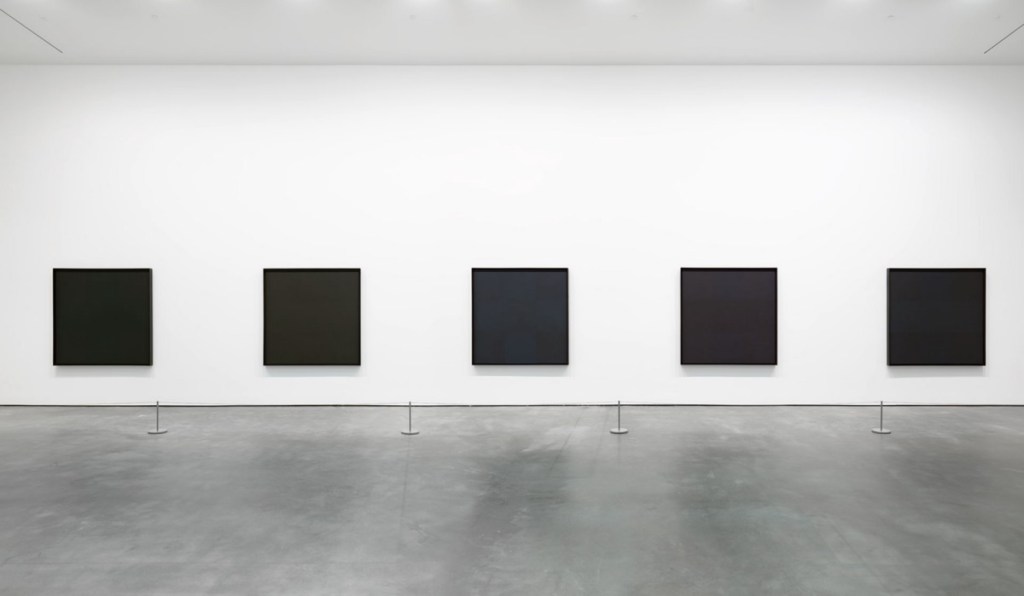
Just think about how he referred to the black paintings to which he devoted the last twelve years of his life, as “free, unmanipulated and unmanipulatable, useless, unmarketable, irreducible, unphotographable, unreproducible, inexplicable icons.” So he could only speak or write about what his painting was not. And in his slide shows everything becomes a flat photographic surface . . . everything is nothing but the photographs themselves. So at the very end, you almost don’t remember anything – you don’t remember anything at all – nothing – and that is the Non-Happening process. Nothing is arriving.
There is something about the vertical. The vertical is wild.
A painter will perhaps agree that a color insists on being a certain size, regardless of his wishes. The color may go on the surface as a pointillistic dot, as something hardly even noticed, as a line or a smudge or a dash, or it might cover the entirety of the canvas in one all-encompassing monochromatic wash; instead of merely complementing the landscape, it may become the landscape. Or it may decide instead to just move up and down much more containedly and cover up the space like Barnett Newman’s TheWild from 1950.
When sound is conceived as a horizontal series of events all its properties must be extracted in order to make it pliable to horizontal thinking.
It has nowhere to go and going there is not about telling a story. There is no story. There is no going. There is no there. A sound simply stops.
Christian Wolff once remarked that eventually everything becomes melody.
I’ve always believed in history. The history of art embedded in one’s work. A horizontal line that intersects the vertical its substance through an auto-medium-specific mediation of one’s own devising. One performs a kind of séance. One seeks to haunt one’s work with ghosts.
The mistake is trying to view one’s work as Pasternak does when he writes of his love for the ‘living essence of historical symbolism.’
It can be a sort of harmony. It can even be dense.
And in it red speaks more than blood, although it is, nonetheless, bloody, and sound itself must be allowed to appear the way it does for Kandinsky, in Kandinsky, although his yellow will no longer be enough.
For Guston art at its inception is synonymous with an all-powerful dynamic in nature rather than a man-made history disguised as nature.
Art approaches nature as it begins to transcend it.
Time itself becomes less perceptible as movement, more conceivable as image.
Writing a line. Drawing a line. Making a line. Drawing words on a line. It is praying in Spanish. Making a sentence. An invocation. Interrupt.
The instant is a vertical interruption.
A line from the Talmud.
And life a passing shadow.
Art in its relation to life is nothing more than a glove turned inside out.
Try and hold on to that!
A prayer for guidance. A prayer for presence.
The atmosphere of the work of art, what surrounds it, that ‘place’ where it exists, is where we find ourselves as we begin to lose our place, and a place has been displaced, and we are placed (replaced) right here.
Wladyslaw Strzeminski, from Cheap as Mud series II
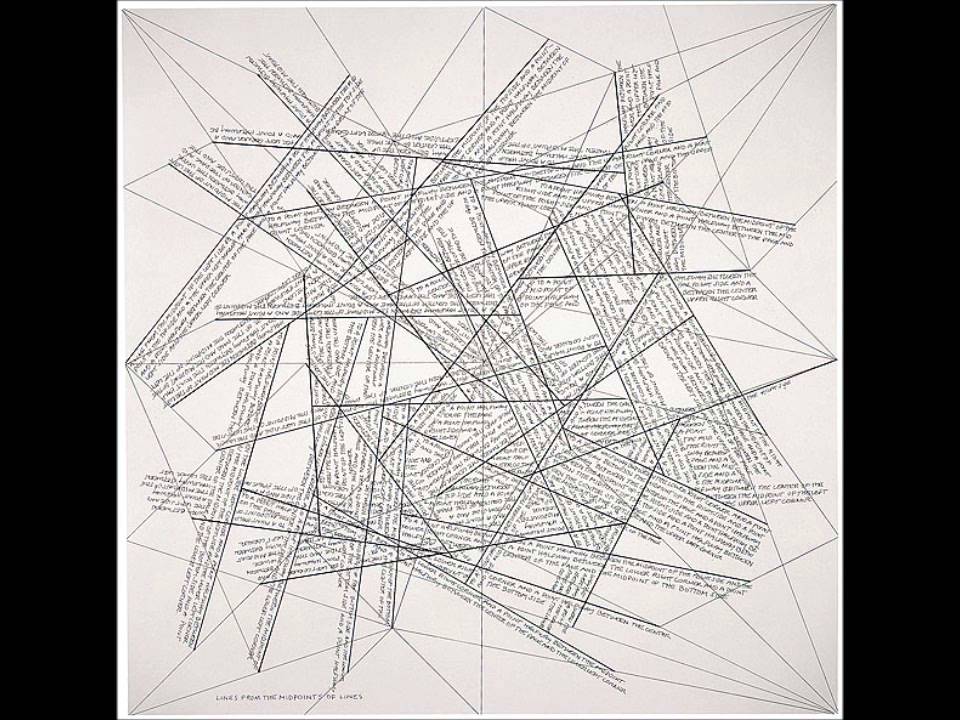
Isolated figures drawn on a blank piece of paper with a meandering line War Against Homes And everything is gone impersonality Cheap as Mud Rigor Mortis. Gestures. Ink on white, light-grey, light-brown, or greenish paper bordering these documentary photographs The Existence of Feet that Trod and receding into a boundless white void In 1952 Strzeminski was writing unfinished before his death a novel ‘The poetic structure of the disintegrating text’
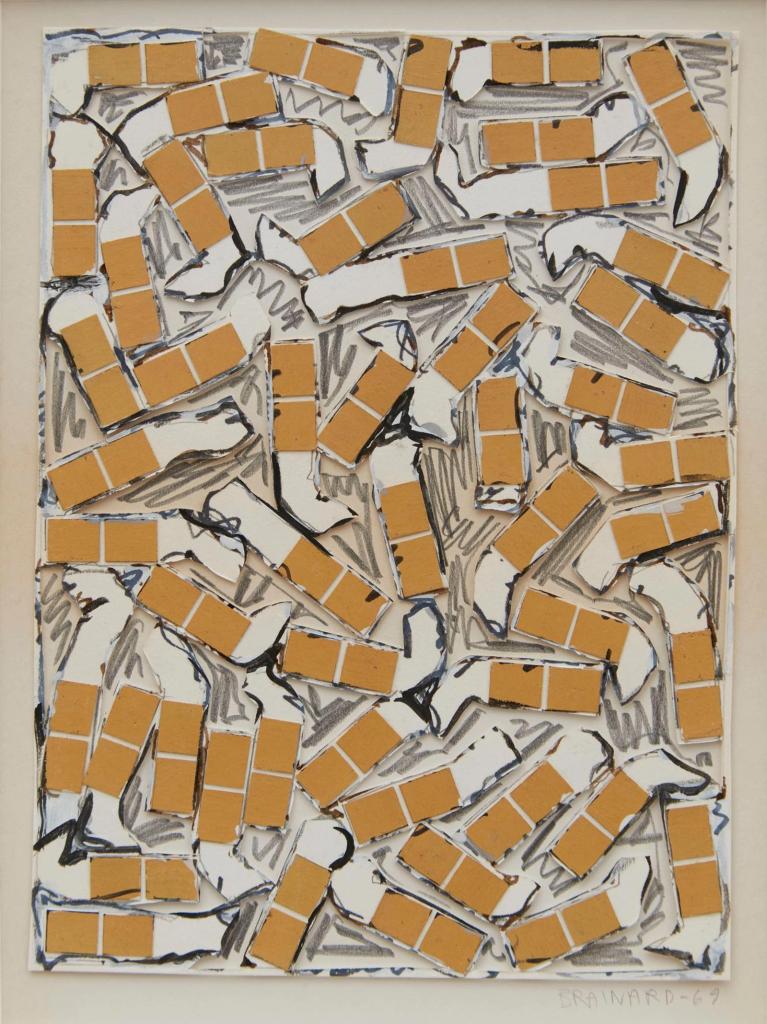
Joe Brainard Cigarette, 1969 Graphite, gouache, and mixed media collage on paper
They were lived with living I have not ordered them to educate the fingers carving out the heads and arms and legs of tiny wooden dolls performing vitally our lives respecting the boundaries or edges of the text, revising these bumps by cutting and restitching from outside, keeping new writing to a minimum and in this way, always seeking out the unacknowledged and accepting, from many sources, this collage strips, I thought I might copy and send to you something always provisional cut it, drown it out, mistreat it in any ways that seem appropriate this is actually a marker of extremist care, an indication, as it echoes, of the word “tentative” this propensity toward inconclusion, and always the provisional in art coming from an understanding that most good things are tentative, it’s about leaving things intentionally unfinished unresolved and open-ended “I have arranged things so that arguing a shift in focus toward the “unit of the book” we might reimagine them as “entries” revealing, but always in a “parallel” way a way of caring for these works a grasp for fragments death taking dictation a sadness paradoxically like joy caught in a hinge “As a box is to a kite. The inside of stumbling. The way to breath. The caricature on the blackboard.” It’s a hybrid sensation up the center of the hinge, the space behind the walls the heart of the artist vacating the enclosure of the work
To the last two days here, there is a novel-within-the novel, nothing happens and it always rains.
Short in often one or two-word sentences, reports from a stream, like a photograph.
A sudden absence from herself, circling thoughts, preoccupation with suicide (one for example: cut with scissors).
But writing can only be done about failure or loss, and here the images are birds, trapped birds inside a house.
The installation also consisting of quotations (the pleasure of research) from a Russian ornithologist, I made the cage of feather coated wires spaced gradationally, among the Calvinist tracts and the fluttering birds.
There’s a swallow trapped in a church, a long riff about saving creatures from suffering in the rain, an injured miserable cascade.
Though she is already in America, writing long letters later to become an art under her own name, the author everyone agrees almost certainly invented.
It is the blindness of a cage, in the exhumation of these bones, made into art.
She had come from afar. It was the first day. And she was walking through Solonga’s loft. In preparation. Swallows with last efforts last wills against the pain that wishes it to speak. Theresa speaking from afar through layers of cotton bandaged all around her throat. A growing spot growing red, more and more red as red as apple feeds its bleed of ghost. Must break. Must void. She allows others in place of herself. This is what this project has always been about. Admits others to make full. The weight of history. The others each occupying her. Make swarm over her flesh. Flesh up me in New York City. Midwifery and bitch me. Unstitch my salve and let me bleed. When the amplification stops there might be an echo. To see their names and hear their words. She waits inside the pause that is my life. This very moment here inside Solonga’s loft. The view of park. The children out the window playing. There will need to be a bloody bever. Thicker now even still there’s blood. Another layer. Weight the pain must say. Inside her voids is flesh. She takes. The pause. Slowly. It will fit you pretty well.
And she, who is also interested in history, is reading Dictée like the script of an avant-garde movie. The kind of film Theresa liked. Hoped to make one day. In longer form than anything. She’s tried. This book will come now this. This film. Inside its pages. Surface.
She sees Theresa’s book on Solonga’s shelves. The original edition. Dictée, published by the Tanam Press in 1982. And reads it. Learning later of her death. Learning later of her having been murdered. Learning later that she had also been raped. Weight scraping on wood to break the stillness of bells.
Cha’s use of the period Flat Beckett is so aggressive it flattens her voice into a hard robotic drill.
Driving forward and braking. And braking. And breaking. Every line. With a period.
The day of the funeral Textual objects her parents receive a copy of her book. She’d mailed it just a few days before.
She hands her ticket to the usher, and climbs three steps into the room. She proceeds to the front. Close to the screen. She takes the fourth seat from the left. The utmost center.
‘An Oriental Jane Doe,’ according to the police. Dumped in a parking lot on Elizabeth Street. Rub. Straw. Shaft. Near where she lived. No hat. No gloves. One boot.
Basement strangled and beaten. Belt around the broken hyoid of her neck.
Her friends toast her book in St. Mark’s window. Her scratch marks on his face. Her ring around his finger. Her gloves in that basement looked alive.
In Dictée, calling from the underworld. Her photographs of hands. Shown posthumously.
The burden of history. The Japanese repression. The Soviet oppression. The North Korean. South Korean. Recent past that is no more. The 1970s New York. French. Korean. English. Dutch. Dictée.
A way of saying more by speaking less. Her portrait seen by the movement of the camera as it pans to where she might be standing, might be reading, might be writing, might be going soon to sleep. You do not see her yet. For the moment, you see only traces.
She’d arrived two years earlier in 1980 to be a part of the conceptual art scene. But it is already dead. Now there are stars instead of artists. Schnabel. Salle. Clemente. That night she planned to watch a film by Straub-Huillet at the Public Theater.
She was to see it with two friends.
Meet Richard at 5 at the Puck.
She is interested in Theresa Hak Kyung Cha’s history and how it crosses with her own. The way Cha wound up in New York and never left.
It is a weave few readers care to look at with some care. The woven textures of Strzeminski’s Unist paintings. And time is now a part of the weave.
Cha works in textiles at the Metropolitan. She has a group of photographs of hands drawn from a variety of sources, from ancient Chinese prints to modern French paintings, cropped and reproduced, in various gestures.
To scribe. To make sounds. Make flesh. Dictée first. Anniversaries second. And then constructivism. Julius Eastman and Nasreen made Woodman. Wood. I would and will of course. To do. And meek eat flesh. Dictée before Apparatus. Follow the single line.
I find myself incapable of following a single line.
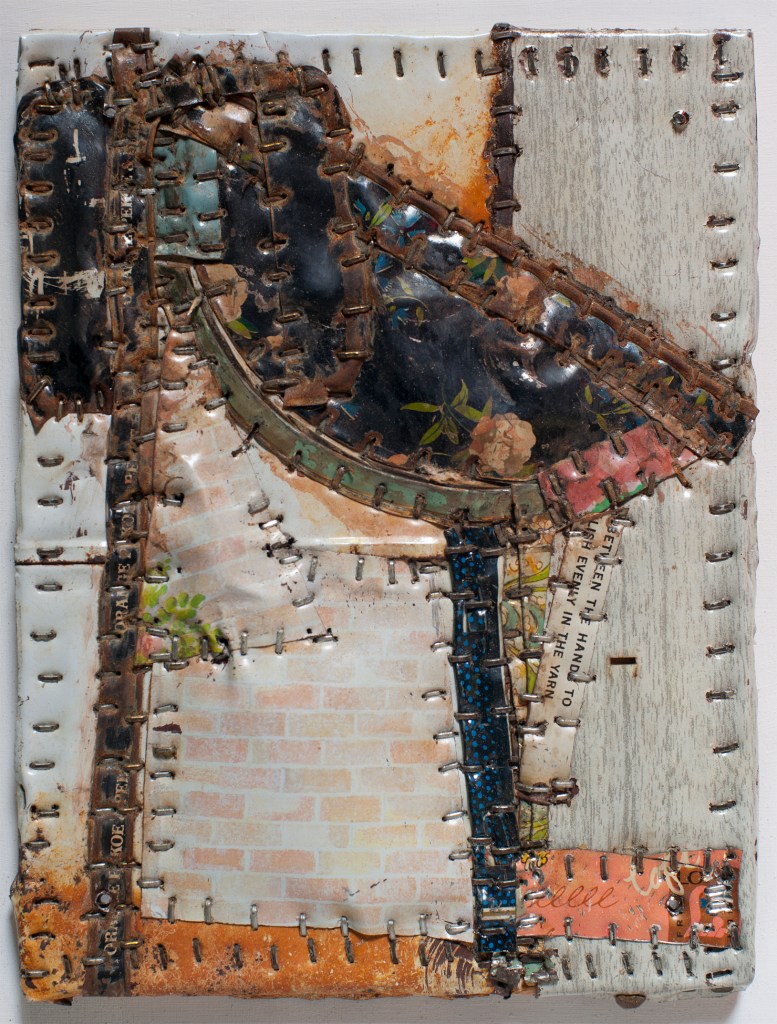
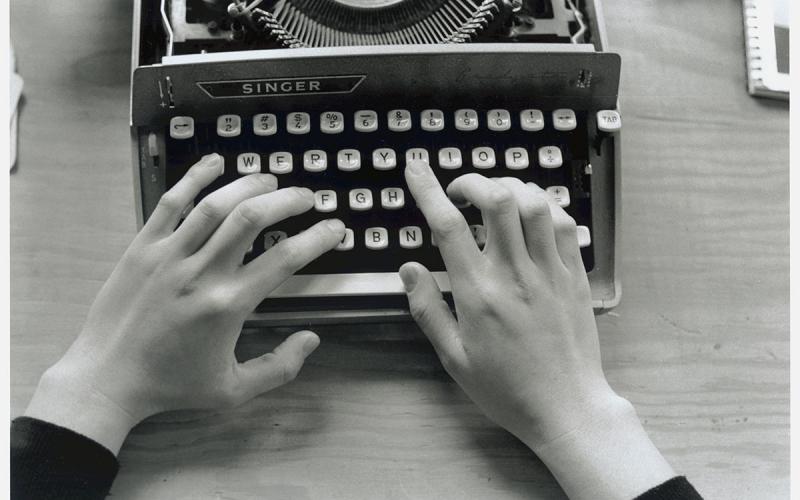
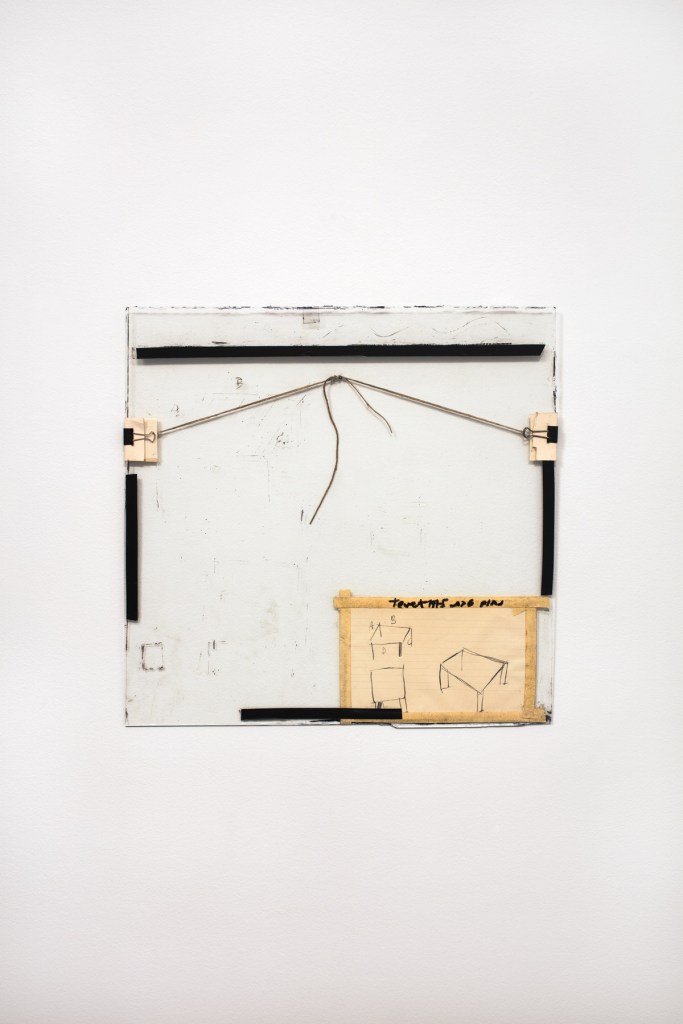
Move all the way to the right-hand side of the wall. An object painting made of scraps and wood and painted white. It was painted by Solonga. She constructed it in 1989. Beside it hangs a tiny photograph of hands by Cha, close to the wall in its tiny invisible frame. We think these might be Cha’s own hands, long and spidery her fingers paused in medias res and hovering before the keys of a Singer typewriter, as in her short film Permutations, where we think the face we see must be her own, so the hands might belong to someone else, her younger sister Bernadette. The line divides in two.
One step right from the desk. Follow the single line.
The sound instrument is made from two pieces of flat box-shaped wood, with a hinge at the center.
Two lines with space between. But if you were to weave them dense. Another other line. And so much else. For there is not a center. And all of it is full. Look at you here.
Banner and banter and not a lot of verse, reverse. White lilies and the daffodils that look at you whenever you go out. Each pew holds nine. So sit there quietly. The next verse. And then back to the first. Until it begins.
And it begins. Here. Again. From afar.
She is interested in the burden of history.
I write. If I am not writing, I am thinking of writing. I am composing. Documenting. Recording movements. Movements I record and also choreograph. That is writing. That is composing. Near black ink drawing a line over a pulpy sheet. Flooding what will come and stopping as the drought sets in. The dryness of the heat over the bones. Wet made fleshy and precise. But there is no sign of flow.
Something of the ink resembles Marta’s face. Others when possible. Scratch to imprint. She pushes hard the cotton square against the mark to make another book. One of Marta’s treated New York City guides. Apparatus as well. And a beam of light shoots out into the dark. Made filled. Sand. Its body’s extension of its containment.
The stain begins to absorb the material spilled on. And a line splits in three. Theresa, Marta, and myself. Collect the loss directly from the wound. Contents of the others seeping outward. I can hear the children laughing in the rain. The laughter dims. The commas and the periods. Ways of pausing. Being silent. Pages and pages. A little nearer. Advent.
Cha was not only a writer and a filmmaker and an artist, she was also an anthologist; although, of course, a good anthologist, someone who understands, who is sensitive to the gaps between texts, who composes speech as well as silence, is also, by necessity, an artist.
The medium or the mediums I will use depend on the requirements of any given work.
There was no firm distinction between Cha’s visual and linguistic practices.
In a 1981 summary of her work, Cha wrote that she had been working as a visual artist and writer since 1972.
To address and to incorporate the apparatus.
This year that I was born she was beginning. This book conceived as a collection. Autonomous works. A plural text. Revealing. Reveling in. Unraveling the process.
I hope this book in its totality.
She is interested in the burden of history. Apparatus. History as a movie projector. But without the speakers. History as a machine. But without the sound. It is a reading of gestures. Or so is one conception. Cinematic. Theresa Hak Kyung Cha coming to New York from San Francisco. She is editing a new anthology to be released by the Tanam Press in 1981. She reaches out to Straub-Huillet for something to include. She is interested in history. In language and the moving image. In words that can be sourced and made collage. In photographs and human gestures that can be made to work with symbols. She takes images and words and makes them dance across a screen. They are about her life and they exist but they do not point. They are a kind of mute dictation. Dictée
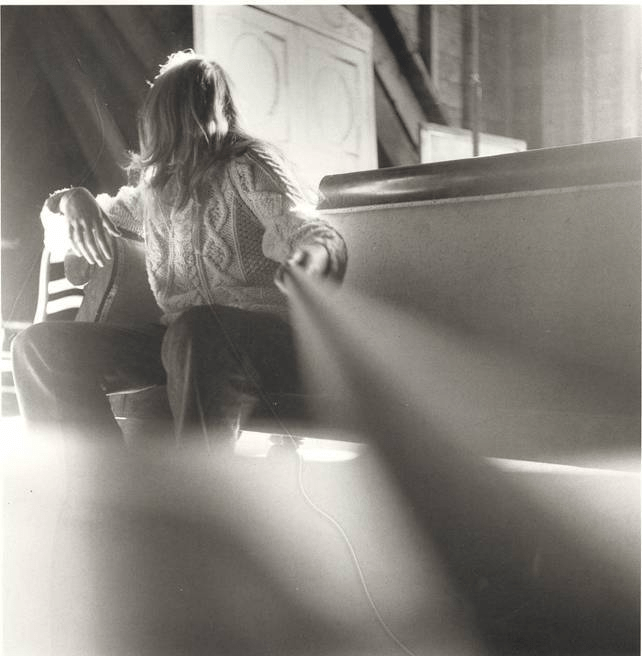
Francesca Woodman, Self-Portrait at Thirteen, 1973
She filled old ledgers with her scratchy handwriting, ‘pirouettes of speech,’ playing with language, ‘Steinwriting,’ as she called it. A ‘just-breath summer,’ ‘sand thoughts all from sea,’ ‘ grey monotones and fog.’ Sometimes writing in her journals in the third person. Her attitude toward her photography – dire, urgent, passionate – full of insecurity, self-doubt. In many of the entries there are notes on photos she plans to stage. It is 1973 and ‘I think when I get home I should take pictures of objects: purse, hand, etc. “clues to a lost woman.”‘ To scour her pictures – playing dress-up, staging photos – the performative nature of her work. Among stained, peeling walls she seems to dissolve – animal furs and plants blurred or obscured, glass shards, a careful arrangement – in a darkened corner. She might like to edge out of the frame, leaving only fragments of herself, the boundaries of pictorial space, Woodman preternaturally gifted. She becomes her own specimen, crawls into a curio, Three Kinds of Melon in Four Kinds of Light, pushed. She became fluent in Italian. Read all of Proust. Listened to Bach. When she was a girl her father gave her an old Yashica camera. Self-Portrait at Thirteen, sitting on a bench, a bulky cable-knit sweater, her face behind a curtain of hair. A charming eccentric who spoke in a quick, high-pitched voice, donned theatrical ensembles and rode a beribboned bike. A penniless artist in a cold-water flat in New York’s East Village. At odds with straight photography. The quiet act of solving photographic problems. She filled the studio with props. A dissenter of form. To create contrived, dramatic situations. Not moving, to exhibit her work, her career – she was still experimenting with technique and composition – fast enough. Loss and longing. Longing that was loss but never lost. A career of less than a decade, infused with — printed, a year after her death – Some Disordered Interior Geometries. Pictures fielding poetry, diary entries, handwritten notes.
Flowers optimistically going to seed producing it in fragments It is midday in the sentence and the blue is sky all high Reason in sentences and blackbirds determined What is Greek swarming into pattern part of a field isolate changing colors, the walls of a room the big chance for each How succinct! with time supporting action swim it does unscrolling cover warm and flat my eyes doubtful chalk draws the milk line differently an inner one aloud and slowly (face to face) as if pants and sweaters sunlight on clouds loosing of it flawed unwarranted you’re exposing exposedness perspective in getting arranged blurted slowly and must be read clockwise weary of earshot for what will come next happily we go when it departs


 marginalamericannotes.com