This was a preparing-for-writing project Making a novel out of notes An indirect manner of proceeding It’s all of it in the not-knowing It has to do with notation To build it out of notations taken from my research and my life A daily practice of notation My past, it’s in the mist, what is intense is in the now This moment of writing Noting it down Note-taking with a pen Taking notes (or is it making them? Making notes? She wonders this sometimes) The status of your notes as writing What did you note down today? What did you pick out? Choose to preserve? How to pass from the notation to the book? Connecting, linking up, stitching, stretching fragments? Small stories she has developed from her notes Connections indicated with a piece of thread blue thread and green returning to a kind of art project To do away with parts of the work, to ruin it if necessary, in order to make it live (inside) these spacings empty moments between notes breaths, caesuras, openings that structure spots or moments [the prose is presented in columns] I put myself in Uwe Johnson. I am Uwe Johnson. I no longer merely write about Johnson. I am Johnson. So long as I write, he is I, and I am he. I think of the scene and I can see myself writing chronicling my process as a part of my work as my work testing it out identifying with him an association of practice new work made from her distortion, her mistakes It’s a way of doing research investigating into making as an act of making of practicing her gestures (Woodman’s gestures? Nasreen’s gestures?) in your own as loving extensions of these gestures this research (always) in process
Cay’s death was not surprising. Extremity and death hung around her and fed the work. She took on Akhmatova’s signature haircut. As she speaks, three or more different ideas often find themselves in one sentence. She layers her words like her work layers paint over text, over fabric, over wood, or like the interview tape layers her voice singing above the expresso maker, nearby conversations, and all the other noises at the coffee shop.
I’m charged, I guess. It’s a painter’s energy. Nothing but needles and broken glass. Her work is very personal, and it’s not difficult to see that she prefers a private life.
Bahnmiller is extremely well-read and collects all kinds of texts—books, poems, philosophy. If I read it over and over, it becomes a painting. Her first show was nothing but a study, paintings and blueprints, very Bauhaus and severe. My palette was very cement-like and gray and earthy.
Her childhood stories pervade her works and persona. Ercilla, who helped her develop multiple language skills, a love of local parks and museums, and encouraged her creativity. It can get confusing no matter how well you know her biography. It glows in the dark and has music. ‘Sweet Dreams.’ She remembers that her nanny had to sit next to Adolf Eichmann on the bus before he was caught in 1961. It just doesn’t seem to be a memory. It was a matter of, I’ve always made things and I’ve always written. Her work calls out injustices. I find that most of the world isn’t sensitive enough.
Quotations are from pages she dog-eared and underlined—often writing ‘Imp.’ On trees as bare as calligraphy. One form of this poetry of space—apart from the poetry that can be created by combinations of lines, forms, colors, objects in their natural state, as one finds them in all the arts—is the language of signs.
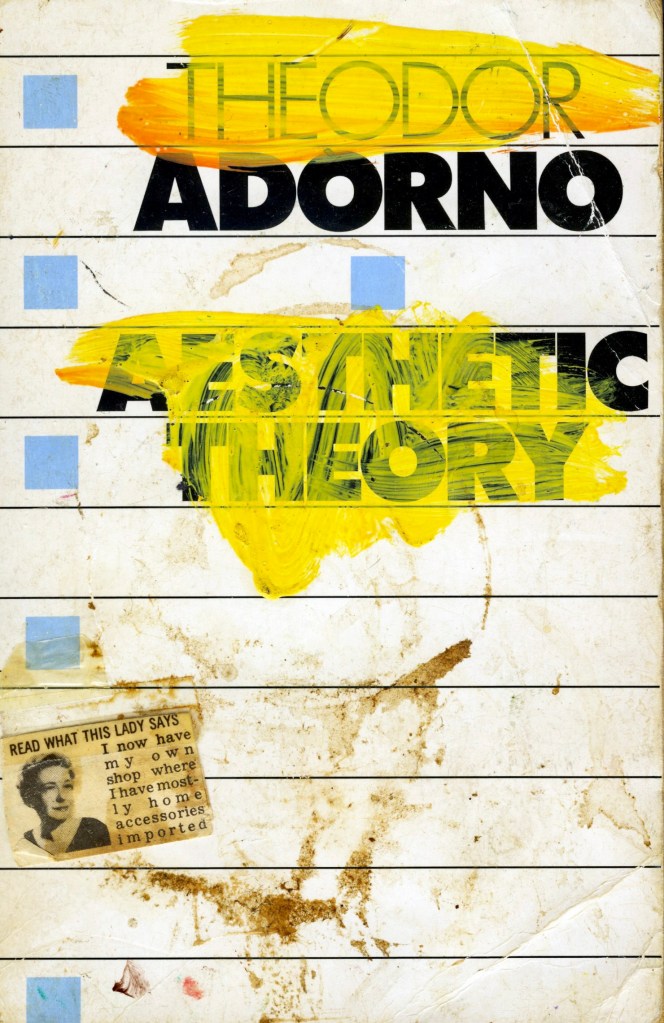
Bahnmiller painted the covers of her favorite books and talked on the telephone nonstop. She was a bricoleur and scavenged from the streets and thrift shops. This work is the archeological ruin of Detroit, a city steeped in sedimentation of light, or as the architect Louis Kahn wrote, ‘spent material.’
The stark absence of an ‘outer’ world necessitates the imaging of an interior—Dickinson’s ‘Bright absentee.’ Several years before her death, she began giving away books, rolling pins, artwork, artifacts.
Her talents were bound up with dark emotional social and urban forces she couldn’t control. I have nothing to hide. I was raped thirteen years ago. Besides almost losing my life and having my back broken, to have the man that did it walk. Sometimes, justice is bought.
She saw the book as a container for everything. She held poetry, along with the late novels of Henry James, above everything else.
Five years to regain a bit of the life I once had. To go back to dreams. Intense summer heat . . . HOOPS, MED, obsession, WHITE HEAT, MEN, the lack of fear to anything. The desire to go fast, to speed in a car, run, fly . . . at the blue tarp.
The decision to be a painter was one I never made. It is what one always was and is. Locating, placing, documenting, establishing, grounding oneself. Color Xeroxes, notebooks, drawings and paintings result from investigations of specific areas. The thorough quality of observation and documentation. It was an investigative and conceptual project she never really left.
Over the years—fatigue of writing, of being witness to oak trees and birches and new paths. Beat against the sobbing les maudits of yellow skin possibilities, late November sunlight not unlike Eluard’s light.
And I lose her like a little sunlight in cold water. Men shout, Hammer. And I see her suffer. And I see her light.
The last time I felt such Peace, my life was taken from me.
I was too afraid to begin taking pictures from the street, so I began to take some pictures from Solonga’s windows. Through her windows, inside out inside Solonga’s loft. Unconsciously, I began to relate my photography of her apartment and possessions to those photographs I’d taken back in Amsterdam before departing for New York, those pictures taken of those homes and objects belonging to those people, those many people, who had died without any known friends or relations, those people who had died alone. Although, presumably, Solonga was still very much alive and would be returning at some point, some future point, and thus reclaim possession of her surroundings and her things, perhaps sometime next year, as Geert said possibly was probable. There was a stillness all around me that infused, or seemed to me to infuse, my images with loss, with death, with incalculable absence, impossible decrepitude, something archaic, something permanent that I could not exactly articulate in words, something that I felt, could feel, felt now, but that my images were presently beginning to lay out before me, allowing me to see in ways the naked eye could never capture, the clicking of my camera always signaling a rhythmic pause in my looking, an ocular breath, a caesura not dissimilar, at least in my perhaps not completely balanced imagination, to Emily Dickinson’s signature dashes, signaling a kind of pointing that was not a pointing, something like Gertrude Stein’s carafe, that is a blind glass, a seeing only darkly what escapes the naked eye, but something seen, nonetheless, and what is the naked eye if not the eye stripped back of its intuitive intelligence and wonder, so it’s a seeing now infused with intuitive intelligence and wonder, something that my mind could never figure, at least not without killing the image first, and stuffing it in words that poison it before it ever breathes.
And what exactly is this breathing but a flicker, something going in and out, something perhaps autoerotic, going in and out of itself, as I look at my images of these postcards, these framed postcards hanging over Solonga’s bed, sent to her just a few short years ago by the American artist Ray Johnson, shortly before his highly performative, very real, yet seemingly staged suicide in 1997. He jumped into the sea and died. And his art is now around us. And it is equally mysterious, equally hermetic as the artist’s death. He died alone, which was his choice. Exactly as he’d lived. He dived and died and lived. He is living now. Here. Inside these images of postcards that he sent.
The images get closer to the words than can the eye. The images of words making words into these images. Sequestering them in plastic. An image of an image of America’s sweetheart, Shirley Temple, done up in cap and matching outfit, seemingly in leather. She seems to look directly at the viewer. And pointing down above her from the left there is an upside down bunny head, one of Johnson’s signature bunny heads, with the name of the American artist and critic, John Coplans, and the date 10.25.86 written also upside down beneath it, nay above it, on the card. A shapely naked beach bum with his back to us before her. And there is a long upside down toothbrush with its bristles positioned to the left of his private parts. Private parts remaining private. Out of frame though inside the frame (but hiding). Parts that can’t be seen but only imagined. Only Shirley Temple seems to be arriving at a closer look. And we arrive at her arrival and depart.
There is no greeting of Solonga here. There is no signature. But only images of images for her to look at, ponder over, possibly interpret. It is a confluence of images he’s packaged as a thing. And Solonga liked it well enough to hang it up above her bed. Perhaps this image of the beach bum with his backside in her dreams, the way this image has begun to fuse itself into my own. Beaches, imaginary beaches, beautifying city in my dreams. A backside so different, certainly, from those images John Coplans took of himself and made, in the 1980s, into a series of photographs. Garish black and white images of a not so healthy middle age. A masculine frontality that unpleasantly confronts the viewer, and unlike the shapely naked beach bum on the postcard sent by Johnson, leaving nothing to the imagination. Stripping the imagination. There is nothing for Shirley to look at and for us to imagine. These photographs are death. I look at them and I see death.
Ray Johnson put together a book about death between 1963 and 1965, a book consisting of thirteen unbound pages, a book he titled A Book about Death, whose first page spells out its title as ‘A Boop about Death.’ In ‘A Boop about Death,’ says William Wilson, possibly Johnson’s most perceptive commentator, ‘Ray did not want handwriting or print to be so transparent that the surface could be read for content, and then discarded after it had served its purposes.’
Perhaps Ray Johnson saw death when he sent this postcard to Solonga, this postcard with its upside down bunny head pasted in, and floating above–no, actually below (though actually there is no ‘actually’) John Coplans’ name, for here up and down have been made literally and figuratively the same, as equivalent as life and death.
I take my final image of this postcard and I sip my tea.
I’ve been reading the first sentence of the final section of Calamities, and I can’t seem to get past it. It calls on me to follow its trajectory over and over and again, and I do, instead of simply moving on to what comes next. I can’t move on to what comes next. I’m stuck in its loop. This loop of seeing and of hearing and of thinking inside the sentence, of writing the last of it without knowing it’s the last of it, but also growing joyous and carefree along the process, of being at the end without a knowing of this being at the end, or finishing something while being swept up along a line of thought, a line becoming more and more abstract, a line becoming literal, and following the movements of this line the way one would a curve in space, or, much too aptly now, with my hand across a sheet, enfolding a movement with a line of pen, and a possible surge into a kind of structure, precise and alphabetic, and anonymous as well, all without really saying anything at all, or saying what I’m saying without words, or merely writing.
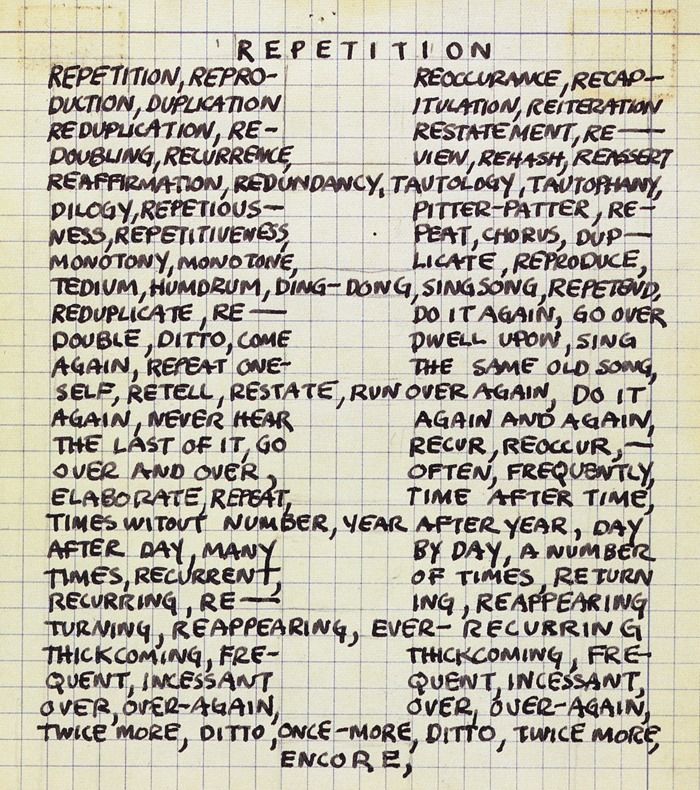
Repetition: A Portrait of Robert Smithson by Mel Bochner
These are plans. She is making plans. The sharpness of her plans. Plans for her next project. Plans for her first book. Plans for People Who Died Alone. Though it is not the photographic project by that name, but the book that she is planning, but the book which is borrowing its title from that just completed project. Borrowing from herself this title and making it a part of her plans. An integral part of her plans. One might say they are photographs as well, or will be photographs as well, but only, strictly speaking, metaphorically, as they are word photographs. They’ll be word photographs. These are her plans. The plans she plans to configure, for the book she plans to write. Planning it now. Here. In New York. Now. While she is staying in Solonga’s flat. Or is it loft? Plans hatched inside this loft belonging to a Danish sculptor named Solonga. She writes through other people. Other artists help her do her work. Other lonely people. Solitary people. Artists like herself. People other than herself and yet somehow herself. Somehow herself. They are themselves and yet herself at the same time. They are herself and they are themselves at the same time. She is herself and she is them at the same time. It is always the same time. The time of reading. The time of writing. It is a kind of compounded I that she is making, a we that she constructs. Falls into. Once I know I’m here, even if I am not here, even if I am there, I can move on. Move on with my thinking. Move on with my writing. Move on with my life. With my life which is an other life, another life here in these words. These words that are not in Dutch but are in English. She has gotten accustomed to thinking in English, to feeling in English, to reading and writing in English. She is deterritorializing her thoughts by putting them into words, inside words, in words, that aren’t, or were not originally, her own. And like many of her subjects she is a guest here, she does not belong here (she does not belong anywhere – not really), in New York, though she is staying here for herself and for her work for a time, if only for a time, a certain time, for quite some time it seems, probably for quite some time it seems as Solonga will likely not be coming back anytime soon, as her friend who got her this apartment, who made it possible for her to inhabit this apartment, to stay inside this loft, her Swedish friend, her close friend Geert, said that Solonga would likely not be coming back for at least a year, or more than that even, more than a year in fact, maybe two, maybe three years, so it is yours until then, she said, it is mine to live in and to work in until then, whenever then turns out to be, even if then turns out to be now as it is always now when I am writing, when I am planning to write or thinking about writing. Now even when it’s then. It is now and I am here. Wherever here is. On this page. And this is something that I know as I proceed to make my plans. To plan as I often do when embarking on some new artistic project. Planning, as my parents have often said, is a forte of mine, using that word, that word forte, conspicuously, even though when they were speaking to me they were speaking to me in Dutch, as they usually, though not exclusively, not always, as sometimes they speak to me in English, speak to me in Dutch, which is, after all, their native, and I suppose, my native as well, tongue, unlike English, which is a tongue that is not my own tongue, but a foreign tongue which is now inside my mouth and slowly, ever so slowly, and deliberately, perhaps overly deliberately, haltingly perhaps, beginning to speak.
I saw Vija Celmins this morning delivering a talk on Agnes Martin at Dia. Vija talking about Agnes, Vija thinking about Agnes, Vija looking at Agnes and meditating about Agnes, and trying to talk about Agnes’s work. This Vija talking Agnes really thrilled me.
Vija often calls painting, she says, evidence. I call painting evidence, says Vija.
She saw quite a bit of Agnes in New Mexico. She says that Agnes talks of visions. She talked about a film about Agnes, With My Back to the World. Even though Agnes is twenty-six or twenty-seven years older than Vija, they both, says Vija, were influenced by Abstract Expressionism.
One of the ways that Agnes talks about her painting, she says, is through, what Vija calls, a Zen Buddhistic talk.
She’s a feisty ornery woman, says Vija, adding, and perhaps these are my own inventions, but the refinement of the art process via Reinhardt, I think that must have been an influence.
There’s no ego, she says, in Agnes. Facing what there is through the practice of sitting. Meditation. A receptiveness. And she was very savvy, she says, about pursuing her painting.
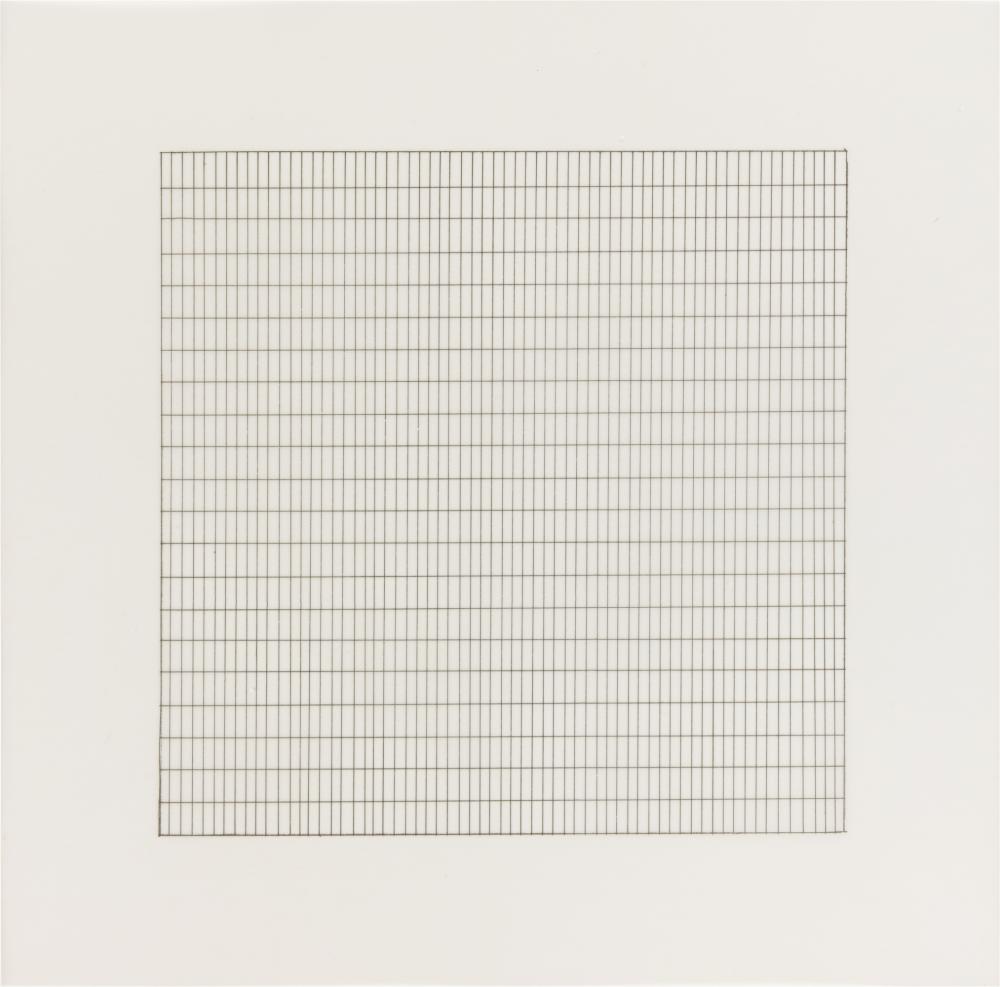
She came to the grid, and to the square, she says, which is very emblem-like. Most of the time though, she repeats, she says, a rectangle inside the square. Rectangles are repeated. Rectangles are repeated. She repeats her rectangles inside the square. This is an aspect of her work.
But unlike Agnes she went back, Vija says about herself, to confronting the image.
The first time that she saw Agnes’s work, she says, it must have been about 1965, she was so unconscious that she doesn’t remember a thing about it. Not a thing. Unconscious to what Agnes was doing she was, as she had come from Indiana. She just couldn’t see it at all back then.
But now she sees that Agnes explored the surface with her lines. And that they share a love for the field, a love for the picture plane, she says.
She says that she, Vija, in referring to her star field paintings and her star field graphite drawings, picked an image that described a surface. I had to do, still do, like Agnes, with very still images.
Though nature crept in, she says. Nature crept in. And then she talks about her sets of stones. Her funky funky stones.
Agnes is a great driver, she says, and she likes the plane, to talk about the plane, driving over a hill and seeing this plain in front of us. And she’s from Canada, of course, she says, and she talks about discovering this plain and saying, and having one of those moments of inspiration, as if the plane, as if the plain somehow freed her. The plain is echoed in her work.
My space is more than just a flat-board space, she says, and Agnes’s works are freed of struggle. She sits, she says, and waits for inspiration, and I understand it.
Agnes says, she says, that there is no image in her work, no memory, no space, no structure, and that the work is about beauty and perfection. And she does say that composition and scale are important, she says, as we can all see when we see her work so very exquisitely composed.
Fire, there can be fire in Agnes, Vija says, but she doesn’t let that come out in the work. The work, and we can see this from these slides that Vija is presenting, is serene. Not fiery or chaotic. Still and gentle like a stone worn smooth.
The way I talk about painting, Vija says, which is very difficult really, is, I always say, she says, I try to build a very full form, a form that’s extremely realized, and I think that it sort of occurs when there’s a balance between that awareness of the depth and a very concrete awareness of the flat structure which will hold that image in place. Hold it somewhere else. And so, I work, she says, unlike Agnes, with those two spaces in my paintings. She would never.
But we have tactility, tactility in common, yes. The feel of it. You can feel yourself.
Agnes says it’s composition, but for me it isn’t composition at all, but a concrete form. And these feelings that we feel for them, these feelings that we feel when we’re before them, standing, these feelings are, in the end, I think, she says, all about love.
I think my own work, she says, like Agnes’s, is quite restrained. I think it’s well, my own feeling about it, is, that my work is quite closed, and doesn’t let, really, people in. It’s not accessible and has quite a remote feel. My work, she says, I see this, is remote. I don’t reveal myself, and there’s no politics.
Agnes seems to feel and think that she is making meaning, but I’ve been having doubts, she says. I’m having doubts. With Agnes there’s no doubt. I don’t know what Agnes means, she says, when she says she’s making meaning.
My work, Vija says, is like a fingerprint. All these tiny nuances. While Agnes’s work is more visionary, and abstract, and moral. There is something in her work that is extreme. These delicate pencil lines, stumbling a little bit, awash an abstract breeze that has been stilled. Somehow stilled. Amazed.
I love her untroubled mind, Vija says, shortly before concluding with the rambles of her talk, in shot quotations from Agnes’s writings. Don’t be afraid to be alone. And solitude. And wait. And wait for inspiration. Wait. Don’t do busy work. Never do busy work. Wait. But wait. And be emotional but try detachment. Detachment is related to freedom. It’s dangerous to be secure. And inspiration is what takes us by surprise.

 marginalamericannotes.com