
I saw Vija Celmins this morning delivering a talk on Agnes Martin at Dia. Vija talking about Agnes, Vija thinking about Agnes, Vija looking at Agnes and meditating about Agnes, and trying to talk about Agnes’s work. This Vija talking Agnes really thrilled me.
Vija often calls painting, she says, evidence. I call painting evidence, says Vija.
She saw quite a bit of Agnes in New Mexico. She says that Agnes talks of visions. She talked about a film about Agnes, With My Back to the World. Even though Agnes is twenty-six or twenty-seven years older than Vija, they both, says Vija, were influenced by Abstract Expressionism.
One of the ways that Agnes talks about her painting, she says, is through, what Vija calls, a Zen Buddhistic talk.
She’s a feisty ornery woman, says Vija, adding, and perhaps these are my own inventions, but the refinement of the art process via Reinhardt, I think that must have been an influence.
There’s no ego, she says, in Agnes. Facing what there is through the practice of sitting. Meditation. A receptiveness. And she was very savvy, she says, about pursuing her painting.
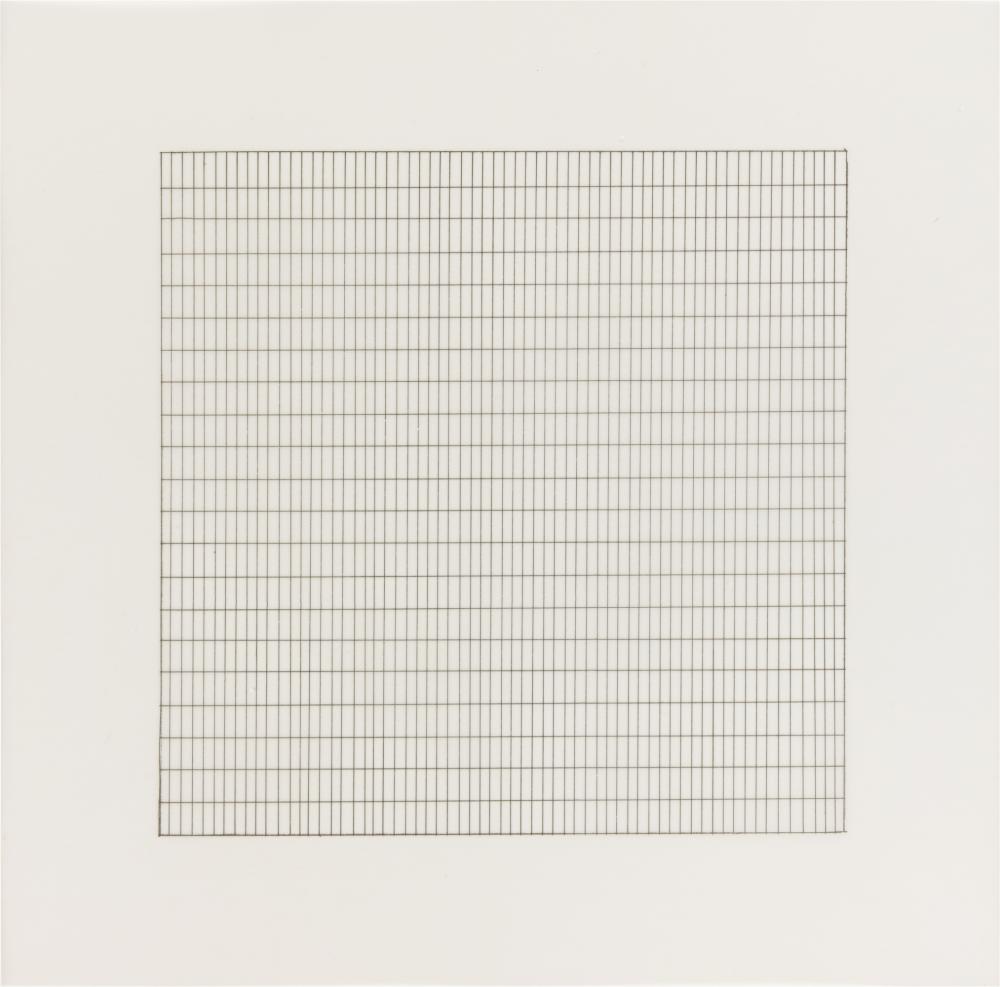
She came to the grid, and to the square, she says, which is very emblem-like. Most of the time though, she repeats, she says, a rectangle inside the square. Rectangles are repeated. Rectangles are repeated. She repeats her rectangles inside the square. This is an aspect of her work.
But unlike Agnes she went back, Vija says about herself, to confronting the image.
The first time that she saw Agnes’s work, she says, it must have been about 1965, she was so unconscious that she doesn’t remember a thing about it. Not a thing. Unconscious to what Agnes was doing she was, as she had come from Indiana. She just couldn’t see it at all back then.
But now she sees that Agnes explored the surface with her lines. And that they share a love for the field, a love for the picture plane, she says.
She says that she, Vija, in referring to her star field paintings and her star field graphite drawings, picked an image that described a surface. I had to do, still do, like Agnes, with very still images.
Though nature crept in, she says. Nature crept in. And then she talks about her sets of stones. Her funky funky stones.
Agnes is a great driver, she says, and she likes the plane, to talk about the plane, driving over a hill and seeing this plain in front of us. And she’s from Canada, of course, she says, and she talks about discovering this plain and saying, and having one of those moments of inspiration, as if the plane, as if the plain somehow freed her. The plain is echoed in her work.
My space is more than just a flat-board space, she says, and Agnes’s works are freed of struggle. She sits, she says, and waits for inspiration, and I understand it.
Agnes says, she says, that there is no image in her work, no memory, no space, no structure, and that the work is about beauty and perfection. And she does say that composition and scale are important, she says, as we can all see when we see her work so very exquisitely composed.
Fire, there can be fire in Agnes, Vija says, but she doesn’t let that come out in the work. The work, and we can see this from these slides that Vija is presenting, is serene. Not fiery or chaotic. Still and gentle like a stone worn smooth.
The way I talk about painting, Vija says, which is very difficult really, is, I always say, she says, I try to build a very full form, a form that’s extremely realized, and I think that it sort of occurs when there’s a balance between that awareness of the depth and a very concrete awareness of the flat structure which will hold that image in place. Hold it somewhere else. And so, I work, she says, unlike Agnes, with those two spaces in my paintings. She would never.
But we have tactility, tactility in common, yes. The feel of it. You can feel yourself.
Agnes says it’s composition, but for me it isn’t composition at all, but a concrete form. And these feelings that we feel for them, these feelings that we feel when we’re before them, standing, these feelings are, in the end, I think, she says, all about love.
I think my own work, she says, like Agnes’s, is quite restrained. I think it’s well, my own feeling about it, is, that my work is quite closed, and doesn’t let, really, people in. It’s not accessible and has quite a remote feel. My work, she says, I see this, is remote. I don’t reveal myself, and there’s no politics.
Agnes seems to feel and think that she is making meaning, but I’ve been having doubts, she says. I’m having doubts. With Agnes there’s no doubt. I don’t know what Agnes means, she says, when she says she’s making meaning.
My work, Vija says, is like a fingerprint. All these tiny nuances. While Agnes’s work is more visionary, and abstract, and moral. There is something in her work that is extreme. These delicate pencil lines, stumbling a little bit, awash an abstract breeze that has been stilled. Somehow stilled. Amazed.
I love her untroubled mind, Vija says, shortly before concluding with the rambles of her talk, in shot quotations from Agnes’s writings. Don’t be afraid to be alone. And solitude. And wait. And wait for inspiration. Wait. Don’t do busy work. Never do busy work. Wait. But wait. And be emotional but try detachment. Detachment is related to freedom. It’s dangerous to be secure. And inspiration is what takes us by surprise.
And now she asks if we have any questions.
 marginalamericannotes.com