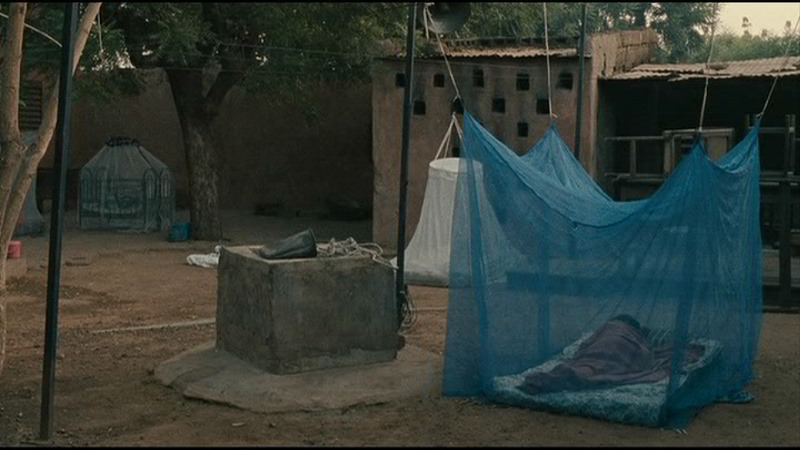
‘And to help someone hear, you have to give them space.’
Something that exists around, something that creates a distance, let’s one see.
‘lady, my things
water leaden
my maps, my compass
after all, what is the political position of stars?’
‘She was praised for the way she analyzed Aristotle’s definition of place in the Physics. Each thing exists in place. Each thing is described by place.’
‘In spite of this, there are many important technical advances in The Threepenny Opera. The curtain appeared to be nothing but a dirty sheet drawn across the stage. A fair-ground organ stood at the back of the stage, with a jazz band on the steps in front of it. Coloured lights lit up when the music played. Free use was made of titles and drawings projected onto screens in red satin frames on either side of the organ, and mock-religious signs were pinned on Peachum’s walls, such as, “It is more blessed to give than to receive” and “Give and it shall be given unto you.” By these means, the audience was persuaded to practise Brecht’s notion of “complex seeing.”‘
The newscaster, having just announced what is to come (the slated ‘feature presentation’), clearly troubled—eyes widening discomfort—as the camera does not cut away as scheduled, is forced to resume her pleasant smiling for the audience (the villagers are gathered here; they’re getting comfortable as nighttime comes, gathering before the glow of it—the set); clearly, her patience has been worn, she’s overtaxed beyond endurance by these awful awful (how absurd this is, how absolutely . . . unforgivable, how unprofessional, how backward) “technical difficulties” soon resolved with PRESENTS superimposed on a sub-Saharan landscape—a single picture-postcard—trunk and canopy—a tree rising (just above) the pleasant, calmly flowing waters (following a wide panning shot of the ‘set’, a medium shot of the man and his horse), underneath which (we can see him sitting: a tight shot, yes) Danny Glover (freeze the frame to show his name), every bit the movie cowboy, loading up his rifle, looking serious, a little troubled, deadly if the need for this should ever come (a black John Wayne, a black Clint Eastwood, Cary Cooper, Jimmy Stewart), every bit the star (the film within the film intends for us to notice this; we do).
And yet.
‘The next step we must take is to see in how many ways one thing is said to be in another.’
‘It is important to remember that Aristotle is not offering a theory of space. He hardly ever uses the Greek word for space, and his view of space is to be found in his discussion of spatial magnitudes. He is here offering a different notion of place.’
‘I have lived in the States, in New York, and in Europe—London and elsewhere.
You stress place, it seems.
‘Drawing equally from declamatory African traditions and European modernist procedures, Bamako stages a kind of Third World Epic Theater.’
I thought you wanted to know my history.’
‘That is why these have contact: it is organic union when both become actually one.’
‘Brecht’s stage was to be stripped of its theatrical magic, and the audience refused the state of emotional, empathetic trance, a degrading condition he associated with what he called “Aristotelian” theatre.’
‘It’s worth knowing that I called upon judges and professional lawyers and also real witnesses. I worked a long time with them. I decided what the framework of the proceedings was going to be like and then I let them put it to life.’
‘[A] young man testifies to how he and a group of fellow migrants barely survived crossing the Saharan desert, leaving one young woman [masquerading as a boy] behind. His testimony is sullen and flat and frankly rather dull by conventional movie standards.’
Heavy, red, streaming dye into the gutters, a lengthy piece of fabric curtaining the screen, hangs.
‘Sissako textures these dense, splendidly performed monologues with lyrical interludes and harmonizing mini-narratives,
‘He also fleshes out the film with a few scripted story lines, which he called “attempts to maintain the viewer’s attention.”‘
‘Mele is a bar singer, her husband Chaka is out
of work
and the couple is on the verge of breaking up
In the courtyard of the house they share with other families, a trial
court has been set up. African civil society spokesmen
have taken proceedings against the World Bank and the IMF whom
they blame for Africa’s woes Amidst the pleas and
the testimonies, life goes on in the courtyard.
Chaka does not seem to be concerned by this Africa’s desire to fight
for its rights’
‘This narrative is advanced only intermittently and ends in a death as unexplained as it is shocking.’
snatches of daily life that supplement and underscore the meta-legal procedural.’
‘But then Sissako cuts elliptically to a re-enactment of the young woman left lying among the blinding sands, surrounded by scavenger beetles’—a shadowy white screen, spotty, tinted, irregularly black.
‘This film is linked to my desire to film in my father’s house, who has passed away . . .
‘Where the grandmother grafted the citrus [and] the graft remained staunch.’
It’s a plain house, made of earth.”’
‘Afterwards, I understood that I could perhaps go further if I gave up the idea of a single space, one theatrical setting.’
‘So the role of the western in this film is to create space.’
‘I wanted the lives of the people living in the courtyard to echo or interfere with the speeches delivered at the bar.’
‘It was impossible for me to imagine this trial anywhere but within a real living space.’
‘I fired at one and I got two!’ the black cowboy laughs.
And the children (laughing) watch.
‘So, I saw this western sequence as a metaphor of the World Bank’s or the IMF’s mission carried out jointly by the Europeans and the Africans.’
The cowboys, like the jurists who exist at the bar inside the courtyard, are superimposed, are simply placed there—grafted onto the land.
‘Even within our imaginations we are raped.’
‘Nightclub singer Mele and her unemployed husband Chaka are quietly drifting apart and pondering the future of their young daughter Ina.’
‘We used four video cameras and a sound recordist, deliberately letting them be visible on the screen . . . in the same film, we had professional actors and actual lawyers, judges and witnesses, people from the neighborhood, and members of my family.’
The film fiction, like the documentary fiction, unfolds side by side with village life.
‘Artworks that negate meaning must also necessarily be disrupted in their unity; this is the function of montage, which disavows unity through the emerging disparateness of the parts at the same time that, as a principle of form, it affirms unity.’
“At first these vignettes seem disjunctive, but Sissako returns to some of them, creating a visual rhythm, and from that a sense of space and place: a community constructed entirely by cinema.’
‘So the role of the western in this film is to create space.’
‘Why should the fate of a people depend on their ability to buy and sell abroad?’
‘Sissako’s primary skill as an artist is his ability to convey total worlds while maintaining a formal porosity that accommodates the displaced, the traveler, and ultimately the impact of the West.’
‘Negation of synthesis becomes a principle of form.’
‘Another mass product of Western industrialism, it has gone on a triumphal tour of the world, crowding out and defacing native cultures in one colonial country after another, so that it is now by way of becoming a universal culture, the first universal culture ever beheld.’
‘I’m stirred by the bluntness of Bamako’s address as a formal strategy and emotional effect, yet I’m nagged by the question of how it speaks to Africans.’
‘At one point, a couple of guys sitting outside a building reach up and turn the radio off, as the trial “is getting boring.”‘
‘I wanted to disappear into shiny, unreal objects.’
‘Speaking in a straightforward way is extremely difficult these days’
‘An elderly Malian man delivers his testimony as a mournful folk song.’
‘For me, we had to film the trial as one would a documentary: a scene couldn’t be interrupted, a witness wouldn’t have been asked to repeat a sentence and we let the court president and the lawyers listen to the testimonies and intervene as they saw fit . . . outside the trial, we chose a fictional scenario, with a shooting script, reverse angle shots, master shots . . .’
‘The hope is that by listening and failing to understand—by taking that profound ignorance on as our own wound—Western ears might at last take in something radically new.’
‘Sissako doesn’t bother with subtitles.’
Even the way the titles come up at the end of the western sequence (‘Directed by . . .’) after ‘something’ has ‘happened,’ after the audience has been absorbed into the scene, reeks of Brecht.
‘So the role of the western in this film is to create space.’
 marginalamericannotes.com