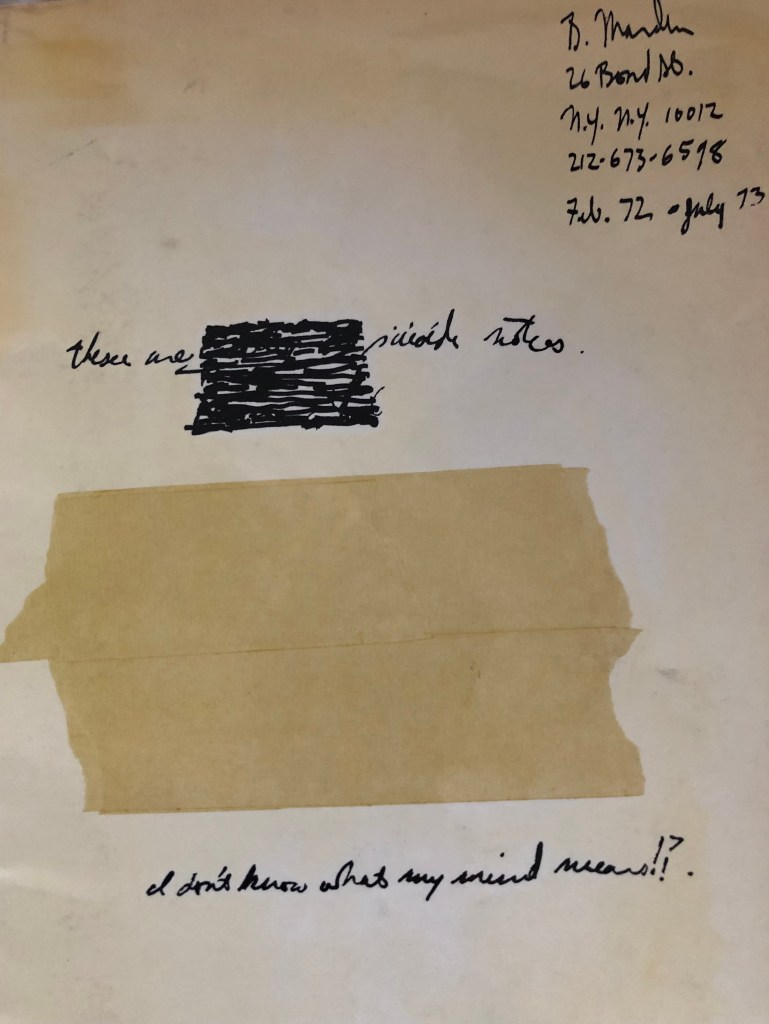
Notes on Mieke
She spends her time mostly alone, and after high school takes up drawing, then photography. She is interested in all those people who we see around us every day who live and die alone. She observes them when she goes outside, sitting in parks on benches, eating at a restaurant, carrying a grungy tote bag filled with food and papers as they cross the street, a rucksack on their backs as they enter a museum or a gallery, sitting in the very last row of a cinema watching a movie, wearing clothes that is slightly worn out but somehow nice as they sit beside her at a theatre or a concert, sit and read the paper at the library or a bookstore, sit beside her on a plane, their eyes are sometimes closed and they will never talk.
Notes by Mieke.
The photographs are not staged. They are what they are. And yet they are composed. A chosen angle, slant of light, a juxtaposition of textures, colors, objects given somehow leave to make, even if it isn’t speech, a kind of noise. I am responsible for how their lives will look, with how they’ll be preserved, perhaps remembered if there is anyone around who will recall that thing they took such pains to make in private, what we often label ‘lives.’ I try to draw an index here.
A woman found in an apartment down the street, dead she’d been for thirteen days. It was a waft beneath the door that moved a neighbor to get quickly to the phone, a waft that let the landlord in, and the police to find that she had ‘died in the bath’ and no one earlier to wonder where she was, to make a call, drop by, or knock. She lived there thirty years, so quoted in the Times, and no one even knew her name.
I have a specific relationship to newspapers. I am never able to read them for more than a few days in a row. But I don’t throw them away because I think I might still read the bits that I didn’t cover and the ones I didn’t read at all because I am sure there are lots of interesting things inside. By the time the pile grows larger than myself and falls over, I start negotiating to get rid of it because I get tired of restoring the pile each time a tram comes by and not having read the papers and adding more to it. The passing of time is manifested in the pile and I don’t find reconciliation.
Notes (some quotes) by Mieke
‘I like it that art is anonymous.’
‘Our dreams in the one life given to us
Have no boundaries, unlike this sky
We sought a heaven first,
And now discover heaven is empty,
Empty and yet crowded
Our offspring by our death will find new life there
We shall not see the purpose
We fulfill it
Outside the stars
And at the speed of light we arch across the void
Yet we seem motionless on a world, a grain of sand
Where time, a human construct,
Has stopped and died’
‘I think that all art could be anonymous so that you just look at the art, there’s no story.’
A Note by Lee Lozano
‘Finally I must say something about why I write in such small books. It is to encourage myself to maintain terseness.’
A (quoted) Note on a Statement by Ray Johnson
‘Taken from Johnson’s “work table” box. Johnson mentions this Yiddish-English dictionary several times in “Should an Eyelash Last Forever?” For example: “So I’m cutting these things out block by block and doing Yiddish dictionary information the way I did the American dictionary, which was long before Kosuth. I methodically went from A to Z and simply cut out these blocks of information and endlessly glued them down or attached them with Scotch tape.”’
A (quoted) Note about Ray Johnson.
‘Johnson at times used his Correspondence art to air what appeared to be very private messages.’
A Note on Magda by Mieke
That’s what she said as she cut and pasted notes and pictures (and there were also several drawings) onto the newest version of her guide to the city of New York and its life. Always reworking the pages, studying their surfaces with the fingers of her hands, looking straight into the chasms and then smiling, though this smile was but an automatic response, a reaction to the sweep of unspoiled air that breezed across her face and then flew by. It wasn’t like this anymore, she said, and this was good. Or at least it was fine. She accepted it. And shouldn’t that be enough? And it was enough. And she was right. It was the paintings and the rhythms of the words that really counted, as they fell backward, opened, and provided a place for us to sleepwalk into. This was, indeed, true, she felt. It was right. And she’d been noting things that linked them all together, both in marginal notations and her notes, for some time, tying their lives together like a string, stringing their deaths up on a line that you can walk along and post things, add things over, write on.
 marginalamericannotes.com